
The output went up.
Delivery confidence did not.
Your team adopted AI assistants and the numbers look good — more code, faster tickets, green dashboards. But AI does not know your security standards, your integration dependencies or your compliance requirements. This is not a case for banning the tools. It is the governance layer that makes their speed safe to trust.
Early Adopter pricing is locked for the first 21 days of launch in exchange for candidate feedback and real-world case study contributions. Standard enterprise pricing of $299 applies thereafter.
It is not that the code is wrong.
It is that nobody checked.
You cannot see where AI is being used. Developers, contractors and vendors are all using assistants with good intentions. None of it is declared, so none of it routes through your security, architecture or privacy controls.
Proprietary material is leaving the building. Source code, system architecture, customer data and sometimes credentials, pasted into public consumer-grade models by people solving a problem quickly.
You cannot verify what your vendor delivered. AI-assisted code, scripts and configurations arriving inside contracted deliverables, with no disclosure requirement and no review evidence attached.
Peer review quietly erodes. The output looks finished and confident, so it gets skimmed rather than reviewed. Fabricated references, wrong variables and insecure patterns pass through on presentation.
Volume rises on a weak foundation. Components built fast on top of an undocumented architecture. More output, more dependencies, and less confidence that any of it integrates.
The bill arrives later, larger. A flaw that takes two hours to fix in development takes two weeks to unravel once it is integrated and in production. AI generates that debt faster than any team ever could.
In a governed environment, speed is an asset. In an ungoverned one, unverified acceleration is just an illusion of progress.
Eleven files. A five-part audit.
And one number your board understands.
The AI Reality Check Master Guide
The Automation Trap, the Shadow AI problem, how technical debt compounds at machine speed, and the Human-in-the-Loop mandate — governing AI without slowing the team down.
The AI Usage Disclosure & Triage Checklist
A five-part survey you send to internal teams and vendors: tool and scope inventory, data privacy and compliance check, peer-review verification, acknowledgment, and governance routing.
The HITL Quality Gates & Review Templates
Three templates: the AI Output Governance Charter, the Bimodal Review Gate separating lower-risk from formal-evidence work, and a drafted SOW clause for vendor AI disclosure.
The Technical Debt Risk Exposure Calculator
Log the unverified output, estimate remediation hours and rate, and the Pay Down vs Defer sheet compares fixing it now against the multiplied cost of deferring past launch.
Project Nexus
The full governance sequence applied — the disclosure that surfaced the shadow usage, the gates that were missing, and the remediation decision the numbers supported.
The Audit Review Checklist
The condensed review sequence on five pages. For running the audit on a live project without working through the full guide first.
Usage Sequence & Authority Boundary
The order to work the package, and the limits that protect you — do not unilaterally approve, reject, block, deploy or certify AI-assisted output. Make usage visible and route the decision.
Single-User License
Licensed for personal professional use, with clear terms on what you can and cannot do inside your organisation.
Four moves.
None of them ban anything.
Governance here means visibility, proportionate review and a priced decision — not a policy that pushes the tools underground. Each move has a document behind it.
Send the five-part checklist to internal teams and vendors. Which tools, which use cases, what data went where, and whether any of it was peer-reviewed. Not an investigation — a baseline.
Not every output needs the same scrutiny. Track A handles lower-risk work at speed. Track B sends architecture, security, data and production-impacting output through formal review with evidence.
Log each unverified output, estimate the hours to put it right, apply a blended rate. "Poorly structured code" becomes a figure a steering committee can act on.
Fix it now, or carry it past launch at the multiplied cost. Both options on one sheet, with the assumption behind the multiplier stated and owned rather than hidden.
The principle underneath all four is one sentence: AI may assist, but a human remains accountable for validation.
What this page
doesn't show you.
Three pages from the
actual package.
Not mockups. These are real pages, exactly as they arrive.
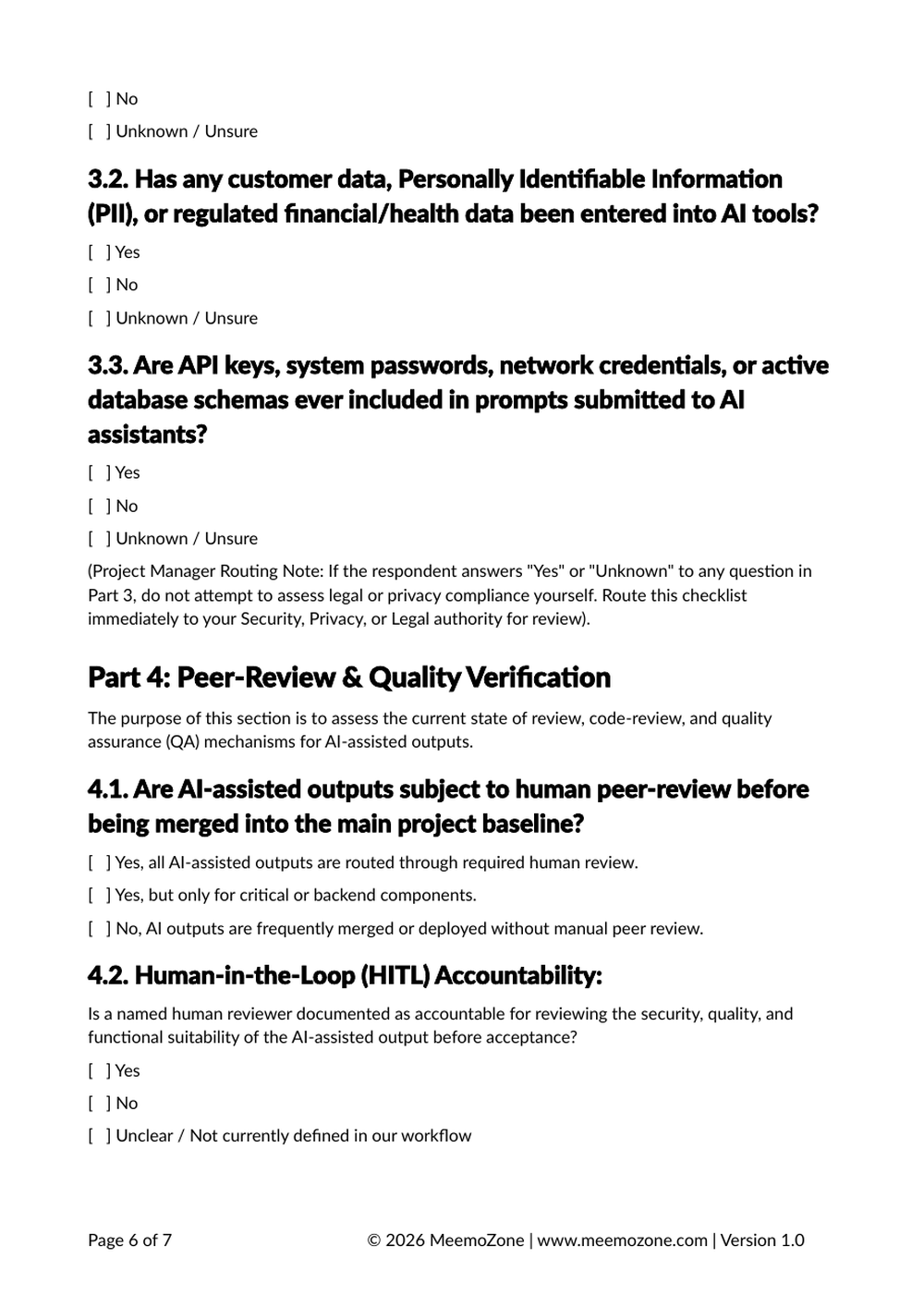
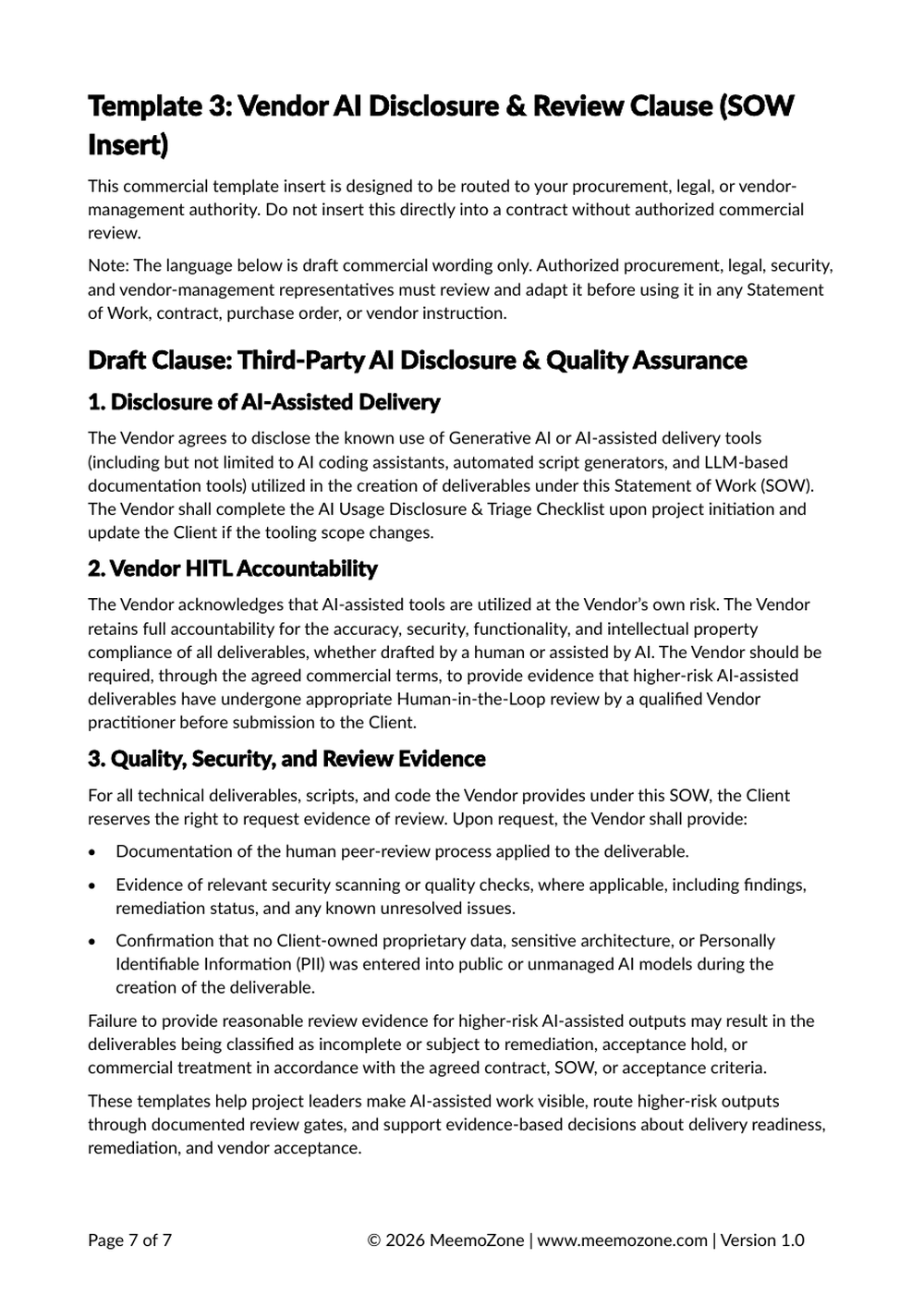
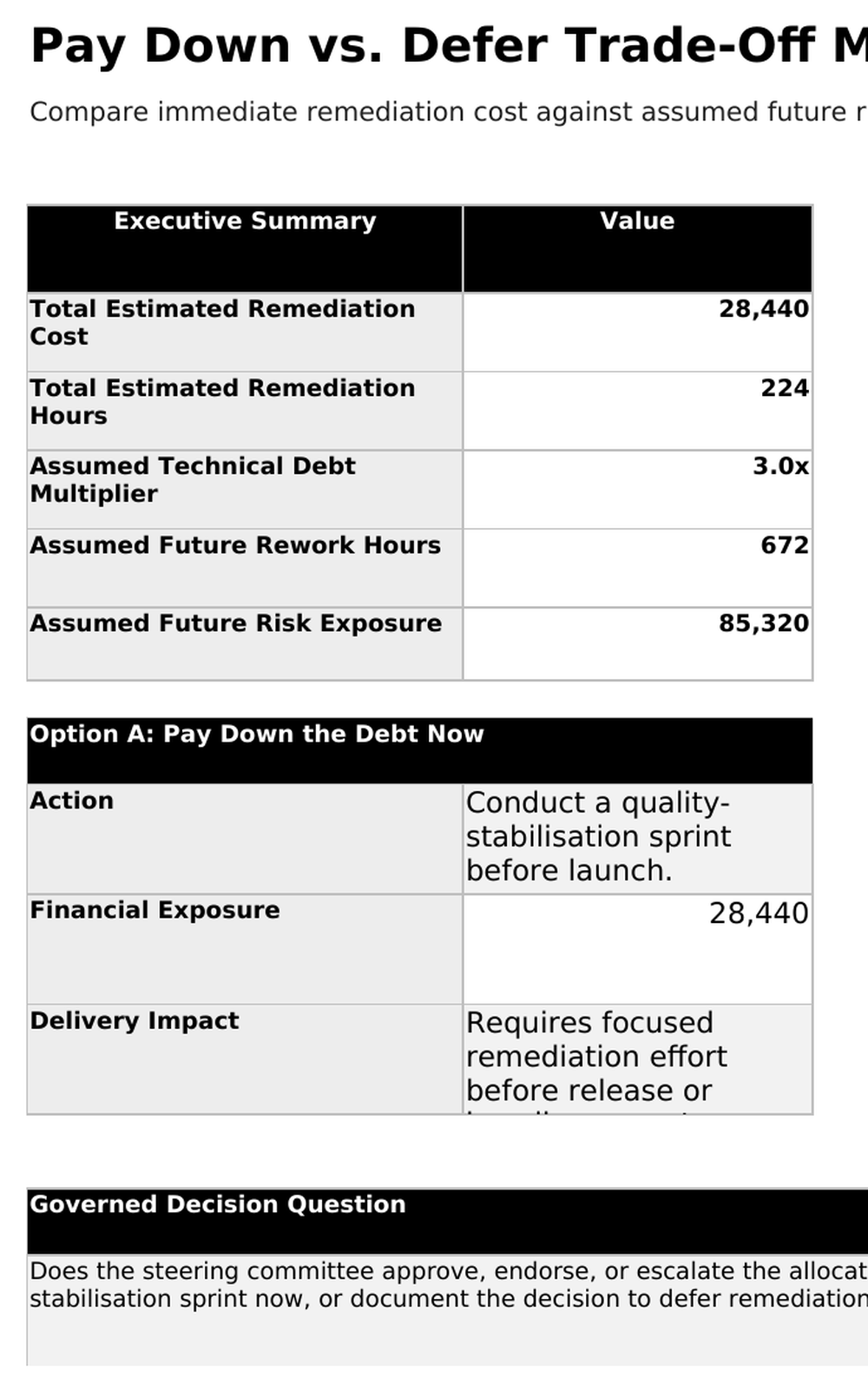
3 of 44 pages shown — plus the 6-sheet Excel calculator.
Executives do not fund projects because the Jira board looks tidy. They fund projects that protect revenue, reduce cost, and lower risk.
Nearly three decades in delivery. Eighteen years at Shell as an IT/OT leader and advisor. Most recently IS&T Program Director on Rio Tinto's Simandou megaproject in Guinea. Programmes across Cairo, Dubai, Gabon, post-conflict Basrah and West Africa.
Mohamed Mansour
Executive Practitioner · Founder, MeemoZone · Founder, Inventem
Technology | Transformation | Project Management
The debt is already there.
The only question is when you pay it.
Early Adopter pricing holds for the first 21 days of launch.
Standard enterprise pricing of $299 applies thereafter.
The audit tells you what it costs.
It cannot authorize the fix.
Visibility and a number get you to the right conversation. Getting the remediation funded, holding the vendor who shipped the output, and dealing with a project already past saving are three different problems. Series 1 covers all three.
The Vendor Accountability Scorecard
The SOW clause sets the disclosure expectation. This is the evidence system that enforces it — acceptance criteria, review evidence, and invoices linked to verified deliverables.
The Executive Escalation Playbook
You have the exposure figure. Now walk into the room with three priced options instead of a problem, and leave with an authorized decision and a named owner.
The Project Rescue Toolkit
When the audit reveals the debt is structural rather than fixable in a sprint. Formal stop-loss, recovery architecture, and the case for intervention.
Early Adopter bonus: any Series 1 purchase during the launch window — a single package or the full Vault — includes complimentary planned beta access to the MeemoZone Interactive Governance Agent program, subject to release readiness.
This is 1 of 6.
Get all six for just $100 more.
The AI Reality Check handles governance and risk. The Series 1 Turnaround Vault adds the charter, project takeover, vendor control, executive escalation and full project rescue. Bought separately, the six come to $1,394 at standard retail. The Vault holds all of them for $599 — and $299 during the launch window.
Early Adopter access · first 21 days of launch
See the Vault →