
You are not confessing a sin.
You are facilitating a decision.
Most managers walk into the room, list the reasons the project slipped, and apologize. That frames a structural business reality as a personal failure — and pulls the conversation into blame instead of decisions. Executives do not need an apology. They need options they can choose between, priced in money they recognize.
Early Adopter pricing is locked for the first 21 days of launch in exchange for candidate feedback and real-world case study contributions. Standard enterprise pricing of $249 applies thereafter.
The delay is not what
costs you their trust.
The silence before the delay. You hold the news back for rational reasons — fear of blame, fear of looking incompetent. Every week you hold it, you absorb more of the risk personally.
Hope as a strategy. The team can catch up over the weekend. They almost never do, and by the time that is obvious the sponsor has one option left instead of three.
You escalate in technical language. API endpoints, refactoring, pipeline blockages. The executive hears an IT problem and concludes it is yours to solve.
You lead with an apology. It frames a structural business reality as your personal failure, and pulls the room toward blame instead of a decision.
You bring a problem, not options. With nothing concrete to choose between, the sponsor does the only safe thing available — defers, and asks for more analysis.
AI makes the reporting prettier. Generated charts wrapped around fear-filtered status data. The deck looks more credible, so the risk travels faster and further before anyone catches it.
Executives are rarely angry about the technical failure. They are angry that they were deprived of the time to adjust.
Eleven files. Four scripts.
One deck in two themes.
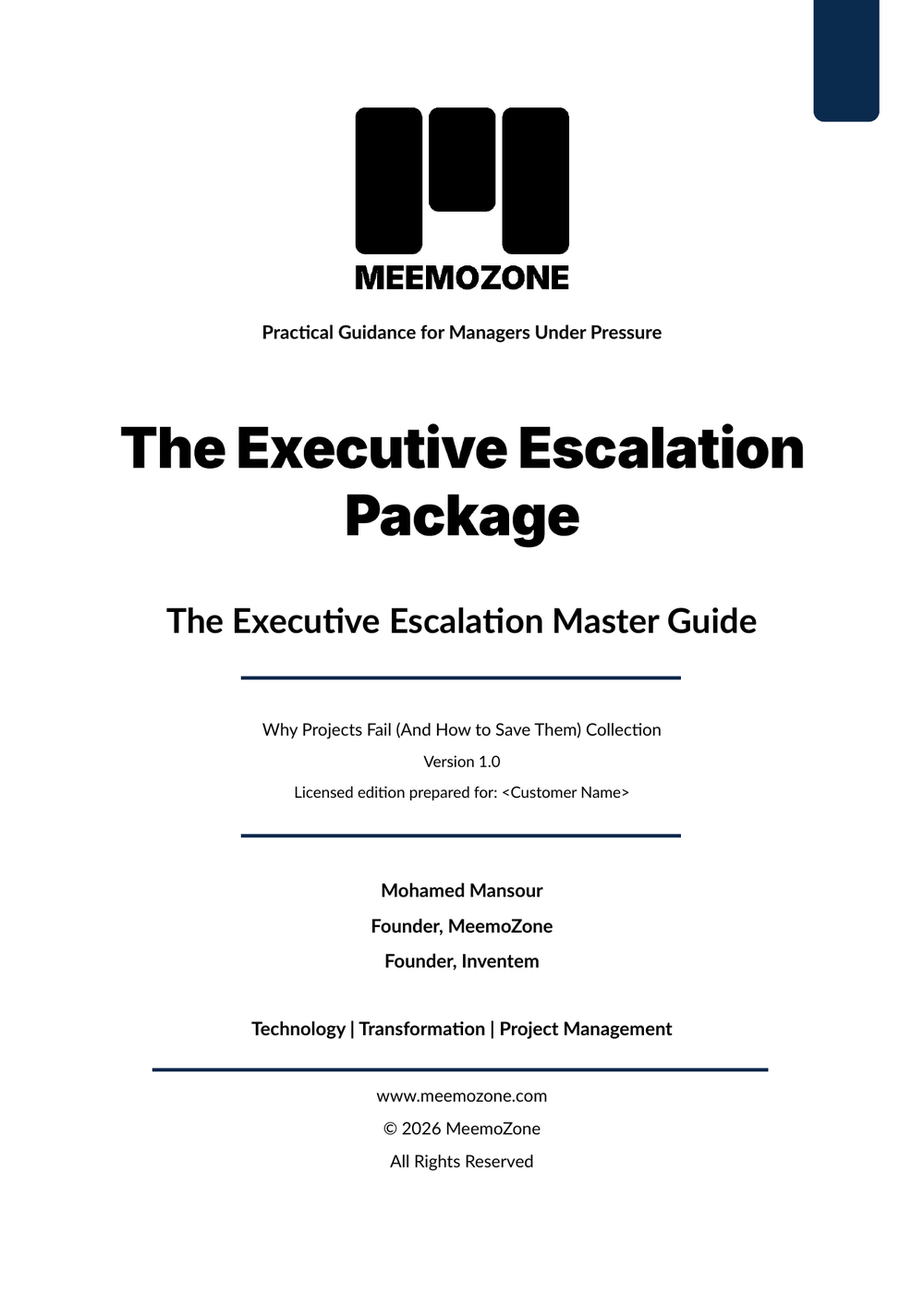
The Executive Escalation Master Guide
The Watermelon Trap, the AI Reality Check on reporting vanity, the "Trade-Off, Not Apology" framework, how to translate technical debt into business pain, and the three-step escalation sequence.
The Sponsor Alignment Script Pack
Four written escalations, ready to adapt: the Early Warning, the Decision Debt Escalation Memo, the Status Reset Memo, and the Sponsor-to-Executive Briefing Support Script.
The Executive Escalation Briefing Deck
Current reality, business impact, options and trade-offs, required decision path, next checkpoint. Supplied in two themes — branded, and a corporate-neutral version that drops into your own template without fighting your company's deck standard.
The Cost of Delay & Trade-Off Calculator
Enter the weekly costs and it totals your Cost of Delay, names your primary impact driver, compares recovery options side by side, and prices every decision still sitting unmade.
Project Horizon
The whole sequence played out — the early warning, the status reset, the numbers behind the business case, and the boardroom meeting that ended in an explicit decision.
The Escalation Conversation Checklist
What to have ready before you walk in, what to say first, and what you must not leave the room without. For the meeting that got scheduled at short notice.
Usage Sequence & Authority Boundary
The order to work the package, and the limits that protect you — do not bypass agreed governance routes, do not misrepresent evidence, do not assign blame. Make the risk visible and let accountable sponsors choose.
Single-User License
Licensed for personal professional use, with clear terms on what you can and cannot do inside your organization.
Escalation is not one
panicked email.
It is a disciplined three-step sequence designed to eliminate surprises and walk the sponsor toward a decision they can actually make. Each step has its own script.
A brief, informal flag that risk is rising — an email or a quick one-to-one. Plant the seed. There is turbulence ahead and you are actively managing it.
The status reset. Downgrade from Green to Amber or Red on objective evidence — calm, specific, free of blame and defensiveness. The Watermelon reporting stops here.
Pivot straight to the trade-off. A small set of viable options — cut scope, add budget, push timeline — and an explicit answer on which path is authorized and who owns it.
"I am so sorry, but the vendor missed the API deadline, so we are going to be three weeks late. We will work weekends to try and fix it."
"The vendor's API delivery failed our objective security gates. We now face a decision point: push the launch by three weeks to fix the security flaws, or launch on time and explicitly cut the API integration from the first release. Sponsor, which path do you authorize?"
Same facts. Same three weeks. One of those sentences ends in blame — the other ends in a decision.
What this page
doesn't show you.
The deck you'll present,
and the numbers behind it.
Not mockups. These are real slides and a real calculator sheet, exactly as they arrive.
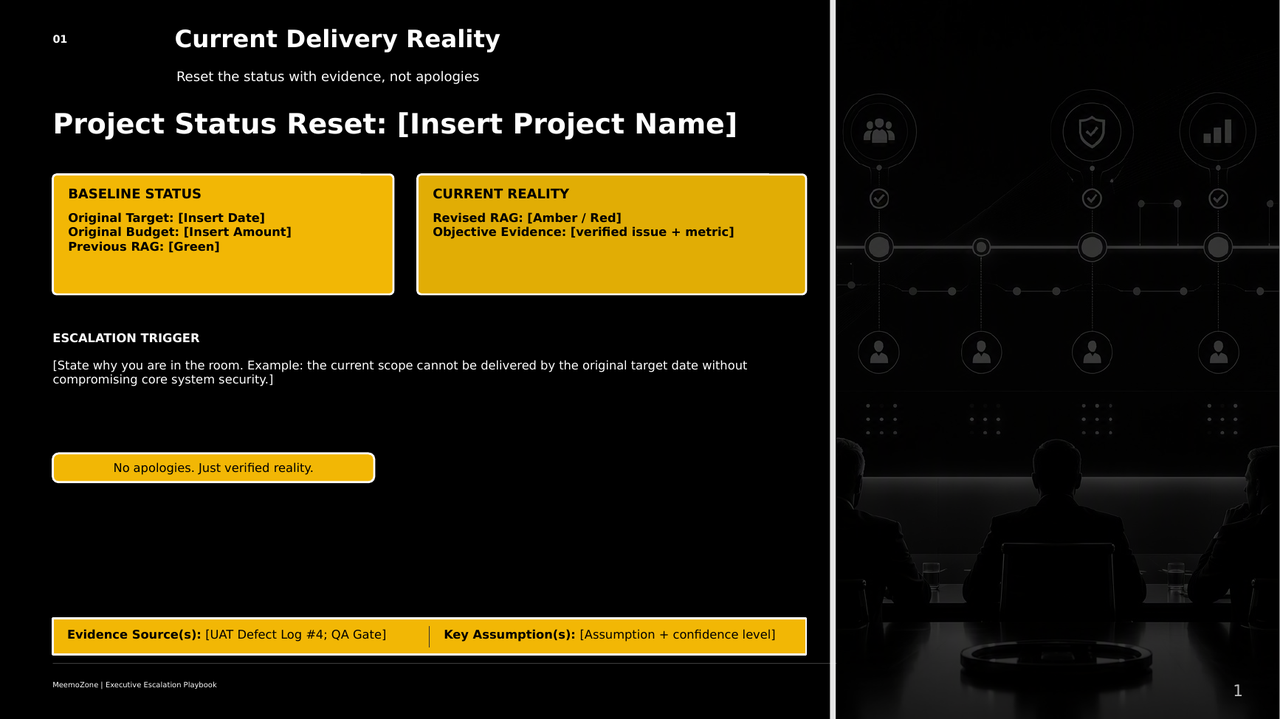
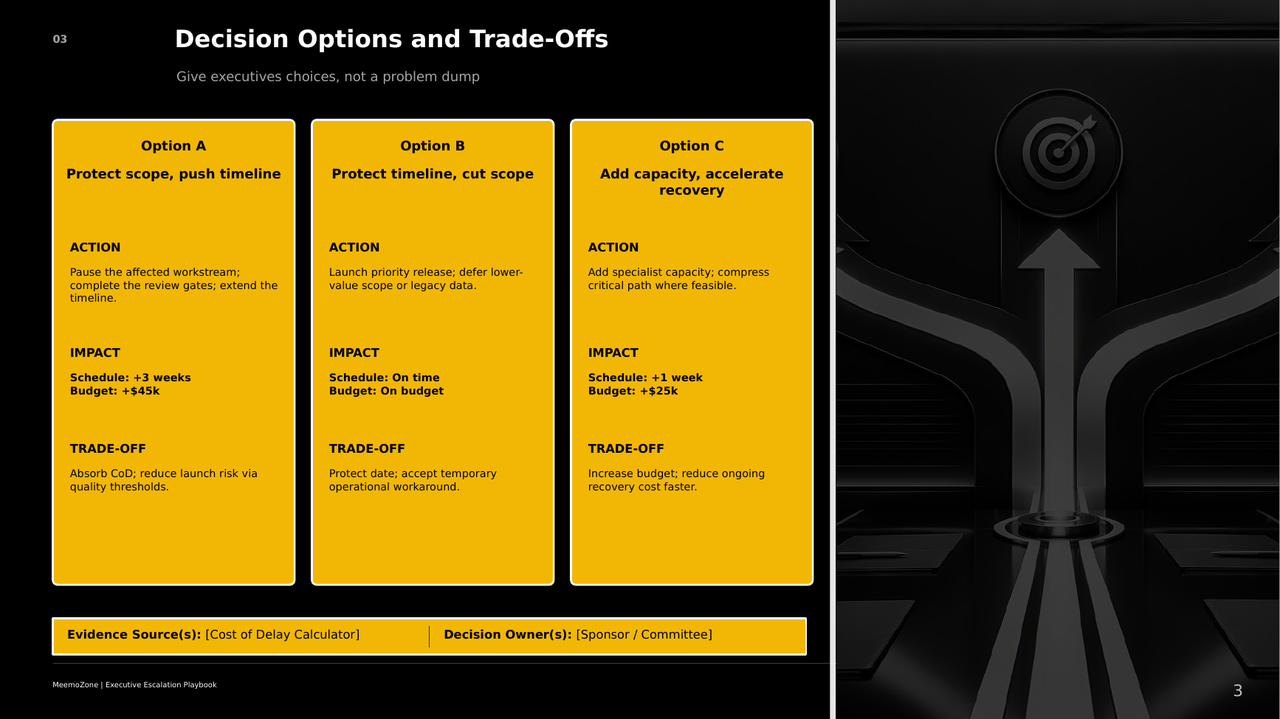
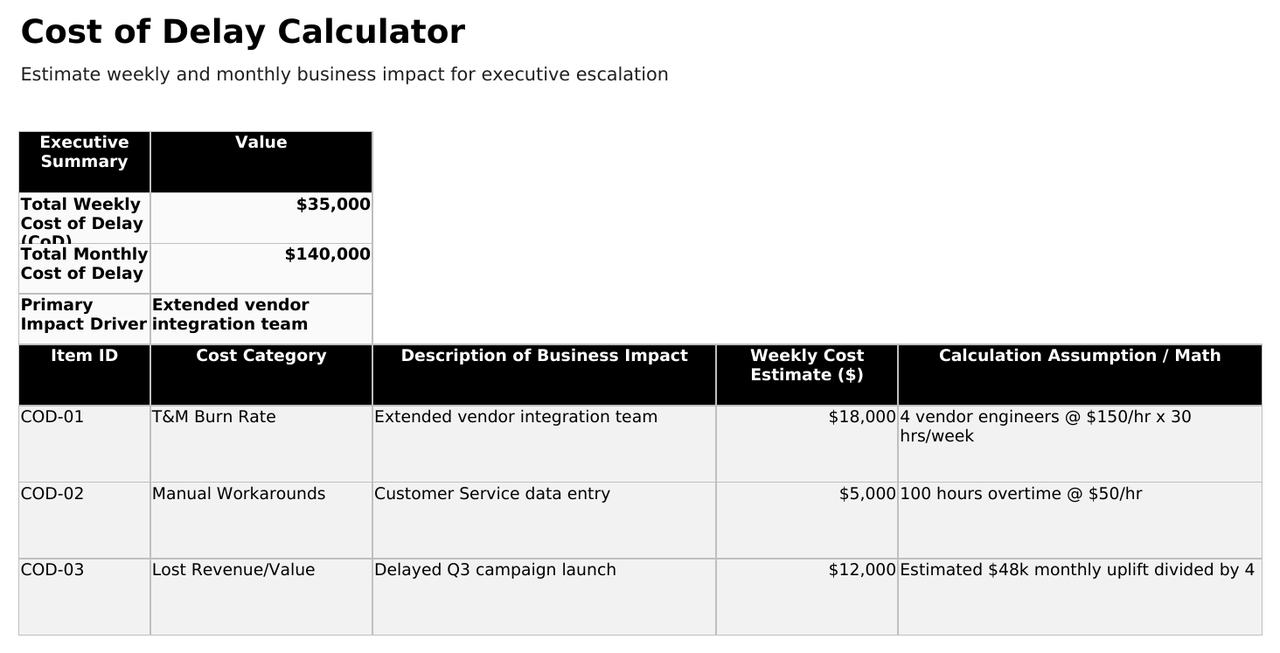
3 of 33 pages, 5 slides and 6 calculator sheets shown.
Executives do not fund projects because the Jira board looks tidy. They fund projects that protect revenue, reduce cost, and lower risk.
Nearly three decades in delivery. Eighteen years at Shell as an IT/OT leader and advisor. Most recently IS&T Program Director on Rio Tinto's Simandou megaproject in Guinea. Programs across Cairo, Dubai, Gabon, post-conflict Basrah and West Africa.
Mohamed Mansour
Executive Practitioner · Founder, MeemoZone · Founder, Inventem
Technology | Transformation | Project Management
One deferred decision
costs more in a week than this does once.
Early Adopter pricing holds for the first 21 days of launch.
Standard enterprise pricing of $249 applies thereafter.
A decision is only as strong
as the evidence underneath it.
The scripts and the calculator get you the meeting and the answer. What they cannot do is produce the evidence in the first place, or execute what the sponsor decides. Series 1 covers both ends.
The Vendor Accountability Scorecard
Most escalations start with a supplier. Build the acceptance evidence and the invoice trail before you walk into the room, not after.
The First 90 Days PM Toolkit
Escalating someone else's project before you have the ground truth is how you end up owning their decisions. The structured takeover sequence comes first.
The Project Rescue Toolkit
When the trade-off conversation reveals that no option on the table saves it. Formal stop-loss, recovery architecture, and the case for intervention.
Early Adopter bonus: any Series 1 purchase during the launch window — a single package or the full Vault — includes planned beta access to the MeemoZone Interactive Governance Agent program, subject to release readiness.
This is 1 of 6.
Get all six for just $120 more.
The Escalation Package handles the boardroom. The Series 1 Turnaround Vault adds the charter, project takeover, vendor control, AI governance and full project rescue. Bought separately, the six come to $1,394 at standard retail. The Vault holds all of them for $599 — and $299 during the launch window.
Early Adopter access · first 21 days of launch
See the Vault →