
"We can't stop now.
We've already spent
three million dollars."
That sentence has kept more projects alive than any business case ever has. It is also the wrong question. Money already spent cannot be recovered by spending more of it. The only decision available is what to do with the runway you have left — and this toolkit tells you exactly how much that is, and what each option costs.
Early Adopter pricing is locked for the first 21 days of launch in exchange for candidate feedback and real-world case study contributions. Standard enterprise pricing of $299 applies thereafter.
Nobody is deciding.
The money is deciding.
Ghost burn. Time-and-materials resources still billing against workstreams nobody can validate or integrate. The invoices are precise; the value is theoretical.
Scope still expanding. New requirements continue to arrive and get accepted, because stopping them would require a decision nobody wants to be the one to make.
Routine management on a non-routine problem. Another Gantt update, another steering committee, another fortnight. None of it touches what is actually broken.
Nobody knows the real number. Not the budget — the runway. How many weeks of money remain at the current burn, and the date it reaches zero.
Sunk cost freezes everyone. Three million already spent, so pausing feels like admitting waste. The past takes the decision hostage and the future pays for it.
Someone suggests automating the recovery. AI tooling to compress the timeline on an unstable foundation — more output, no more confidence, and the defects move further downstream.
Until you know what is broken, how much runway remains and what is structurally blocking it, any attempt to speed up only deepens the crisis.
Twelve files. Four scripts.
One deck in three themes.
The Project Rescue Master Guide
The triage mindset, the stabilization boundary that stops ghost burn, the automation trap, the sunk cost reality, and the three-step turnaround sequence.
The Project Rescue Communication Pack
Four governance-safe scripts: the Distress Status Memo, the Vendor Workstream Review request, the Executive Triage Cadence setup, and the Recovery / Pause / Termination Decision Memo.
The Rescue Decision Briefing Deck
The same boardroom deck in three finishes — Signature Dark for presenting, Clean Light for screen-share, and Print-Friendly Monochrome for board packs that get photocopied.
The Burn Rate, Runway & Rescue Decision Calculator
Weekly burn, weeks of runway, and the projected date the money runs out. Plus sunk cost segregated into what is gone and what can be reallocated, and both decision paths priced.
Project Phoenix
The full sequence applied — the burn that was found, the containment actions routed through governance, the segregated spend, and the decision the steering committee actually made.
The Project Rescue Checklist
The condensed triage sequence on three pages. For the Monday where the project was declared distressed on Friday and you have no time to read a guide.
Usage Sequence & Authority Boundary
The order to work the package, and the limits that protect you — do not unilaterally stop vendor work, halt payments, terminate contracts or suspend teams. Create evidence, quantify runway, route the decision.
Single-User License
Licensed for personal professional use, with clear terms on what you can and cannot do inside your organisation.
Three steps. One of them
is permission to stop.
Most recovery material assumes the answer is recovery. This one prices all three paths honestly — reduced-scope turnaround, strategic pause, or formal closure — and puts the decision where it belongs, with the people authorized to make it.
Find the burn rate, isolate the structural blockers, calculate what runway remains. Recommend containment — pause the unvalidatable vendor workstream, hold new scope, replace routine status with a triage cadence.
Walk in with three costed options, not an open-ended problem. Separate what is already spent from what is still at stake, and leave with an explicit, documented decision and a named owner.
If recovery is authorized, the old plan does not come back. A new budget, a new timeline, reduced scope and stronger controls — so the project cannot quietly drift into distress a second time.
Recovery is not resuming the original plan. It is a new baseline, or it is nothing.
What this page
doesn't show you.
The deck you'll present,
and the numbers behind it.
Not mockups. These are real slides and real calculator sheets, exactly as they arrive.
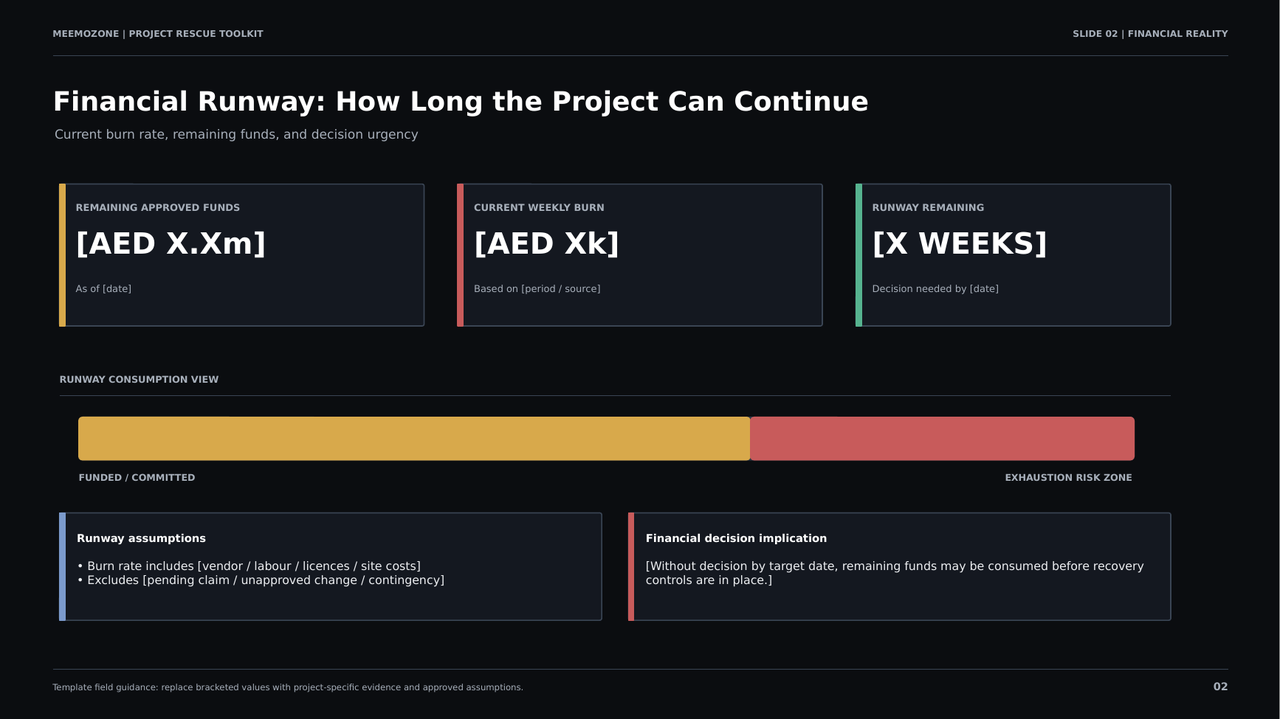
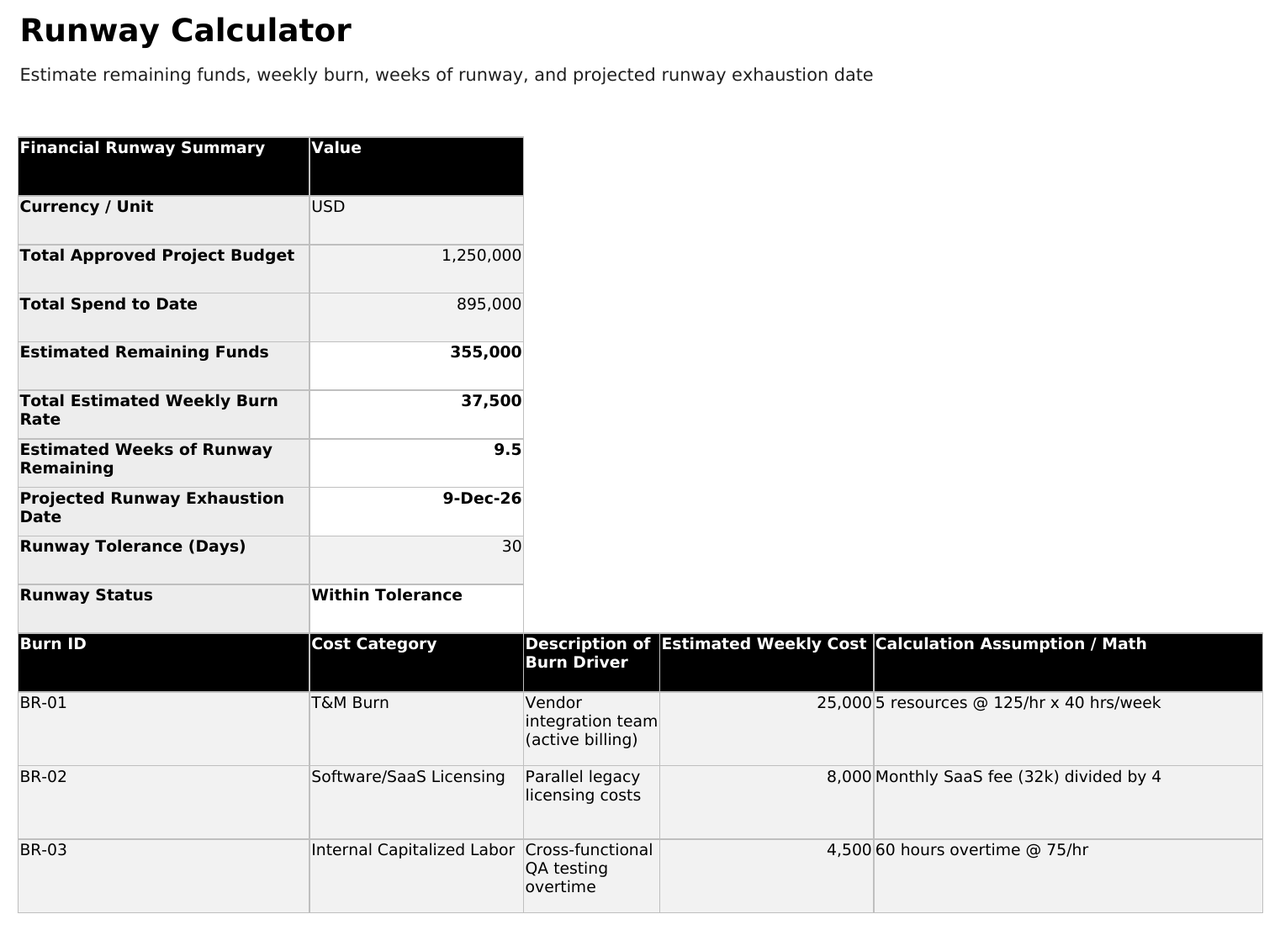
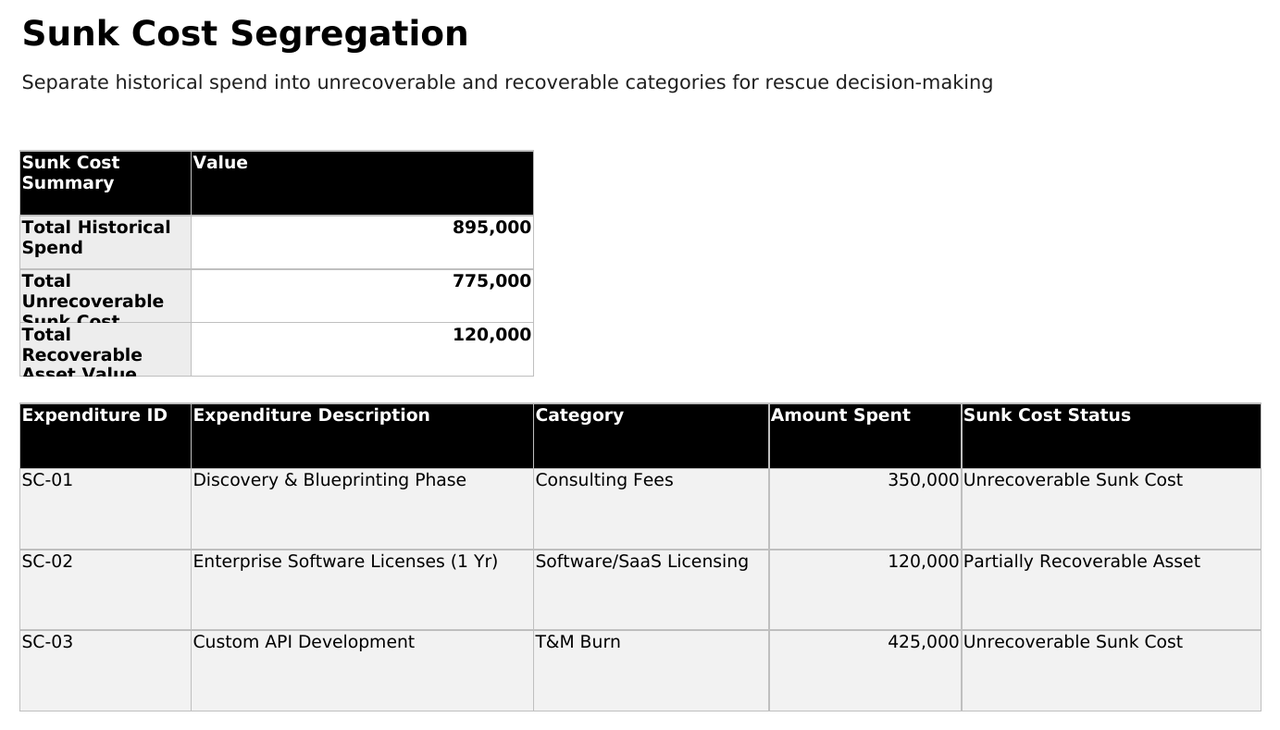
3 of 32 pages, 5 slides and 6 calculator sheets shown.
Executives do not fund projects because the Jira board looks tidy. They fund projects that protect revenue, reduce cost, and lower risk.
Nearly three decades in delivery. Eighteen years at Shell as an IT/OT leader and advisor. Most recently IS&T Program Director on Rio Tinto's Simandou megaproject in Guinea. Programs across Cairo, Dubai, Gabon, post-conflict Basrah and West Africa.
Mohamed Mansour
Executive Practitioner · Founder, MeemoZone · Founder, Inventem
Technology | Transformation | Project Management
A week of ghost burn costs
more than everything here.
Early Adopter pricing holds for the first 21 days of launch.
Standard enterprise pricing of $299 applies thereafter.
Rescue is the most expensive
place to learn this.
Every distressed project was once a project with an unclear baseline, an unverified vendor, or a handover nobody controlled. Series 1 covers the three points upstream where this gets cheaper to fix.
The Vendor Accountability Scorecard
Most uncontrolled burn is time-and-materials nobody can validate. Link invoices to accepted deliverables before the burn becomes the crisis.
The First 90 Days PM Toolkit
If the distress arrived with the handover, the takeover sequence is the intervention that comes first — evidence, governance reset, and a stabilisation roadmap.
The Board-Ready Project Charter Package
The cheapest intervention in the series. A charter that defines value, measurement and intervention thresholds before a single commitment is made.
Early Adopter bonus: any Series 1 purchase during the launch window — a single package or the full Vault — includes complimentary planned beta access to the MeemoZone Interactive Governance Agent program, subject to release readiness.
This is 1 of 6.
Get all six for just $70 more.
The Rescue Toolkit handles the crisis. The Series 1 Turnaround Vault adds the charter, project takeover, vendor control, executive escalation and AI governance — the five interventions that come before one. Bought separately, the six come to $1,394 at standard retail. The Vault holds all of them for $599 — and $299 during the launch window.
Early Adopter access · first 21 days of launch
See the Vault →