
The Agile Illusion: Why Lack of Planning Cannot Be Masked by Sprints
Sep 20, 2026
You know that suffocating pressure during a steering committee meeting when leadership demands to see "immediate progress," and you feel forced to launch sprints before anyone actually knows what the product is supposed to do? As a technology leader driving a digital transformation, you understand the immense pressure to move fast. Stakeholders want visible progress. Leadership wants momentum. The team wants to show activity.
So, the promise of Agile feels irresistible. You hope that shorter sprints, faster iteration, and more regular ceremonies will finally unlock speed without the drag of traditional planning. But for many managers, that is not what happens at all. Instead of streamlined efficiency, they inherit pure chaos. Instead of a product that learns and improves, they manage a delivery machine that looks busy but feels increasingly unstable.
It is easy to blame your developers or assume that your corporate culture is just too rigid. But in most cases, this frustration is a structural failure, not a personal one.
Recent data from Digital.ai, in its 17th and 18th Annual State of Agile Reports, reveal a harsh reality: 66 percent of companies claim to have undergone Agile transformations, but half are actually practicing "illusory agile." These organizations operate under traditional, rigid constraints that are simply disguised by trendy Agile terminology. While genuine Agile projects are technically three times more likely to succeed than waterfall projects, faking it carries a massive penalty. Digital.ai notes that Agile "scaling issues" specifically cause 42 percent of Agile projects to fail, demonstrating the massive friction that occurs when attempting to force lightweight frameworks across complex enterprises.
Furthermore, the reporting itself is often an illusion. Digital.ai highlights a dangerous "visibility paradox," where 55 percent of organizations claim to have end-to-end visibility into their pipelines, yet 63 percent simultaneously experience worsening software quality. Tracking sprints and generating burn-down charts does not equate to building a functional product.
When Agile Becomes Theatre
Let me show you the hidden threat of faking agility to appease stakeholders actually guarantees a massive, public failure. To understand how dangerous this Agile illusion can be at scale, we must look at Hertz's digital overhaul.
The global rental car agency initiated a massive digital transformation to revitalize its web and mobile customer experiences worldwide. The engagement was aggressively marketed using "Agile" terminology, promising rapid, iterative value. However, the execution was textbook illusory Agile. Hertz fundamentally misunderstood the methodology and outsourced the vital Product Owner role entirely to their consulting firm, Accenture.
In professional project management, a Product Owner is the internal executive responsible for maximizing product value, serving as the definitive voice of the customer to prioritize the team's backlog. By outsourcing this role, Accenture essentially acted as both the delivery engine and the decision-maker, unilaterally judging whether its own code met the business requirements without collaborative internal iteration.
Because these critical feedback loops were broken, the "Agile" facade immediately crumbled into a rigid, dysfunctional waterfall contract. The delivered product was an operational disaster. It was hardcoded solely for the North American market, rendering it entirely useless for international scaling, and the fundamental architecture had to be abandoned. According to public court and SEC filings, this catastrophic failure resulted in a highly publicized $32 million lawsuit between Hertz and Accenture.
That is the ultimate cost of using sprints to mask a lack of foundational alignment.
Finding Truth in the Trenches
I know this danger well because I have had to clean it up.
In one of the massive programs I directed recently, I arrived to find teams fighting fires everywhere. On the surface, they were working in short sprint cycles. But underneath that activity, their schedules were incredibly shallow. The teams were moving in two-week bursts, yet nobody could clearly answer a simple question: What does success look like on a Tuesday? They were trying to sprint without a solid foundation.
To stabilize the program, I developed a hybrid approach I called 'Wagile'—merging the structural discipline of traditional Waterfall with the iterative execution of Agile. We kept the high-level Work Breakdown Structure (WBS) to protect our major milestones. A Work Breakdown Structure, or WBS, is a hierarchical, visual decomposition of the total project scope into manageable, predictable deliverables. In simple terms, it is the map that shows the whole project broken into parts that the team can actually control.
But we didn't stop at the high level. At the start of each month, we extracted specific activities from the WBS and required the project managers to decompose them into strictly granular, one-day tasks for a monthly sprint commitment. We then used daily stand-ups and sprint reviews to rigorously track daily progress against that long-term vision.
That experience taught me a vital, enduring lesson: true agility doesn't mean abandoning the master plan. It means building an unbreakable bridge between high-level executive strategy and daily, granular execution. You cannot sprint effectively if you do not know where the finish line is.
AI Cannot Outrun Bad Governance
This brings us to a common illusion in software development right now. You might think Artificial Intelligence coding assistants are the magic bullet to hyper-accelerate your sprints, but here is the twist: Generative AI isn't making your team more agile; it is simply generating bad code faster. Today, organizations are trying to mask this lack of planning by throwing Artificial Intelligence at the problem, hoping it will let them skip the hard thinking.
The Trend: The trend is universal: organizations are rapidly rolling out AI coding assistants, like GitHub Copilot, to hyper-accelerate Agile sprint timelines. Executives expect these tools to yield massive, linear increases in developer output and speed.
The Illusion vs. Reality: But this creates a highly dangerous productivity illusion. The assumption that faster typing equals faster software delivery is fundamentally flawed. Recent industry AI developer productivity studies from Axify, Gitnux, and Latent Space reveal a shocking truth: while developers feel 20 percent faster using AI for boilerplate code, they are objectively 19 percent slower at completing holistic, complex tasks.
If the architecture is unstable and the sprint machine is already running without real alignment, generic AI does not solve the problem. It simply digitizes chaos. Generating unverified code faster without evolving your governance accelerates the creation of massive downstream review bottlenecks and Technical Debt. Technical Debt is the hidden cost created by shortcuts—the future pain you inherit when today’s faster decision makes tomorrow’s delivery slower, more fragile, and more expensive. Faster typing only means you build the wrong feature faster.
The Tangible Future: Agile development's future requires organizations to stop viewing AI as a localized typing assistant. True efficiency relies on Agentic AI acting as an autonomous orchestrator across your Continuous Integration pipeline. Continuous Integration is the engineering practice of frequently merging code into a shared repository so that automated builds and tests run continuously to verify that new code still behaves properly. In the near future, Agentic AI will autonomously cross-reference newly generated code against your fixed enterprise architecture, automatically generating complex integration tests and catching design problems before a human reviewer ever sees the code. It is not "AI makes Agile magically work." It is "AI enforces quality boundaries for disciplined teams."
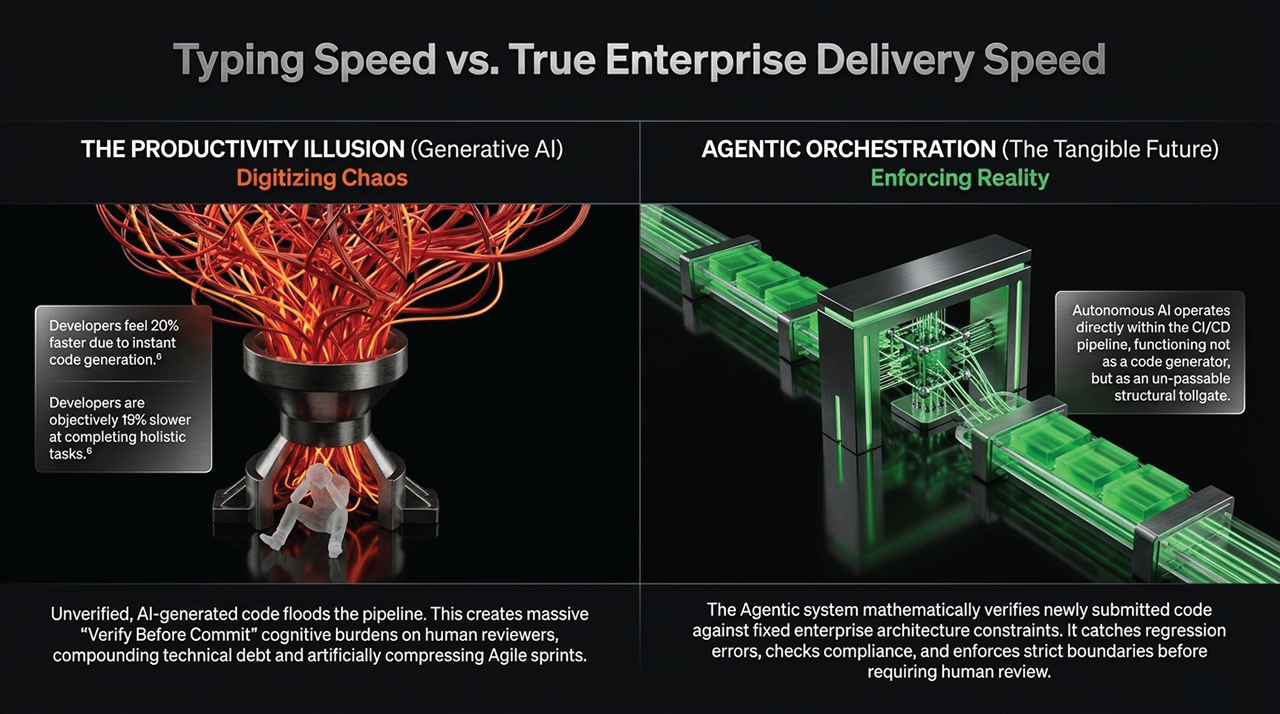
Figure 1. The Productivity Illusion vs. Agentic Orchestration. A visual comparison illustrating how hyper-accelerated, localized AI code generation creates massive downstream technical debt, and how organizations must transition to Agentic AI acting as an autonomous structural tollgate within the CI/CD pipeline to ensure true delivery speed.
The Hybrid Realism Playbook
To break free from the Agile Illusion and earn genuine respect from the C-suite, you must stop trying to force pure Agile into a traditional enterprise environment. Instead, you must deploy a rigorous governance framework that acknowledges the structural limits of iterative development.
Here is your battle-tested, four-step operational playbook to bridge the gap between agility and predictability.
Step 1: Enforce the Internal Product Owner
Genuine Agile relies heavily on the client acting as a deeply engaged, authoritative leader. You must enforce the rule of the internal Product Owner. As we learned from the Hertz disaster, you must never outsource this vital role to a vendor, a systems integrator, or an external consultant. The Product Owner must sit within your organization and hold the fiduciary authority to validate software increments against actual, measurable business value. If the Product Owner does not understand the corporate strategy, the agile team is simply sprinting toward the wrong target.
Step 2: Deploy Hybrid Realism (Bimodal Governance)
Do not try to force your entire enterprise into a two-week sprint cycle. Instead, deploy Bimodal Governance. Bimodal Governance is a strategic management model that relies on managing two separate yet coherent styles of work: one focused on rigid predictability and the other on rapid exploration. Use iterative Agile sprints strictly for frontend software development and daily task execution where flexibility is required, and the cost of change is low. Simultaneously, rely on rigid Waterfall milestones for infrastructure, hardware deployments, and capital allocation, where the cost of change is extremely high. That is not a compromise; it is realism.
Step 3: Establish an Unyielding Scope Baseline
Never let the term "Agile" become an excuse for infinite, undocumented scope expansion. Before execution begins, you must establish a clear, unyielding Scope Baseline. A Scope Baseline is the formally approved version of a scope statement, the work breakdown structure, and their associated dictionary, which serves as the ultimate reference point and agreed boundary for the project. Once this baseline is secured and signed off by the C-suite, your engineering teams can work iteratively inside it—but "Agile" can no longer be used to justify endless, unbudgeted additions.
Step 4: Secure Cross-Departmental Buy-In
Agile frameworks almost always fail to scale when they collide with siloed, traditional legacy departments. You must secure cross-departmental buy-in before scaling your sprints. Train the broader operational workforce in your hybrid methodologies so they understand how to interact with your IT teams. Consider the massive, successful hybrid rollout at Target Corporation, which systematically trained 40,000 employees in these practices. If the surrounding organization does not understand how your hybrid model works, every sprint will encounter the organizational immune system and be rejected.
Good managers do not win respect by running fast in the wrong direction. They earn respect by building the bridge between strategic planning and daily granular execution.
If you are ready to stop fighting fires and start managing your digital transformation with executive precision, the next step is straightforward. Download The Hybrid Governance Template today to access the exact operational matrices you need to establish a firm scope baseline, integrate your work breakdown structure into daily sprints, and protect your project from the Agile illusion.
References
- Digital.ai. 17th and 18th Annual State of Agile Reports. (Source for the 66% "illusory agile" epidemic, the 42% scaling failure rate caused by enterprise friction, and the 63% declining software quality visibility paradox).
- Public Court/SEC Filings. Hertz Corporation vs. Accenture LLP. (Source for the $32 million lawsuit caused by outsourcing the Product Owner role and failing to deliver a scalable, international digital architecture).
- CIO Dive. Target hits the bullseye with agile tech and operations. (Source for the successful hybrid Agile rollout case study, specifically detailing the systemic training of 40,000 enterprise employees to secure cross-departmental buy-in).
- Gartner / Industry Research. Bimodal IT / Bimodal Governance. (Source for the strategic management model of deploying two distinct work styles—iterative Agile for frontend development and rigid Waterfall for infrastructure—to safely scale transformations).
- Industry AI Developer Productivity Studies (e.g., Axify / Gitnux / Latent Space). (Source for the data highlighting the "productivity illusion," where developers utilizing AI coding assistants feel 20% faster but are objectively 19% slower at holistic task completion due to downstream debugging and technical debt).