
The Black Box: Managing Vendors Before They Manage You
Sep 20, 2026
You know that hollow realization when a massive vendor invoice lands on your desk, and you realize you are paying for hundreds of hours of activity, but zero actual business value? As an IT leader driving a major digital transformation, you will eventually face a decision that can shape the entire outcome of the program. Do you build the solution internally with your own team, or do you buy it from an external vendor?
Building internally can feel safer because you keep more control over your people, systems, and priorities. However, isolating your organization from the broader technology ecosystem is often a strategic mistake. According to the IDC FutureScape Enterprise AI Outlook, organizations that utilize strategic external vendor partnerships achieve twice the success rate of those that attempt complex internal builds.
So, this is not an argument against vendors; good vendors are often necessary. The real issue is whether you manage them through a transparent, outcome-based partnership or allow them to operate inside a "Black Box".
This dynamic introduces the Principal-Agent Problem. The Principal-Agent Problem occurs when your priorities as the buyer (the principal) fundamentally clash with the vendor's financial incentives (the agent). In simple language, you want rapid business value, but the vendor may be rewarded for logging more hours, generating more change requests, and dragging out the engagement.
That conflict becomes dangerous when organizations sign traditional time-and-materials Master Services Agreements, or MSAs. An MSA is the foundational contract that governs the vendor relationship and sets the commercial rules of the game. Under a time-and-materials model, you, as the client, bear almost all delivery risk, while the vendor is paid for the hours and effort expended. When the contract rewards activity more than actual outcomes, the vendor's financial logic quietly drifts away from your business logic.
A Multi-Billion Dollar Lesson in Vendor Misalignment
Let me walk you through the hidden trap of how misaligned vendor contracts systematically drain an enterprise from the inside out. To understand the catastrophic impact of the "Black Box" vendor trap, we must examine the supply chain collapse at Zimmer Biomet.
Zimmer Biomet, an $8 billion global medical device manufacturer, initiated a massive SAP S/4HANA supply chain and ERP transformation. They sole-sourced the implementation to their long-time consulting partner, Deloitte. The project suffered from extreme contractual asymmetry and a continuous "revolving door" of offshore personnel. Junior developers were coding modules without understanding the broader business context of a global medical supply chain.
Under intense internal pressure to hit a scheduled milestone and stop the financial bleed, both the vendor and the client agreed to push the system live over the U.S. July 4th holiday weekend—a notoriously high-risk window for business continuity. They ignored critical signs of business unreadiness. The failure of the resulting warehouse management module literally ruptured the company's medical supply chain. According to public court and SEC disclosures, this catastrophic failure resulted in $75 million in direct lost revenue, a devastating $2 billion decline in market capitalization, and a $172 million lawsuit against the vendor.
The lesson is clear: if the vendor relationship is structured poorly, you cannot outsource accountability. The client still absorbs the full impact of the disaster, even when the vendor helped create it.
What Hostile Environments Taught Me About Sourcing Balance
Over many years with Shell, working on multi-billion-dollar ventures and managing multimillion-dollar IT programs, I learned that smart sourcing is never about ideology. It is about fit.
Before an IT initiative, you have to think critically: are you going to insource or outsource? There are things you can, and maybe should, outsource and use off-the-shelf software systems when it is more economical, and you are ready to follow standard market practices. But there will also be cases when it is much better to insource, especially if you are working on core proprietary intellectual property that acts as your market differentiator.
After deciding whether to insource or outsource, you need to carefully assess the contracting strategy that best fits your procurement needs, based on a clear risk-mitigation plan. Maybe the best option is a fixed-price contract when the scope is very clear and will never change, or a cost-plus incentive when the scope is ambiguous over a long period. But always remember that the relationship between you and the vendor must be a win-win. If you treat vendors as adversaries, or if one party reaps all the gains while the other suffers, the partnership will inevitably collapse.
Why AI Cannot Read Your Mind (Or Enforce Your Contracts)
This brings us to the common illusion in modern procurement. You might think Artificial Intelligence is the magic bullet to fix your vendor management problems, but here is the twist: Generative AI isn't holding your vendors accountable; it is simply digitizing your contractual confusion.
Today, many overwhelmed project management offices are hoping that Artificial Intelligence will magically solve their procurement challenges.
The Trend: Organizations are rapidly using generic AI platforms to draft vendor contracts and Service Level Agreements, or SLAs. An SLA is a documented agreement outlining the specific quality, speed, and technical metrics of service delivery.
The Illusion vs. Reality: Drafting a contract with AI creates a dangerous illusion of executive control. AI-generated legal text cannot magically enforce that contract in the field, nor can it physically stop a systems integrator from billing you for unproductive hours. If your procurement model is fundamentally broken, dropping generic AI onto it simply digitizes your contractual confusion. You end up with a cleaner document but the exact same misaligned incentives.
The Tangible Future: The tangible future of vendor management relies instead on AI-powered Continuous Controls Monitoring (CCM). Continuous Controls Monitoring is the use of automated software to track and audit systems, transactions, deliverables, and control thresholds in real time. In the near future, Agentic AI will automatically audit third-party software deliverables against your contractual benchmarks. It will programmatically halt vendor invoice payments if security or readiness thresholds are violated, thereby enforcing the contract autonomously and objectively.
Your Playbook for Outcome-Based Sourcing
If you want to earn the deep respect of the C-suite, you must stop allowing vendors to define the commercial logic of your digital transformations. You need a sourcing model that aligns incentives before the work begins.
Here is your battle-tested, four-step operational playbook to conquer the Black Box Vendor Trap and build high-performance partnerships.
Step 1: Abandon Time-and-Materials Billing
The first critical discipline is to step away from the traditional billing status quo. You must stop using vendor-drafted Master Services Agreements (MSAs) that rely on hourly billing or arbitrary technical milestones. This time-and-materials model financially incentivizes systems integrators to maximize billable hours and actively seek out project delays so they can pursue lucrative change orders. A change order is a formal request to alter the original project scope, which vendors often use to increase their revenue at your expense. For strategic transformations, do not let hourly billing become the default commercial engine.
Step 2: Establish a "Vested" Sourcing Model
To replace the flawed time-and-materials model, you must transition your enterprise to a Vested Sourcing model. Vested Sourcing is a business model that explicitly ties MSAs and SLAs directly to shared-value business outcomes rather than time-and-materials billing. In simple language, a Vested model means the vendor's success is tied to your success. You are tying their ultimate profit margins directly to the successful achievement of measurable, strategic business goals. If the vendor delivers the software but the business does not achieve the expected ROI, the vendor's profit is penalized.
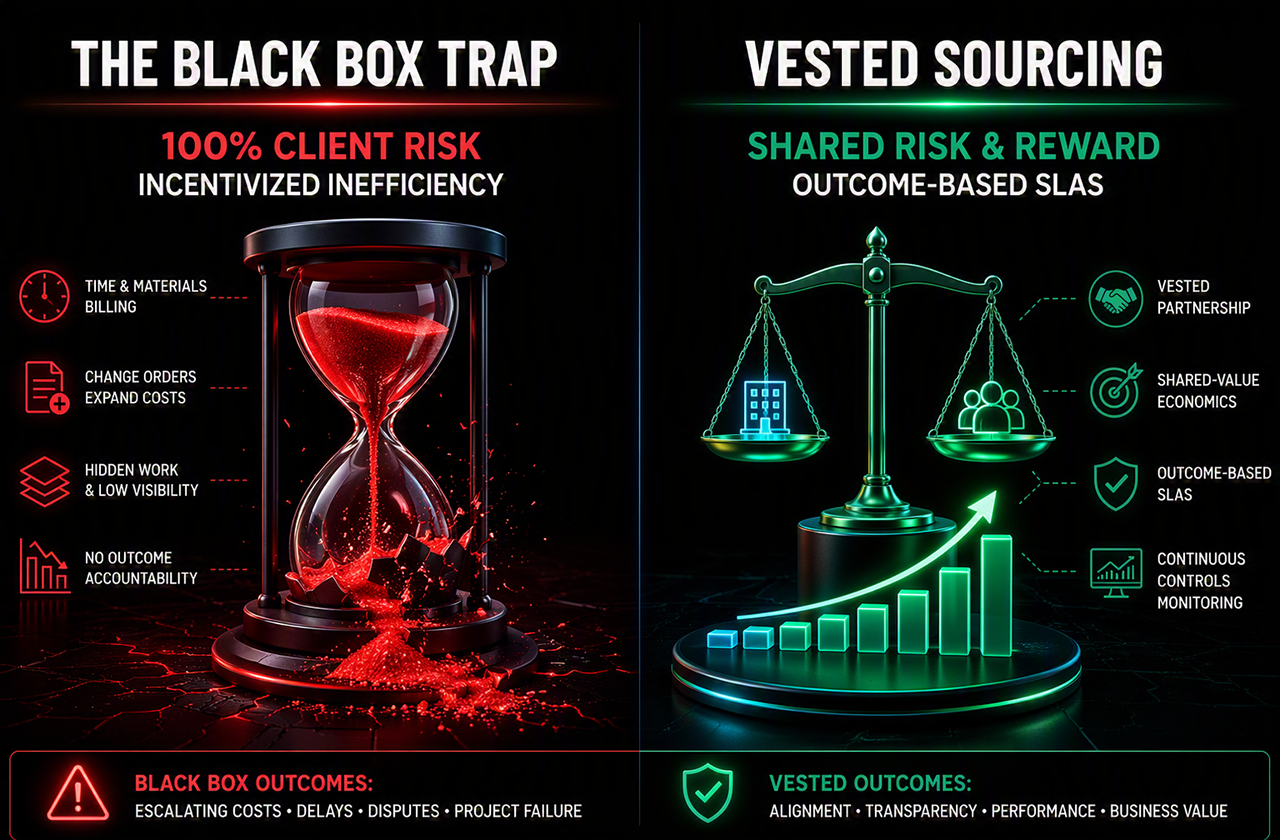
Figure 1. The Black Box Trap vs. Vested Sourcing. An operational matrix contrasting the financial drain of traditional time-and-materials contracts against the aligned incentives and shared-value economics of outcome-based partnerships.
Step 3: Define Shared-Value Economics
Once you have established the Vested framework, you must define Shared-Value Economics. Shared-Value Economics means both parties benefit when the business outcome is achieved—and both parties feel the consequences when it is not. Under this model, the vendor is highly compensated for the actual result of optimizing the business, rather than the mere effort of installing software. If the vendor successfully automates manual processes, reduces error rates, and lowers total operational costs, their profit margin increases proportionally. Conversely, if their system fails to streamline the workflow, they absorb the financial pain alongside your enterprise.
Step 4: Enforce Clear SLAs on Outcomes
The final discipline is to manage outcomes, not just activity. You must enforce clear SLAs on the business outcomes that the Tier-1 vendor must deliver. Stop attempting to micro-manage how they execute the daily technical work or govern their internal resource planning. If you have structured the Vested contract correctly, you no longer need to audit their timesheets. Because the vendor is only paid for successful outcomes, they are organically incentivized to deploy their best people and work as efficiently as possible. This completely transforms a traditionally adversarial vendor dynamic into a highly functional, shared-value partnership.
Good managers do not earn respect by letting vendors manage the commercial logic of the transformation. They earn respect by building procurement structures that protect the enterprise before the first invoice arrives.
If you are ready to stop playing defensive procurement games and start architecting contracts that guarantee performance, take the next practical step. Download The Vendor Accountability Scorecard using the link below to evaluate your current MSAs and start transitioning your partnerships toward true Vested Sourcing.
References
- IDC FutureScape / Enterprise AI Outlook. (Source for the statistic that organizations utilizing strategic external vendor partnerships achieve twice the success rate of those attempting complex internal builds).
- Public Court Filings / SEC Disclosures (Zimmer Biomet vs. Deloitte). (Source for the details of the SAP S/4HANA failure, the July 4th deployment rupture, the $75 million in direct lost revenue, the $2 billion market cap decline, and the $172 million lawsuit).
- Supply Chain 24/7 / IAOP Outsourcing Publications. (Source for the "Vested Sourcing" business model, which ties Master Services Agreements (MSAs) and Service Level Agreements (SLAs) directly to shared-value business outcomes rather than time-and-materials billing).