
The Forgotten Stakeholder: Why Ignoring End-Users Guarantees Rejection
Sep 20, 2026
You know that agonizing moment on launch day? You’ve burned the midnight oil, the technical tests are all green, and you finally deploy the new software, only to watch your workforce refuse to log in, instantly reverting to their old spreadsheets. As a dedicated project leader driving a digital transformation, you know the immense pressure of crossing the finish line. You push your team to the limit, hit your technical milestones, and finally deploy the new software to the business. You expect a victory lap, but instead, you are met with complaints, resistance, and a workforce that simply refuses to use the system.
It is a devastating feeling, but if you have experienced this, you are not alone.
According to industry adoption data from the ERP Software Blog, an overwhelming 70 percent of all enterprise software implementations fail strictly due to poor user adoption. Furthermore, 83 percent of senior executives state that forcing staff to adopt new workflows is their single largest barrier to digital transformation.
The cost of ignoring the user interface is brutal. The Gitnux Market Report highlights that poor UX design accounts for 41 percent of all e-commerce platform failures.
This happens because managers fall into the Quality vs. Time/Budget Paradox. The Quality vs. Time/Budget Paradox is a dangerous operational trap identified by the Project Management Institute (PMI). Their data show that while "user involvement" is the single most important factor in ensuring a project's ultimate quality, it is often cut because it does not directly improve short-term budget or schedule metrics. Consequently, stressed project teams routinely cut end-user feedback to meet arbitrary deadlines, inadvertently destroying the project's long-term business viability.
A $16 Billion Lesson in Missing the Frontline
Let me walk you through the hidden reality of how ignoring frontline workflows turns a technical success into an operational catastrophe. To understand the catastrophic impact of the forgotten stakeholder, we must examine the U.S. Department of Veterans Affairs (VA).
According to the U.S. Department of Veterans Affairs Office of Inspector General (OIG) Reports, the VA engaged in a massive $16 billion modernization mandate to replace its legacy health information system with a commercial off-the-shelf Oracle Cerner Electronic Health Record (EHR) platform.
While the implementation team adhered strictly to technical database specifications, they severely neglected the nuanced, high-stakes workflow realities of frontline clinical staff. The most glaring architectural failure was the "unknown queue". If the new software could not easily route a clinical order to a specific destination, it silently deposited the order into a hidden digital drop-box.
Medical staff were entirely unaware of this queue's existence. The mechanism functioned exactly as the software vendor had programmed it, but it completely ignored the operational realities of medical triage, referral routing, and clinical communication. This severe misalignment led to plummeting user adoption, direct patient harm, and a complete halt of the $16 billion deployment.
The software was not rejected because users were difficult. It was rejected because the system did not respect the reality of their work.
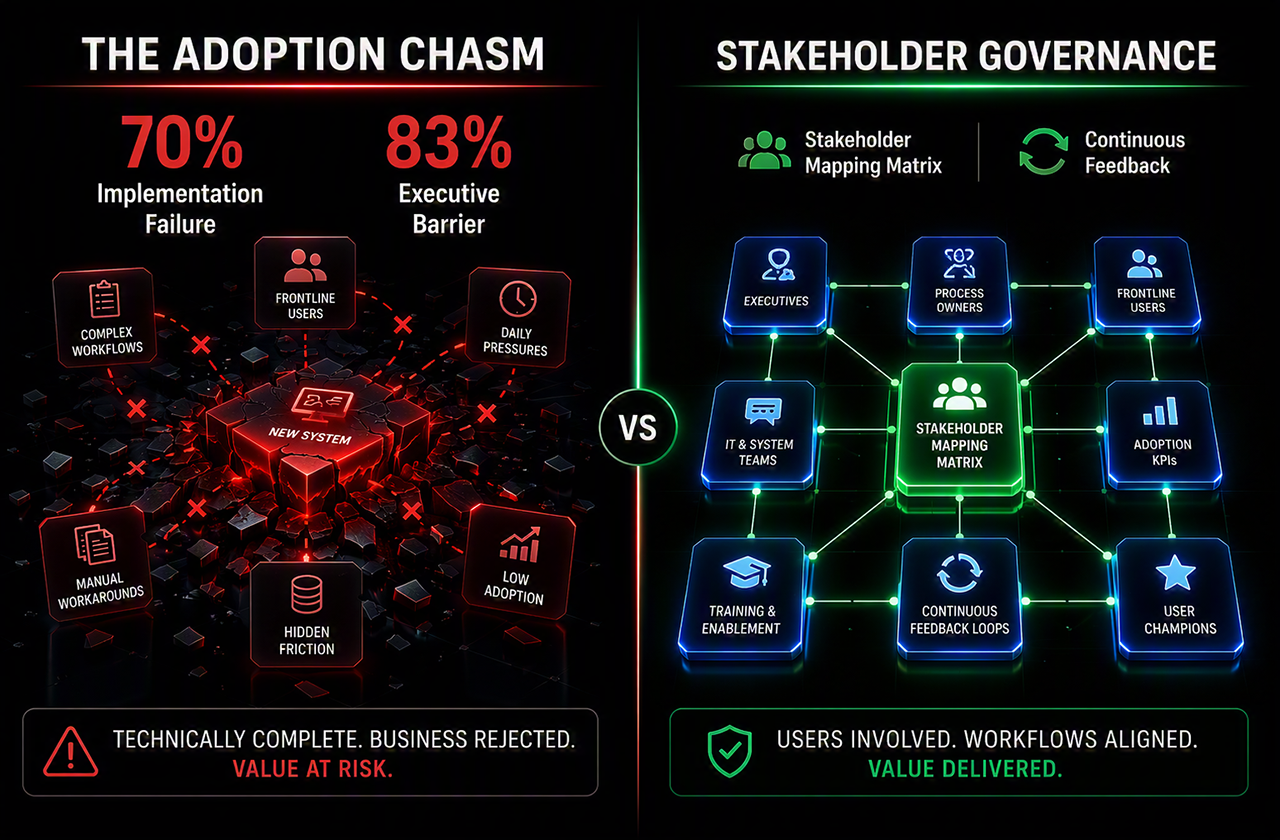
The Adoption Chasm vs. Stakeholder Governance. An operational matrix contrasting the 70% software implementation failure rate caused by fractured workflows and ignored users, against the sustainable, aligned delivery achieved through a structured Stakeholder Mapping Matrix and continuous feedback loops.
The Discipline That Saves Your Portfolio
I was fortunate early in my career. I never experienced a massive failure due to neglecting user requirements, but that was not luck—it was discipline.
I learned this while working at Shell, an organization renowned globally for its rigorous standards. From day one of my project management training, managing user expectations and involvement was treated as a non-negotiable standard throughout the project, from kickoff to closeout. While strict standards can sometimes lead to over-engineering (an entirely separate trap), this specific discipline saved our portfolio.
I witnessed firsthand how integrating end-users end-to-end became the single most influential success factor. Our projects achieved their targets not because the code was simply perfect in a vacuum, but because the PMs relentlessly protected users' daily workflows and treated end users as co-owners of the solution.
That taught me a lesson I still believe strongly: user involvement is not a soft courtesy. It is a hard operational standard. When you involve end-users deeply, they transition from passive critics into active champions who will defend your project.
AI Chatbots Cannot Fix Bad Design
This brings us to the common illusion in digital adoption today. You might think Artificial Intelligence is the magic bullet to fix a clumsy user interface, but here is the twist: Generative AI chatbots aren't repairing your broken software; they are just forcing users to navigate your bad design. This is where many organizations are making a modern version of the same mistake. They build a system that creates daily friction, and then turn to Artificial Intelligence to repair the adoption problem post-launch.
The Trend: Organizations are rapidly deploying AI chatbots and digital adoption platforms to train users and push compliance after the software is already live.
The Illusion vs. Reality: Forcing the adoption of a poorly designed system via an AI chatbot is like putting a Band-Aid on a broken bone. If the software fundamentally increases the end user's administrative burden, slows their daily workflow, or introduces friction, no chatbot can fix that. Users will inevitably find a way to bypass it. They will revert to spreadsheets, shadow IT, or manual workarounds to keep moving.
The Tangible Future: The tangible future of enterprise deployment relies on AI capturing passive behavioral telemetry from end-users from Day 1. Instead of deploying post-launch chatbots, Agentic AI will actively map and embed user friction points directly into the iterative design process before the software build is ever finalized. In simple terms, it means learning from actual user behavior before the system becomes final.
The End-User Adoption Playbook
If you want to earn executive respect, you must stop delivering software the business refuses to use. Adoption cannot be delegated to a training manual. You must deploy a continuous feedback loop and prioritize business change management.
Here is your four-step operational playbook.
Step 1: Elevate User Adoption to a Primary KPI
The first discipline is to formally decouple technical completion from project success. A KPI, or Key Performance Indicator, is a measurable signal used to judge whether the project is achieving what matters. Software that is functionally perfect in a testing environment but operationally rejected by the frontline workforce is a complete failure. You must make user adoption a primary KPI on your executive dashboards. Track practical signals such as login rates, feature usage, and help desk ticket volumes to measure true success. If the business does not use the tool, the project is not finished.
Step 2: Deploy the Stakeholder Mapping Matrix
Before your engineering team writes a single line of code, you must deploy the Stakeholder Mapping Matrix. A Stakeholder Mapping Matrix is a strategic visual grid used to categorize everyone impacted by the project based on their level of influence and interest. However, do not use it only as a political map; use it as a workflow map. Identify exactly how the new system changes the daily routine of the floor staff. Sit with them, watch them work, and directly build your technical requirements around removing their friction.
Step 3: Build Continuous End-User Feedback Loops
You must actively defeat the Quality vs. Time/Budget Paradox. You do this by building a continuous feedback loop—a repeated cycle of showing work, collecting user input, and validating changes. Do not wait for a final User Acceptance Testing phase at the very end of the project when it is too late to make structural changes. Bring a core group of frontline workers into your sprint reviews and let them break the software in front of your developers. Protect this involvement aggressively; you must never cut user feedback sessions to save time on the schedule.
Step 4: Shift from Software Training to Business Change Management
Finally, you must realize that sending out a PDF manual or a tutorial video is not change management. You must shift your focus to true Business Change Management. Business Change Management is a structured organizational methodology that addresses the psychological and behavioral realities of transitioning a workforce from one state to another. It addresses the human fear of obsolescence, the loss of familiar routines, and trust. Do not attempt to handle this alone within IT; partner directly with Human Resources to execute this effectively.
Good managers do not earn respect by delivering software that looks complete on a Gantt chart but fails in daily use. They earn respect by protecting the workflow of the people who must live with the system after launch.
If you are ready to stop guessing what your users want and start engineering guaranteed adoption, take the next practical step. Download the Stakeholder Mapping Matrix using the link below to start identifying your critical users and securing their buy-in today.
References
- ERP Software Blog / Industry Adoption Data. (Source for the 70% software implementation failure rate due to poor user adoption, and the 83% metric citing user adoption as the largest executive barrier to digital transformation).
- Gitnux Market Report / Customer Experience (CX) Metrics. (Source for the statistic that poor UX design accounts for 41% of all e-commerce platform failures).
- Project Management Institute (PMI) / Project Outcomes Analysis. (Source for the "Quality vs. Time/Budget Paradox", establishing that user involvement drives ultimate quality but is frequently cut because it does not directly accelerate short-term budget or schedule metrics).
- U.S. Department of Veterans Affairs Office of Inspector General (OIG) Reports. (Source for the $16 billion EHR modernization failure, the specific architectural flaw of the "unknown queue," and the subsequent halt of the deployment due to clinical workflow friction).