
The "Big Bang" Fallacy: Why Modular Execution is Your Safest Bet
Sep 20, 2026
You know that terrifying adrenaline spike just right before you flip the switch on a massive system replacement, praying the entire business doesn't crash the next day? As a technology leader driving a digital transformation, you know the seductive appeal of the grand launch. The C-suite wants a decisive moment. The program board wants a clean cut-over. The business wants to flip a single switch at night and wake up the next morning inside a completely new digital enterprise.
That is the promise of the "Big Bang" deployment. One weekend. One switch. One dramatic reveal.
It sounds bold. It sounds efficient. It sounds like visionary leadership. But in complex enterprise environments, a massive, one-time cut-over is often not leadership at all. It is a catastrophic gamble. When you attempt to replace a large, interconnected system in a single dramatic event, you create a scenario where every hidden dependency, every fragile integration, and every untested workflow must behave perfectly at the exact same time.
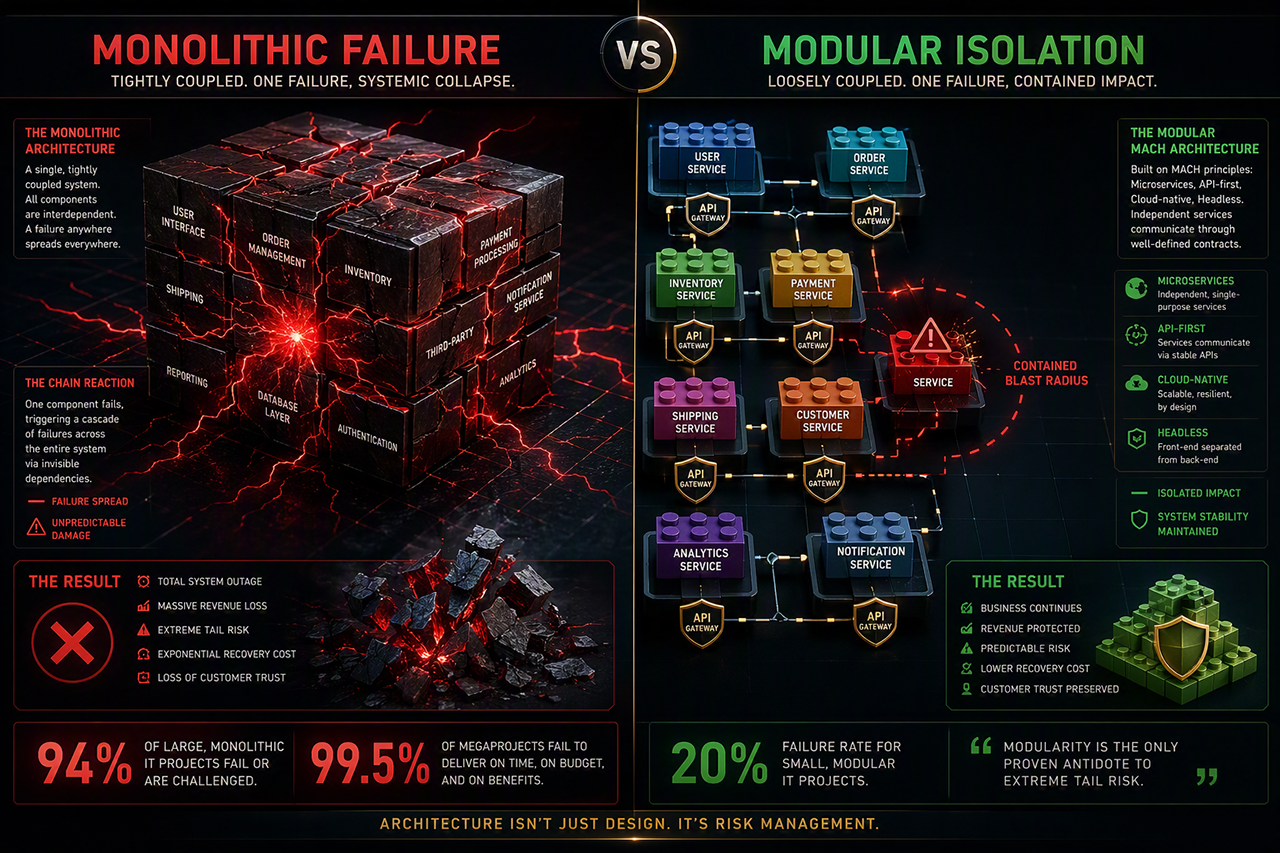
The numbers reveal exactly how dangerous this is. The Gitnux Market Report highlights a stark divide: massive, monolithic enterprise software projects face a staggering 94 percent failure or challenge rate, while small, modular IT projects experience only a 20 percent failure rate. The danger multiplies at the absolute highest levels; data from Oxford Global Projects demonstrates that 99.5 percent of large IT and infrastructure megaprojects fail to deliver perfectly on time, on budget, and with expected benefits.
The antidote to this massive failure rate is Extreme Modularity. Extreme Modularity means breaking a large architecture into small, predictable, independent units that can work, fail, improve, and scale without placing the entire enterprise at risk. Oxford Global Projects cites global solar PV farm construction to support this logic: 75 percent of solar projects are delivered strictly on time because they are built by linking thousands of small, predictable units rather than constructing one bespoke, highly complex machine.
A €14 Billion Lesson in Monolithic Ambition
Let me show you the hidden trap of how betting the business on a single launch window triggers a catastrophic domino effect. To understand how destructive the Big Bang fallacy can be, we must examine the software collapse at Volkswagen Group.
Through its software subsidiary CARIAD, Volkswagen attempted to build "Platform 1.2", a unified software architecture and operating system intended to power future electric vehicles across multiple global brands. The initiative was staggeringly complex, requiring real-time integration with over 200 external suppliers.
That level of ambition is not automatically wrong, but the underlying architecture matters. The initiative relied on a Big Bang integration strategy, attempting to harmonize highly disparate legacy systems into a tightly coupled Monolith. A monolith is a software system in which all functions are tightly coupled, meaning a change in one peripheral area can cause unexpected, fatal consequences in core operations. When one part moves, the whole system shakes.
Because the architecture was not strictly modular, a modification in a minor module triggered massive conflicts across the vehicle's core operational systems. The system became bloated with integration, bridging, and conflicting code, consuming the vehicle's computing power merely to process "special requests" and resolve logic errors. The fallout was enormous. According to The German Autopreneur’s CARIAD Insider Report, this architectural collapse resulted in excess of €14 billion ($15.2 billion USD) in sunk costs, severely delayed critical flagship vehicle launches, and ultimately forced a change in executive leadership.
That is the true cost of trying to force too much complexity into a single narrow launch window. Ambition without modularity is just fragility.
What Iraq Taught Me About Modular Leadership
I learned the absolute necessity of modularity in one of the most challenging environments of my career.
I was directing a multi-billion-dollar infrastructure and digital transformation program in post-war Iraq. The operational reality was incredibly challenging: the facilities were old, the processes were entirely manual, and there was absolutely no existing digital data foundation to absorb a sudden transformation shock.
If we had attempted a 'Big Bang' deployment—digitizing the entire enterprise at once—the sheer operational shock would have collapsed the business. It would have been too much technical change and too much human change on a single Monday morning.
Instead, we deliberately adopted extreme modularity. We deployed large-scale applications, such as SAP, strictly module-by-module and location-by-location in iterative waves. Crucially, we intentionally built 'time gaps' between these deployments. Those gaps were not wasted time; they were armor. They reduced technical integration risk, gave overwhelmed users time to master the new digital tools, and gave our delivery team a grace period to learn from each wave and improve the next.
That experience taught me a profound lesson: modularity is not just about protecting the code. It is about protecting the people. When you drop a massive, interconnected monolith onto an unprepared workforce, you do not create transformation; you create operational paralysis.
AI Will Not Untangle a Monolith by Magic
This brings us to the common illusion in systems architecture today. You might think Artificial Intelligence is the magic wand that will help you to untangle your legacy code, but here is the twist: Generative AI isn't fixing your fragile monolith; it is simply mapping your impending disaster.
Today, many overwhelmed project teams look at their tangled legacy environments and hope Artificial Intelligence will save them from doing the hard architectural work.
The Trend: Organizations are attempting to use standard Generative AI tools to map and untangle massive, monolithic legacy architectures. The hope is that AI can simplify the chaos so the business can still execute a massive "Big Bang" replacement.
The Illusion vs. Reality: Generative AI can help with summarizing and documentation, but it cannot magically transform a tightly coupled, undocumented legacy system into a clean operating model. Recent analysis by the MIT Media Lab demonstrates that dropping advanced algorithms onto fragmented legacy data swamps fails 95 percent of the time. If the architecture is fundamentally flawed, using AI to accelerate a Big Bang deployment simply digitizes and accelerates your integration chaos.
The Tangible Future: The credible future relies on Agentic AI managing the boundaries of extremely modular execution units. Autonomous agents will not rewrite the entire legacy monolith at once; instead, they will safely scale deployments by auditing the API gateways of individual microservices. The AI will ensure each identical, modular block functions perfectly on its own before allowing it to connect to the broader enterprise.
The Architecture of Certainty
If you want to earn genuine respect from the C-suite, you must stop architecting high-risk launch events and start designing predictable delivery systems. The goal is not to appear bold for one weekend; it is to create a transformation that endures contact with reality.
Here is your battle-tested, four-step operational playbook to dismantle the Big Bang Fallacy.
Step 1: Abolish "Big Bang" Deployments
The first discipline is to stop treating a single cut-over as the brave option. You must formally abandon the strategy of replacing core legacy systems in a single highly orchestrated deployment. The sheer volume of simultaneous changes to variables in a Big Bang exceeds human cognitive capacity and the limits of automated testing. Draw a clear line with your steering committee: break your roadmap into distinct, logical phases that deliver standalone value and can be launched independently.
Step 2: Deploy Extreme Modularity (MACH Architecture)
You must shift your enterprise strategy to Extreme Modularity, operationalized through MACH Architecture. MACH stands for Microservices, API-first, Cloud-native, and Headless. It is a modern standard that breaks complex systems into independent services (Microservices), connects them through governed interfaces (API-first), scales them dynamically (Cloud-native), and separates the user interface from the backend logic (Headless). By going "Headless," your teams can update the customer experience without risking a catastrophic failure in your core operational databases.
Step 3: Build with "Lego-Like" Predictability
You must actively re-architect your platforms into distinct, independent services that act like "Lego bricks." Each microservice should act like a specific block with one clear job, one block manages the shopping cart, another verifies identity, and another processes payments. When a component has a single clear purpose, your engineering teams can update, test, scale, or replace it precisely based on usage without destabilizing the entire enterprise ecosystem.
Step 4: Contain the "Blast Radius"
In a massive monolithic system, integration risk is existential—if one component fails, the entire business halts. By enforcing strict architectural boundaries and API-first designs, you proactively limit the Blast Radius. The Blast Radius is the maximum potential impact or damage that a single technical failure can cause across your enterprise. Think of it like building watertight bulkheads in a submarine to prevent a single leak from sinking the ship. When you design for extreme modularity, you isolate the failure, swap out the defective module, and keep the broader business running safely.
Good managers do not win respect by gambling the company's capital on a single weekend deployment cut-over. They earn respect by engineering predictable, safe, and modular systems that generate continuous, stable value.
If you are ready to stop fighting integration fires and start leading your transformation with executive authority, take the next step. Enroll in the Advanced Program Management course today to master the frameworks required to operationalize Extreme Modularity and protect your enterprise.
References
- Gitnux Market Report. Enterprise Software Project Success Rates. (Source for the statistic that massive enterprise software projects experience a 94% failure or challenged rate, compared to a 20% failure rate for small, modular projects).
- Oxford Global Projects. Megaproject Data Base & Forecasting Research. (Source for the 99.5% megaproject failure rate, and the success paradigm of building with "extreme modularity" akin to solar PV farms).
- The German Autopreneur / Automotive Digital Transformation Analysis. The CARIAD Insider Report. (Source for the Volkswagen CARIAD €14 billion / $15.2 billion USD failure caused by attempting a Big Bang integration of 200 suppliers into a monolithic codebase).
- BetterCommerce / Redis Industry Architecture Publications. Modernizing with Microservices. (Source for the framework of adopting MACH Architecture and "Lego-like" Microservices to isolate services and safely contain the Blast Radius of technical failures).
- MIT Media Lab / MIT Sloan. Enterprise AI Deployment Analysis. (Source for the statistic that dropping generative AI pilots onto unready, fragmented legacy data workflows fails to reach production or show measurable financial return 95% of the time).