
"Go-Live" Fever: Rushing to Production and Eroding Value
Aug 27, 2026
You know that cold sweat you get at 2 AM the night before a launch, realizing you are about to push a half-tested system into the wild just because a calendar told you to? As a leader driving a major digital initiative, you know the intoxicating pull of the launch date. The budget is burning, the team is tired, the C-suite wants closure, and everyone is looking at you to "just get it live".
That pressure is real. But here is the hard truth: forcing a software system into production before it is structurally sound is not a demonstration of leadership. It is a massive, career-threatening gamble with your enterprise's capital. When you prioritize arbitrary calendar dates over foundational stability, you fall victim to "Go-Live" fever.
Recent data from the Consortium for Information & Software Quality (CISQ) reveals a staggering reality: in 2022, the total Cost of Poor Software Quality in the United States alone reached $2.41 trillion. Furthermore, direct operational failures caused by deploying poor-quality software account for an immense $1.56 trillion in annual capital losses.
This happens because IT deployments suffer from Extreme Tail Risk. Extreme Tail Risk is a statistical reality in which rare failures are not just a little worse but massively catastrophic: invisible software interdependencies trigger systemic chain reactions, and a single rushed component can cause cost overruns of 200 percent or more. Research published in the PM World Journal explicitly links IT deployments to this severe cost-overrun behavior compared to physical construction projects.
The Danger of the Monolithic Push
Let me walk you through the hidden reality of how rushing a massive, simultaneous global deployment can rupture an entire enterprise's operational capacity. To understand the catastrophic impact of "Extreme Tail Risk," we must examine the global CrowdStrike IT outage.
CrowdStrike, a leading cybersecurity provider, pushed a faulty kernel-level configuration update to millions of Windows devices globally. Under pressure to deploy continuous, rapid updates, the deployment bypassed essential engineering safeguards. Instead of releasing the update gradually to a small, controlled user group or an internal testing ring, a practice known as "dog-fooding, CrowdStrike pushed it as a monolithic global release.
The result was instantaneous and devastating. The flawed update bypassed the necessary quality gates and triggered a systemic chain reaction, causing millions of systems to crash globally. It grounded thousands of commercial flights, halted emergency hospital procedures, and disrupted global financial and logistics networks.
That is the penalty for treating speed as sacred while treating deployment readiness as negotiable. When you execute a monolithic global push without a controlled blast radius, a single unverified component can bring down the entire global enterprise.
The Tax of Compromised Standards
I understand this pressure intimately, because I have made this exact mistake.
Early in my career, I managed a project developing an innovative utility billing software for handheld units. We were executing perfectly on schedule until sudden, immense pressure from the ministry forced us to launch six months early to secure financial incentives. We wanted to protect the opportunity and satisfy the external authority, so we compromised. We accepted temporary workarounds, lowered our quality standards, and pushed the system live before it had truly earned the right to be in the field.
While we successfully met the go-live target, we paid a massive tax later in extra time, effort, and budget on endless reworks to fix the bugs we knowingly deployed.
It taught me a painful, enduring lesson: yielding to arbitrary external deadlines creates massive Technical Debt. Technical Debt is the hidden cost created by shortcuts that makes future delivery slower, more fragile, and far more expensive. True leaders must sometimes absorb political pressure and say, “Not yet—not until the product is ready".
AI Testing Can Create a Dangerous Illusion
This brings us to the common illusion in software testing today. You might think Artificial Intelligence is the magic bullet to speed up your QA phase, but here is the twist: Generative AI isn't finding your critical bugs; it is simply automating a false sense of security.
Today, overwhelmed managers are desperately turning to Artificial Intelligence to speed up their testing phases, hoping it will cure "Go-Live" fever.
The Trend: Project Management Offices are actively using standard Generative AI models to automatically generate thousands of QA test scripts and user acceptance testing documentation. The goal is to dramatically speed up the go-live phase by automating verification.
The Illusion vs. Reality: Relying on generative AI to create your test cases results in a highly superficial illusion of quality. Generative AI is heavily biased toward "happy paths". A happy path is an ideal, frictionless scenario in which the user behaves perfectly, the data is clean, and the system encounters no serious errors. But production does not live on the happy path; real users make unexpected choices, and integrations fail under stress. If your QA process is already weak, generic AI simply digitizes chaos, creating a polished checklist that gives false confidence while catastrophic integration risks remain untouched.
The Tangible Future: The future of enterprise deployment relies on Agentic AI to drive Virtual Commissioning and continuous telemetry. Virtual Commissioning is the practice of using advanced software to simulate and test a system's physical and operational workflows in a digital environment before building it in the real world. Autonomous agents will actively stress-test Digital Twins of your enterprise architecture, simulating extreme operational failures, concurrent transaction bottlenecks, and end-user friction before the system is ever pushed into production.
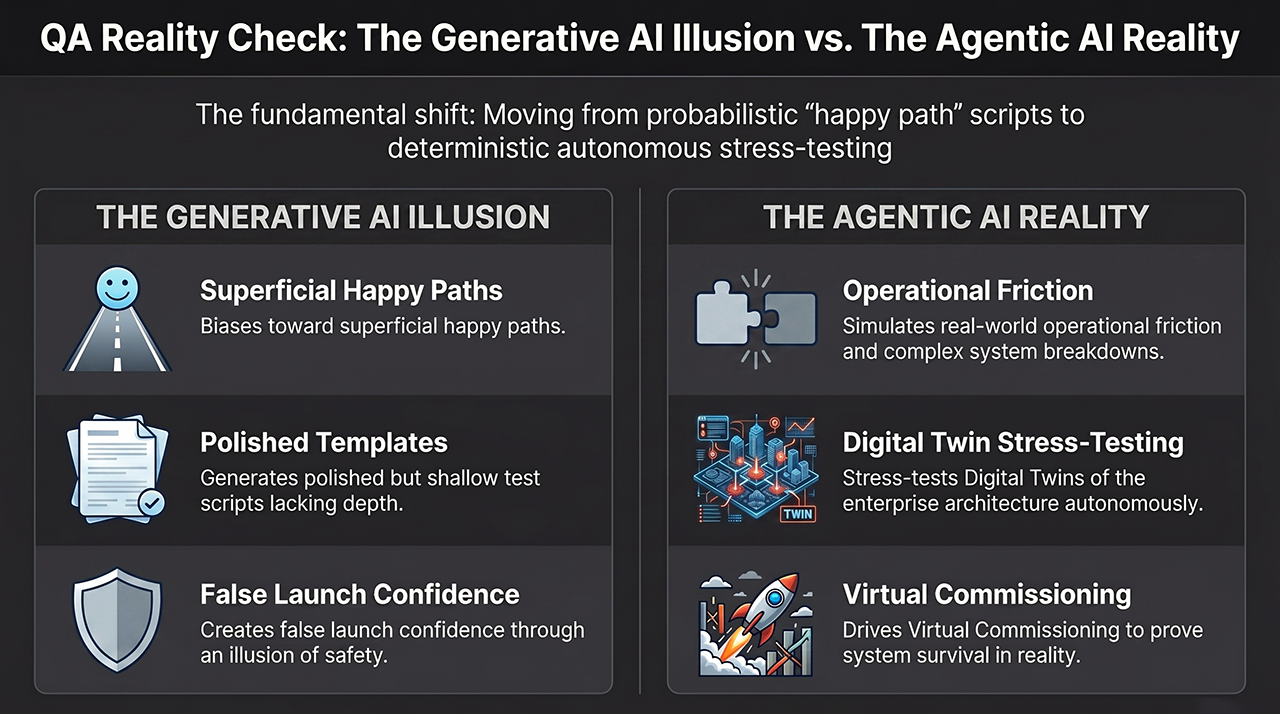
Superficial QA vs. Virtual Commissioning. A visual comparison illustrating how generative AI creates a "happy path" illusion that bypasses hidden systemic failures, and how Agentic AI secures deployments by rigorously stress-testing digital twins before production.
The Launch Readiness Playbook
To elevate your career and earn the C-suite's trust, you must stop treating your launch date as a sacred, immovable object. A launch date is a target, but readiness is a gate. Deploy a rigorous Quality Assurance governance framework that structurally decouples deployment from artificial executive deadlines.
Here is your battle-tested, four-step operational playbook to cure "Go-Live" fever.
Step 1: Enforce QA as an Unbreakable Gate
You must fundamentally transition your testing phase from a reactive, manual inspection squeezed at the end of a timeline into an absolute safeguard. You do this by enforcing Quality Assurance (QA) Gates. A QA Gate is a formal, non-negotiable project checkpoint where a phase cannot proceed unless specific, mathematical quality criteria have been met and verified. Do not allow testing to serve as a timeline buffer to compensate for earlier schedule slips. The QA Gate remains locked until the software proves it is structurally sound.
Step 2: Decouple Launch from Arbitrary Calendar Dates
Pushing a fragile system live simply to hit an arbitrary contractual deadline or artificial target date is a recipe for total collapse. Decouple your launch from arbitrary calendar dates by establishing strict, evidence-based readiness metrics before the project begins. If you breach those objective quality assurance metrics as you approach the deadline, you halt the deployment. Launching an unready system is not an urgency; it is transferring risk from the project plan directly into the live business.
Step 3: Mandate Progressive Deployment Policies
Do not sacrifice structural stability for velocity by executing a massive, monolithic global push. Instead, you must mandate strict Progressive Deployment policies. Progressive Deployment is an engineering strategy in which you release software gradually to small, controlled user groups before expanding the rollout. By releasing carefully, you create a controlled blast radius. You validate strange edge cases and user behaviors in the real world before they can fatally impact the entire global enterprise.
Step 4: Validate Operational Reality (Virtual Commissioning)
Finally, you must realize that testing software in a pristine digital sandbox completely ignores the physical workflow friction of the real world. You must test against operational reality using Virtual Commissioning. As mentioned earlier, this means rehearsing the real working environment and simulating physical and operational friction before pushing the code live. You must observe how real people interact with the new interface under stress to ensure the system survives contact with reality.
Good managers do not win respect by forcing a fragile product out the door just to appease a demanding stakeholder. They earn respect by protecting the enterprise from preventable failure, enforcing QA Gates, and deploying systems that actually generate long-term value.
If you are ready to stop gambling with your deployments and start acting like an executive practitioner. Subscribe and follow up for more insights and resources.
References
- Consortium for Information & Software Quality (CISQ). The Cost of Poor Software Quality in the US.
- PM World Journal / Comparative Research on IT Project Failure Rates.
- Industry Reliability Engineering Standards / CrowdStrike Outage Analysis.
- Software Engineering Institute / Ward Cunningham. The Technical Debt Metaphor.
- Gartner / Industry Research on Autonomous QA.