
The Hero Trap: How Resource Exhaustion Kills Your Best People
Sep 20, 2026
You know that heavy, exhausted silence on the last day of the work week, when you are preparing yourself for a nice weekend, when the board demands a miracle by the first day of the coming work week, and you have to look at your best engineers and ask them to cancel their weekend? The C-suite wants progress. The timeline is shrinking. The scope keeps growing. And somewhere in the middle of that pressure, you look at your best people and think, "If anyone can save this, they can."
So, you lean on them. You ask your strongest engineers to work through the weekend. You ask your project managers to carry out one more initiative. You ask people to skip rest, delay holidays, and absorb pressure the organization failed to plan for.
And when they somehow pull it off, the company calls them heroes.
But here is the hard truth: if your project only survives because your best people sacrifice their health, your delivery model is already broken. That is the Hero Trap. It is the dangerous belief that extraordinary human effort can compensate for weak executive planning, unrealistic scope, and poor resource governance.
The numbers reveal exactly how unsustainable this is. Recent data from the Project Management Institute (PMI) shows that 50 percent of project managers experience critical burnout, largely because 85 percent are forced to manage multiple projects concurrently. Furthermore, PMI data reveals that relying on this heroic human effort to bridge architectural gaps contributes directly to a 19 percent outright cancellation rate for large IT projects.
On the engineering side, a recent Daily.dev survey found an alarming 83 percent of software developers are experiencing critical burnout. Treating these engineers as expendable resources is a massive financial liability; replacing a single burned-out developer costs an organization between 50 percent and 200 percent of their annual salary.
Burnout is not just a human issue. It becomes a severe financial risk and a leadership failure when it becomes normalized.
A Quarter-Billion Dollar Governance Failure
Let me walk you through the hidden truth of how relying on individual brilliance systematically masks structural collapse. To see how destructive the Hero Trap can become at the enterprise level, look at the Australian Securities Exchange (ASX).
The ASX launched a highly ambitious program to replace the country’s core financial clearing and settlement infrastructure with advanced distributed ledger (blockchain) technology. The intent was bold. But an independent audit conducted by Accenture revealed a total failure of corporate governance.
Because the program lacked standard modular frameworks, a siloed team of hyper-specialized engineers had to custom-build complex transactional logic from scratch. As deadlines slipped repeatedly between 2021 and 2023, leadership did not address the underlying governance problem. Instead, they continued relying on these technical "heroes" to solve mathematically impossible architectural bottlenecks under extreme regulatory scrutiny.
The organization kept asking human beings to absorb structural failure. But individual brilliance cannot rescue a project that lacks realistic governance. The development team's cognitive exhaustion mirrored the project's technical exhaustion. Ultimately, the initiative was paused indefinitely after seven years of continuous development, resulting in a staggering $250 million AUD outright financial write-down.
What Hostile Environments Taught Me About Human Limits
I learned the true cost of resource exhaustion while managing megaprojects in incredibly hostile environments.
I spent years working on highly complex projects in Saudi Arabia, commuting for hours each day across the causeway from Bahrain. Later, in Iraq, my commute involved traveling weekly from Dubai to Basrah, wearing bulletproof vests and spending hours in uncomfortable armored vehicles. The sheer complexity of the project work was already immense, but adding that extreme physical and psychological fatigue threatened to break the team.
We realized that extreme stress happens, but it becomes catastrophic when it becomes the organizational norm. I had to institute strict rules, actively forcing my teams to take short rest periods and mandatory long vacations. I didn't just do this for morale; I did it because protecting your workforce's health is the only way to guarantee long-term business continuity.
That experience taught me a principle I still believe deeply in: true leaders do not demand endless heroism from their people to meet unrealistic schedules. If your project needs your best engineer to work 80-hour weeks just to hit a milestone, you have not solved the problem. You have converted poor planning into Technical Debt.
Technical Debt is the hidden cost created by taking structural shortcuts. In this context, the debt is not only in the code but also in morale, judgment, resilience, and long-term team capacity. And that debt will eventually come due.
AI Task Routing Can Automate Burnout
This brings us to the biggest illusion in resource management today. You might think Artificial Intelligence is the magic bullet to fix your team's burnout, but here is the twist: Generative AI isn't rescuing your people; it is simply automating their exhaustion. Today, overwhelmed project management offices are desperately hoping Artificial Intelligence will magically solve their capacity problems.
The Trend: PMI reports that 51 percent of project professionals are now using AI to manage projects, primarily for basic task automation, ticket routing, and meeting scheduling.
The Illusion vs. Reality: While generic AI saves administrative time, relying on it to fix burnout creates a dangerous illusion of safety. Basic AI task-routing algorithms treat human productivity exactly like server load balancing. When AI automatically load-balances human resources based on superficial ticket-completion metrics, it invariably penalizes your most competent employees.
High performers finish their tasks quickly. Because they close tickets fast, the AI aggressively assigns them even more work to maintain "optimal" utilization. If your intake process is broken, generic AI does not fix it; it simply digitizes chaos, accelerating your best people's path to severe burnout.
The Tangible Future: It relies on Agentic AI to objectively track enterprise-wide capacity. Agentic AI will act as an autonomous governance layer, actively monitoring team workloads and structural limits. Instead of just assigning more tickets, it will mathematically block C-suite project intake requests that exceed established human capacity limits.
The Sustainable Capacity Playbook
If you want to earn the respect of both the C-suite and your delivery teams, you must stop treating human endurance as a limitless, elastic resource. Capacity is not a motivational issue; it is a governance issue.
Here is your battle-tested, four-step operational playbook to dismantle the Hero Trap.
Step 1: Overhaul the Project Intake Process
The first discipline is to stop automatically letting every new idea enter the delivery pipeline. You must establish a formal Project Intake Governance tollgate. Project Intake Governance is a strict, standardized evaluation process where new requests are formally reviewed, scored, and approved based on actual business value and available capacity. It is the guarded front door to your team’s time. Mandate that no new project can pass through this tollgate without a precise map of the exact human hours required to execute it.
Step 2: Deploy Resource Histograms
When communicating team exhaustion to the C-suite, remove emotion from the conversation. Do not rely on complaints to communicate burnout. You must utilize Resource Histograms. A Resource Histogram is an objective, visual bar chart that maps the actual availability of your specific team members against the hours required for parallel projects. By putting a Resource Histogram on the boardroom screen, you transition the conversation from a subjective complaint about stress into an objective, mathematical constraint.
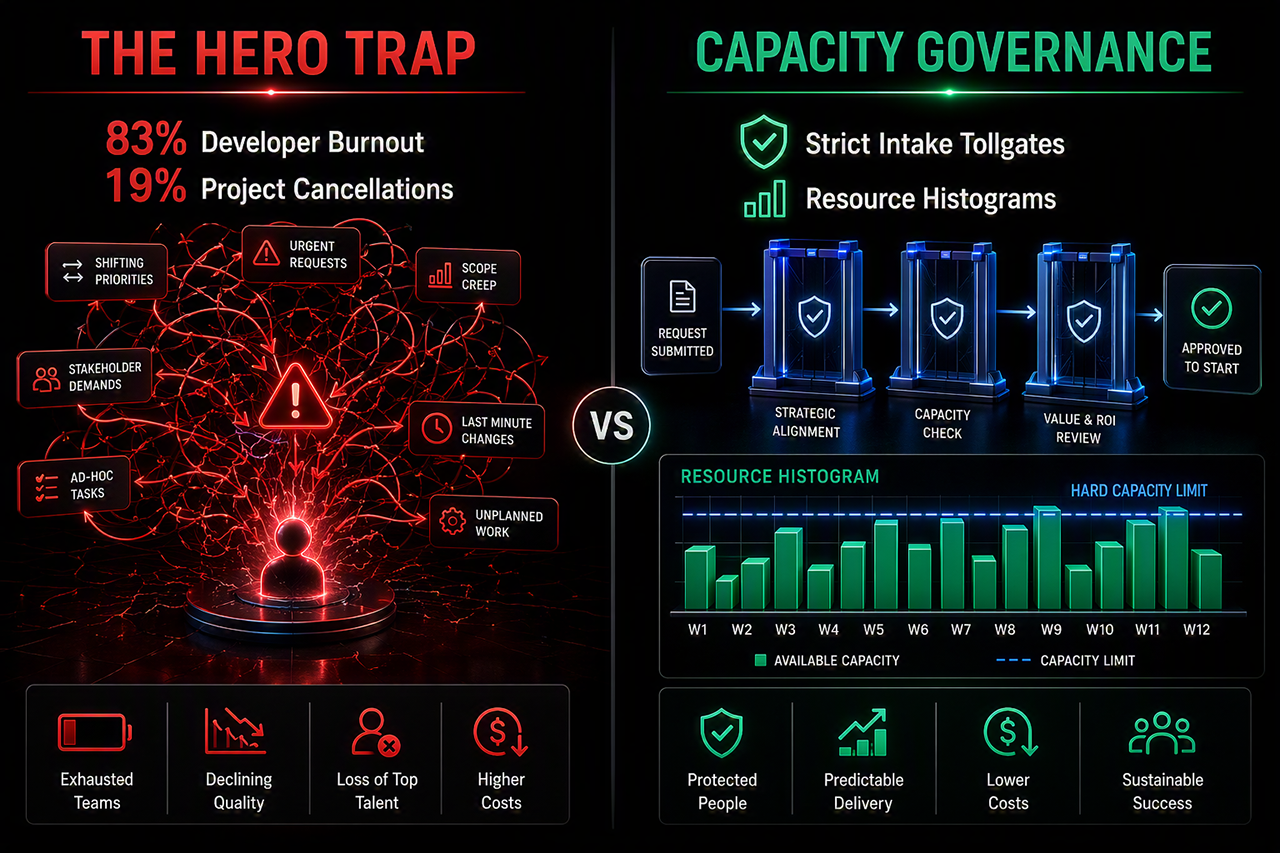
The Hero Trap vs. Capacity Governance. An operational matrix contrasting the systemic failure and high burnout rates caused by unstructured project intake against the sustainable, objective delivery achieved through strict Intake Tollgates and Resource Histograms.
Step 3: Reject "Heroic" Culture
You must recognize that the "Hero Trap" is a direct, visible symptom of a broken project intake system. It is not a badge of honor to have a team working through the night; it is a giant red warning sign. You must decouple your critical project dependencies from single points of human failure. Cross-train your teams immediately, document critical knowledge, and intentionally build buffer time into your schedules to account for rest. Reward engineers for building sustainable systems, not for pulling all-nighters to fix preventable emergencies.
Step 4: Say "No" Using Quantifiable Metrics
The ultimate test of a mid-level manager's readiness for the C-suite is their ability to push back against unreasonable executive demands using data. When an executive brings a new, urgent priority to your desk, do not simply absorb the pressure and pass it down to your team. Use your Resource Histograms to force a data-driven trade-off. Tell them clearly: "If we want this new priority delivered by Q3, the math dictates we must formally pause or deprioritize this other existing initiative."
Good managers do not win respect by promising impossible results and crushing their workforce to deliver them. They earn respect by enforcing operational realism, protecting their enterprise's most valuable assets, and building sustainable systems that deliver consistent value.
References
- Daily.dev / Developer Burnout Survey. (Source for the 83% software developer burnout rate and the 50% to 200% annual salary replacement cost).
- Project Management Institute (PMI) / Pulse of the Profession. (Source for the 50% project manager burnout rate, the 85% over-allocation metric for PMs running multiple projects, the 19% project cancellation rate for large IT projects, and the 51% AI adoption rate for basic task management).
- Accenture Independent Audit / ASX Governance Filings. (Source for the Australian Securities Exchange (ASX) CHESS blockchain replacement failure, the extreme technical burnout, the seven-year delay, and the $250 Million AUD financial write-down).