
The Planning Paradox: Why We Love to Build but Hate to Plan
Sep 20, 2026
You know that intense pressure right after a massive project kicks off? The board wants to see code deployed, infrastructure built, and deliverables moving across your dashboard instantly. As a driven technology leader, you want to deliver that momentum. But when impatient stakeholders are breathing down your neck for visible results, hitting the brakes to write process documentation and debate risk contingencies feels like you are actively stalling the work. But rushing into execution to appease your leadership team is a trap that will inevitably derail your career.
Recent data from Oxford Global Projects reveals a brutal reality: a staggering 99.5 percent of large projects fail to deliver as promised on time, within budget, and in line with expected benefits. This massive failure rate is heavily driven by extreme customization and poor upfront documentation. The root cause of this operational disaster is a cultural phenomenon known as the "Planning Paradox". The Planning Paradox occurs because technical teams harbor a deep, inherent aversion to planning and treat process documentation and estimation as low-priority, non-core activities.
Research published by the Harvard Business Review demonstrates that this poor planning and scope expansion turn 1 in 6 IT projects into "black swan" anomalies. A black swan event is an unpredictable, catastrophic outlier; in IT, these specific projects suffer an average cost overrun of 200 percent and a schedule overrun of nearly 70 percent. When these poorly planned projects inevitably hit trouble, they suffer from an "escalation of commitment". This behavioral trap leads teams to irrationally double down on a dysfunctional course of action despite repeated negative feedback, ultimately driving extreme cost overruns.
A £2.3 Billion Miscalculation
Let me walk you through the dangerous path of skipping documentation in the name of speed, which systematically destroys a project's foundation. To understand how catastrophic this aversion to planning can be, we must examine the United Kingdom NHS Test and Trace System. Launched during the height of the 2020 pandemic, this was a massive digital and operational undertaking designed to track viral transmission across the population. The delivery teams skipped rigorous architectural documentation and behavioral scenario planning in the name of speed, choosing the illusion of speed over accurate planning.
The digital modeling relied on fundamentally unrealistic assumptions, overestimating rational public compliance while failing to model the socio-economic friction of everyday use. The National Audit Office (NAO) explicitly identified "chronic optimism bias" at the project's core. Rather than stopping the build to fix the flawed logic in the software architecture, project planners merely threw a staggering £2.3 billion into the business case as a financial "optimism bias" buffer. In simple terms, they added money to absorb the consequences of poor planning rather than repairing the planning itself.
The outcome of this rushed, poorly documented software was entirely predictable: it could not effectively integrate fragmented data sources. The system generated tens of thousands of false-positive errors and completely failed to reach the critical mass required for success. The National Audit Office reported that the project wasted £155 million strictly on non-functional bespoke digital services and generated £807 million in negative capital budget values.
The Power of Complementary Strengths
I know this trap intimately, but I also know that it can be systematically dismantled. Over my years of directing hundreds of projects, I realized that the root cause of the 'Planning Paradox' isn't a lack of skill, but human nature. I have worked with brilliant PMs—some were technical doers who loved the nitty-gritty of execution, while others were natural communicators. Very few naturally loved sitting for hours thinking through alternatives, slacks, lags, and contingencies.
We all default to our comfort zones, falling victim to optimism or pessimism bias. In a recent massive program I directed, I solved this by forcing PMs out of their silos. I insisted on coupling them: a strong planner was assigned as the primary PM, partnered with a strong executor as the secondary PM, and vice versa across projects. They had to rely on each other’s complementary strengths, neutralizing individual biases and dramatically improving the whole team's performance.
This taught me a profound lesson: acknowledging our natural biases and comfort zones is the very first step to overcoming the planning paradox. If you know your team loves to build, you must engineer a system that forces them to plan.
Beyond the Hype: AI Will Not Rescue Undocumented Chaos
This brings us to the biggest illusion in project management today. You might think Artificial Intelligence is the magic bullet to skip the painful planning phase, but here is the twist: Generative AI isn't eliminating your need to plan; it is simply digitizing and accelerating your undocumented chaos.
Today, overwhelmed project teams are looking to Artificial Intelligence to bypass the friction of planning entirely.
The Trend: Teams are actively using generative AI to speed up engineering tasks, write boilerplate code, and bypass formal planning and documentation phases. It feels incredibly efficient to prompt an AI and instantly receive a code foundation, creating the illusion of rapid momentum.
The Illusion vs. Reality: The danger is believing that generating code faster eliminates the need for strict architectural planning. In reality, throwing generic AI at a poorly planned, undocumented project merely digitizes and accelerates your existing chaos. Generating unverified outputs without a baseline architecture creates compounding Technical Debt. Technical Debt is the hidden cost of shortcuts that slow future delivery, make it more fragile, and increase costs.
The Tangible Future: The true future of project governance relies on Agentic AI acting as an autonomous, unpassable "tollgate". Before allowing developers to build or release any project capital, the agentic system will autonomously enforce strict Front-End Planning (FEP) compliance. It will objectively audit your baseline architectures to ensure absolute mathematical viability, stopping flawed projects before they burn through your budget.
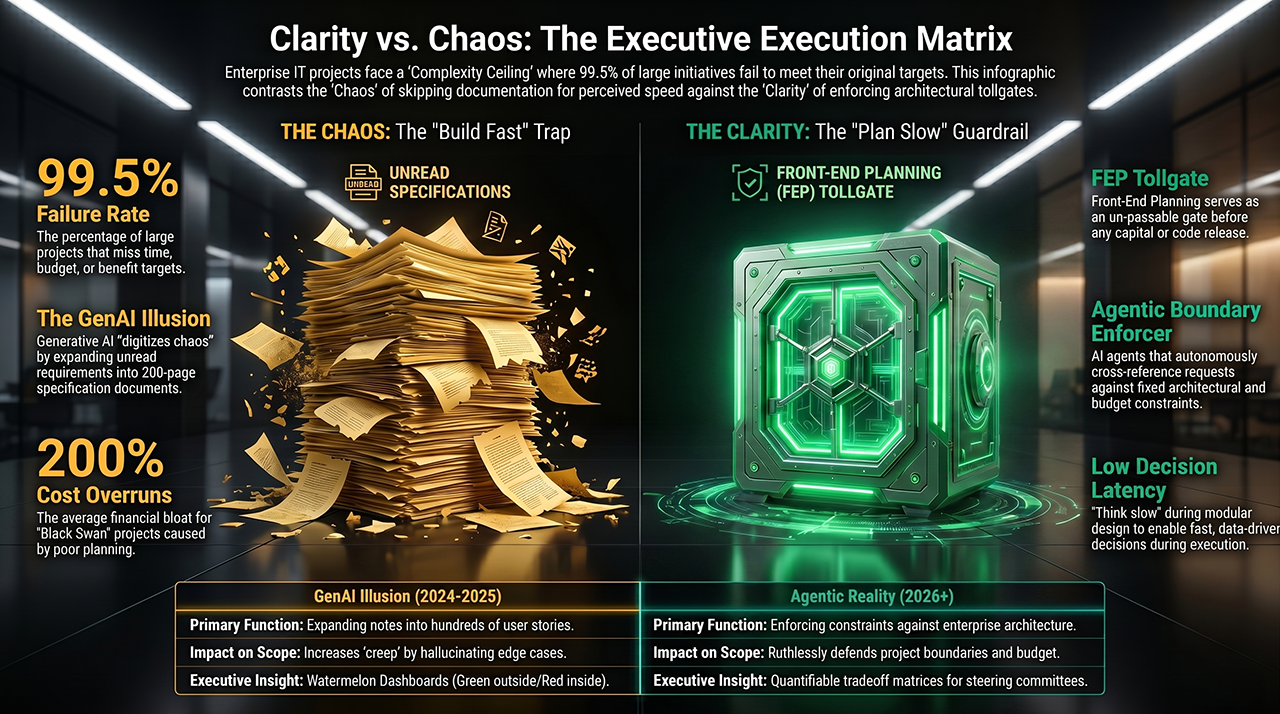
Figure 1. The Architecture of Certainty: A visual matrix demonstrating how organizations must transition from the "digitized chaos" of Generative AI speed traps to autonomous Agentic AI tollgates that enforce strict Front-End Planning (FEP), extreme modularity, and low decision latency.
The Executive Execution Playbook
To elevate your career and earn genuine respect from the C-suite, you must stop treating planning as an administrative chore. Planning is the work that makes the build survivable. You must implement a rigorous, data-driven framework that neutralizes human optimism bias and strictly separates planning from execution.
Here is the exact, four-step playbook you must use to take control of your project's planning phase.
Step 1: Enforce Front-End Planning (FEP) as a Tollgate
You must establish Front-End Planning (FEP) as an unbreakable rule in your project lifecycle. Front-End Planning is a rigorous methodology in which you document all architectural baselines and behavioral scenarios in detail before development begins.
A Baseline is the formally agreed starting point for scope, architecture, schedule, or cost—the reference point against which later changes are judged. Without a verified baseline, every subsequent decision becomes subjective and political. As a leader, you must establish FEP as an unpassable tollgate for your stakeholders. Do not authorize the release of project capital, and do not allow your engineers to write a single line of code, until this documentation is formally verified.
Step 2: Deploy Reference Class Forecasting (RCF)
You cannot rely on your team for accurate estimates, because humans are biologically wired to underestimate risk and overestimate speed. To counter human "optimism bias," you must implement Reference Class Forecasting (RCF).
Reference Class Forecasting is a scientific method that predicts timelines and budgets not by asking the team for estimates, but by comparing your initiative against the actual, historical outcomes of similar past projects. In simple language, it replaces hopeful guessing with historical reality. By using RCF, you remove emotion and guesswork from the room, delivering mathematically sound forecasts the C-suite can trust.
Step 3: Mandate Strict Architectural Modularity
You must actively avoid the temptation to build highly customized, bespoke monoliths that are impossible to untangle later. Instead, you must design your system with strict Architectural Modularity.
Architectural Modularity means building the architecture using small, predictable, and independent units to minimize integration risks. In plain language, you break the system into parts you can isolate, test, fix, or replace without destabilizing the whole thing. This is like how successful solar PV farms are built: by linking thousands of identical, predictable solar panels rather than building one massive, untested machine. If one modular component fails during your build, you can isolate and replace it without bringing down the entire enterprise infrastructure.
Step 4: Shift to "Low Decision Latency" Execution
You must adopt a highly disciplined, two-phased approach to speed: "think slow" during upfront planning and modular design, but once the build starts, keep decision latency low.
Decision Latency is the exact measurement of how fast a team makes decisions during the execution phase. According to the Standish Group's Decision Latency Theory, keeping this latency low, even if the decisions made are imperfect, minimizes the project's exposure to ongoing risk. You achieve this by doing the heavy thinking during the FEP phase, empowering your frontline leaders to make immediate tactical choices during the build without waiting weeks for committee approvals. Slow thinking first. Fast decisions later.
Good managers do not win respect by rushing into the build phase just to appease impatient stakeholders. They win respect by slowing the organization down long enough to establish sound baselines, forecast against reality, structure the architecture intelligently, and create the conditions for fast execution later.
References
- Harvard Business Review / Flyvbjerg. How to Make IT Less Risky. (Source for the statistic that 1 in 6 IT projects become "black swan" events suffering 200% cost overruns and 70% schedule overruns, and the application of Optimism Bias to IT project forecasting).
- Oxford Global Projects. Megaproject Data Base & Forecasting Research. (Source for the 99.5% megaproject failure rate, the success paradigm of building with extreme modularity akin to solar PV farms, AND the championing of Reference Class Forecasting (RCF) as the scientific method to counter optimism bias).
- National Audit Office (NAO). Test and Trace Progress Update. (Source for the £2.3 billion optimism bias buffer, the £155 million wasted on bespoke digital services, and the £807 million negative capital value of the UK NHS Test and Trace failure).
- The Standish Group. CHAOS Report / Decision Latency Theory. (Source for the framework that low decision latency during project execution is a primary predictor of success).
- Behavioral Science / Academic Literature (e.g., Barry Staw). The Escalation of Commitment. (Source for the psychological framework describing the behavioral trap where teams irrationally double down on a dysfunctional course of action despite continuous negative feedback).