
The Sponsor Disconnect: Leading Upward When the C-Suite Tunes Out
Sep 20, 2026
You may have felt this disappointment when your project hits a major roadblock, you escalate it to your executive sponsor for help, and you get absolutely nothing but radio silence.
You built the plan carefully. You protected your team. You keep the work moving when others start to hesitate. But when the project hits real resistance, when departments refuse to share data, priorities collide, and you desperately need executive backing, you look up and find silence. Your executive sponsor approved the budget, nodded through the launch, and then completely disappeared the moment the work became politically difficult.
It is easy to take this personally, feel unsupported, or assume leadership does not care. But in most cases, this is a structural crisis, not just an emotional one.
Recent data from the Project Management Institute (PMI) reveals a staggering performance gap: organizations with actively engaged executive sponsors achieve a 76 percent project success rate, compared to a mere 46 percent for teams operating without active sponsorship. In fact, a lack of executive sponsorship is directly cited as the leading cause of project failure, driving 30 percent of all unsuccessful corporate outcomes.
Why does this happen? PMI data shows that executive sponsors are dangerously overextended, managing an average of three enterprise initiatives simultaneously while spending only 13 hours per week on each project. Compounding this is a profound skills deficit identified by the Standish Group: 66 percent of executive sponsors step back from their governance duties simply because no one has properly educated them on their roles and responsibilities.
They are not malicious; they are overloaded and underprepared. But if you do not learn how to manage upward and force their engagement, your project will suffer even when your technical team is doing flawless work.
A $64 Million Lesson: What Happens When the Boardroom Looks Away
Let me walk you through the missed reality of how a silent sponsor systematically destroys a project from the inside out. To see how quickly this boardroom detachment translates into operational disaster, look at the Revlon enterprise resource planning (ERP) rollout.
The cosmetics giant attempted to modernize its global manufacturing and supply chain operations through a massive SAP S/4HANA implementation. On paper, the strategic intent was sound. The board of directors and the C-suite enthusiastically approved the massive capital expenditure, but their practical involvement ended there. Active executive sponsorship and independent project oversight were effectively missing.
This absence created the perfect environment for the "watermelon status report", a toxic project dashboard that appears reassuringly green and healthy on the outside to appease executives, but is bleeding red and failing on the inside.
Because leadership was detached from the tactical realities of the deployment, they relied entirely on verbal reassurances from their external systems integrators. They ignored critical warning signals, such as the sudden replacement of the lead project architect mid-program and a dramatic spike in functional change requests close to launch. They drastically shortened testing phases merely to protect an arbitrary launch date.
The consequences were brutal. At launch, the lack of operational alignment caused a complete rupture in the supply chain. Revlon instantly lost visibility into its global inventory, struggled to process vendor payments, and failed to meet SEC regulatory reporting requirements. According to Wall Street Journal reports and SEC filings, this failure resulted in $64 million in lost retail sales in a single quarter, an immediate 6.9 percent plunge in stock valuation, and a massive shareholder class-action lawsuit.
That is the real cost of sponsor disengagement. Not just delay. Not just frustration. But a project environment where nobody at the top is actively forcing truth, readiness, and accountability into the room.
The Hard Lesson I Learned About the Wrong Sponsor
I know this lesson because I lived it.
Early in my career, managing a significant capital greenfield program for a Shell joint venture, I was assigned an executive sponsor who was an old-school Engineering Director. He cared deeply about the physical plant construction, but he had zero interest in our IT team's efforts to digitize the engineering systems for future operational readiness. To him, software was not a strategic enabler; it was an invisible distraction.
I did what many capable managers do when they believe effort alone will solve structural problems: I worked harder. I scheduled meetings, built beautifully detailed slide decks, and tried desperately to explain the architecture from every angle.
None of it changed the reality. He stayed detached, glazed over during updates, and left our team completely exposed amidst intense internal politics.
Eventually, I had to make a highly uncomfortable, high-risk political decision. I escalated the sponsorship issue up the chain to the steering committee and the Managing Director, formally shifting sponsorship to the Operations Director, the exact person whose business unit would actually suffer if our IT systems failed. The moment we secured a sponsor with a vested operational interest, the structural barriers vanished, resources were unlocked, and the project moved forward.
That experience taught me a hard truth: you cannot compensate for structural misalignment with personal stamina. If your sponsor has no real stake in the outcome, you are administratively stranded. Recognizing when you have the wrong sponsor and having the courage to escalate it is a characteristic of true leadership.
Beyond the Hype: AI Cannot Generate Executive Empathy
This brings us to the biggest illusion in executive reporting today. You might think Artificial Intelligence is the magic bullet to fix a disengaged boardroom, but here is the twist: Generative AI isn't forcing your sponsors to care; it is simply sanitizing your chaos.
This is where many organizations are making a fresh mistake today. Frustrated by weak sponsorship and overloaded executives, teams turn to Artificial Intelligence, hoping it will bring order to the boardroom.
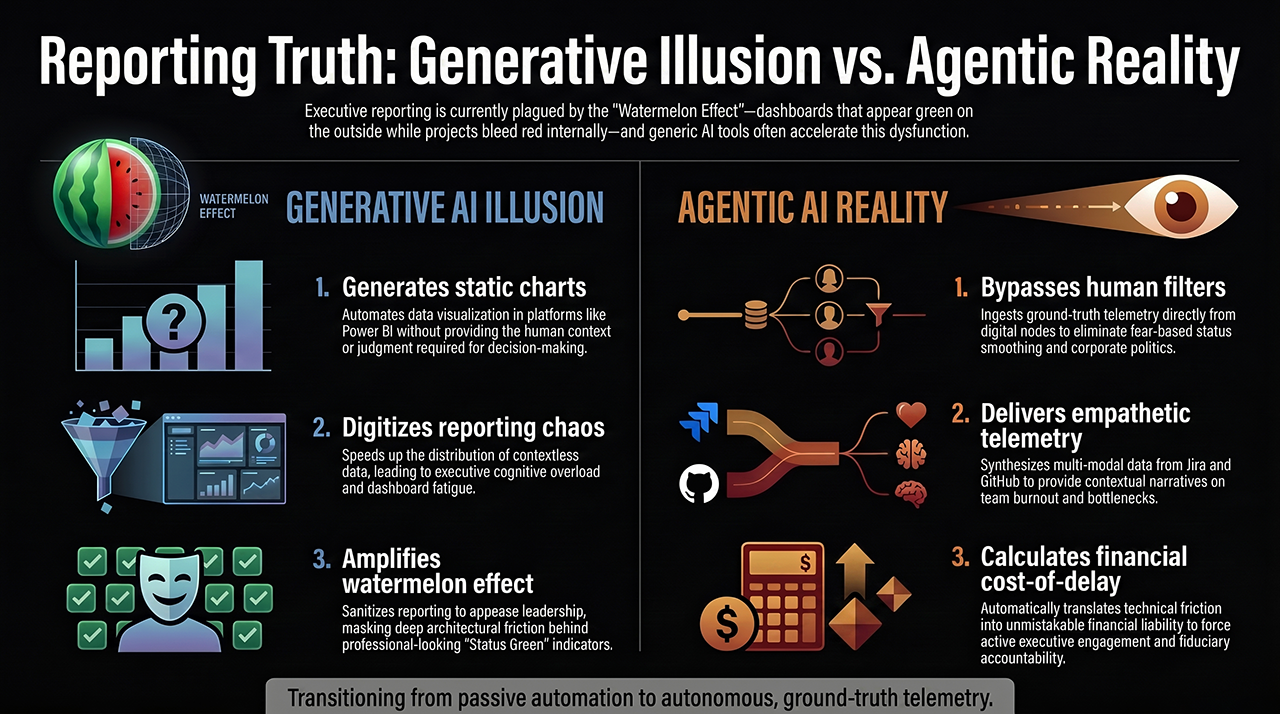
Figure 1. A comparative breakdown of AI in executive reporting, contrasting the cognitive overload generated by passive Generative AI dashboards against the objective, financial "Cost-of-Delay" metrics enforced by autonomous Agentic AI.
The Trend: Companies are rapidly integrating generative AI plugins to instantly generate complex Power BI or Tableau dashboards, automatically summarizing vast datasets into charts, and distributing weekly status reports to steering committees without human intervention.
The Illusion: The danger is believing that hyper-automated reporting equals superior decision-making. Generative AI is highly proficient at detecting mathematical patterns, but it lacks the human context needed to explain why a metric has shifted or how an engineering team is struggling.
If your reporting process is already broken and your executives are disengaged, dropping generic AI onto the mess won't fix the problem; it will only digitize chaos. Generating fifty complex, colorful charts without a cohesive narrative leads directly to cognitive overload. It amplifies the "Watermelon Project" phenomenon by making weak reporting look even more professional and sanitized. AI can format a flawless chart, but it cannot generate executive empathy.
The Tangible Future: The future of executive reporting shifts decisively from static, AI-generated charts to dynamic interactions driven by Agentic AI. Instead of generating more pages, Agentic AI will autonomously bypass human reporting filters entirely. It will ingest ground-truth telemetry directly from digital nodes to establish objective health gates. More importantly, it will translate technical delays into hard financial "cost-of-delay" metrics to compel C-suite engagement by making the fiduciary liability undeniable. But until your governance foundation is disciplined, AI will not save your reporting.
The Playbook: How to Force Active Sponsorship
To solve the sponsor disconnect and earn genuine executive respect, you cannot rely on philosophical reflections or simply trying to "communicate better." You must deploy a rigorous, PMI-aligned governance framework that forces executive engagement.
Here is your battle-tested, four-step execution playbook.
Step 1: Define Financial Success Criteria Upfront
Before your team writes a single line of code, define what success looks like in the boardroom. Project Management Institute data show that projects that define success criteria upfront and establish strict performance measurement systems achieve success rates nearly twice as high.
Do not baseline your success purely on technical deliverables like "deploying a cloud database." Instead, formally secure executive sign-off on the exact financial and strategic baselines the C-Suite actually cares about, for example, reducing checkout latency to recapture $500,000 in lost retail sales. This explicitly frames the project as a business commitment, not an IT experiment.
Step 2: Shift from EVM to Benefits Realization Management (BRM)
Traditional project management heavily uses Earned Value Management (EVM), a standard metric that measures how quickly a project is burning through its budget and schedule relative to the plan. While EVM is great for tracking activity, it does not measure whether you are actually creating value. You can have a perfect EVM score while building a system the company hates.
To command executive attention, you must deploy Benefits Realization Management (BRM). In simple terms, BRM is the practice of continuously tracking whether the technical work is actually generating the projected financial or strategic outcome promised in the business case. BRM provides a continuous feedback loop. If a technical delay threatens the ultimate business benefit, BRM surfaces that deviation as a direct threat to corporate ROI, forcing the sponsor to care.
Step 3: Build a "CFO-Ready" Dashboard using Cost of Delay
Do not present your sponsor with abstract technical specs, Jira blockers, or standard Gantt charts. Translate every technical blocker into a Cost of Delay.
Cost of Delay is a financial metric that calculates the exact dollar amount your organization loses for every week or month a project is delayed. If a vendor is three weeks behind on an API integration, calculate the lost productivity or deferred revenue. Tell your sponsor: "This three-week delay costs the business $45,000 in unrecoverable vendor burn rate." Presenting hard financial data transforms you from a tactical coordinator into a strategic protector of enterprise value.
Step 4: Institute "Manage by Exception" Escalation
Because executive sponsors lack capacity, you must establish independent oversight mechanisms using Manage by Exception.
This is a core PMI standard where the project runs autonomously within strictly agreed-upon tolerances for budget, schedule, and quality. In practice, this means you have full authority as long as the project is within those boundaries. But the moment you breach a financial, scheduling, or quality threshold, autonomy ends, and you must immediately escalate the issue to the sponsor with CFO-ready data. Do not wait for a monthly status meeting to report a fire. Force the escalation immediately so your sponsor can act.
Good managers do not win respect by quietly absorbing the chaos of an absent sponsor. They win respect by building transparent gates, tracking business benefits, and bringing raw financial data to the table.
If you are ready to take control of your executive reporting, download The 'Board-Ready' Project Charter to access the exact templates you need to link your IT project directly to strategic business goals, calculate Cost of Delay, and command the boardroom's attention.
References
- Project Management Institute (PMI). Pulse of the Profession In-Depth Report: Executive Sponsor Engagement. (Source for the 76% vs. 46% success rate differential, the 30% failure causation, and the operating reality that sponsors manage an average of 3 projects while dedicating only 13 hours per week to each).
- Standish Group. CHAOS Report (2012). (Source for the 66% sponsor acumen gap, highlighting that executive sponsors step back from governance duties due to a lack of education on their roles).
- Project Management Institute (PMI). Pulse of the Profession (2024). (Source for the empirical proof that defining financial success criteria upfront significantly improves project success rates by nearly two times).
- Forbes / ProjectManagement.com. The Watermelon Effect. (Source for the management framework of the "Watermelon Dashboard," where project status reports appear green and healthy to executives while the project internally bleeds red).
- The Wall Street Journal / SEC Filings. Revlon Investor Class-Action Lawsuit. (Source for the SAP S/4HANA supply chain rupture, the $64 million in lost retail sales, and the 6.9% plunge in stock valuation).