
The Coaching vs. Fixing Paradox: Stop Solving Your Team's Problems
Nov 08, 2026
The Hidden Cost of the Hero Manager
Professionals are historically promoted into leadership positions because of their technical brilliance as individual contributors. When an engineer, analyst, or operations specialist excels at diagnosing complex problems and delivering swift fixes, executive leadership rewards them with a management title. Yet, once they step into executive responsibility, the very impulse that drove their early career success—stepping in to personally solve every operational bottleneck—becomes their greatest operational liability.
When a manager acts as an omniscient 'Hero Fixer,' they create an immediate dependency loop. Team members quickly learn that bringing an unsolved problem to the manager's desk results in the manager taking over the task, dispensing the exact solution, or rewriting the deliverable themselves. While this gives the manager a short-term dopamine burst, it systematically starves the team of problem-solving autonomy, stifles professional growth, and creates a severe operational bottleneck.
Modern organizational research has starkly documented the empirical consequences of micromanagement and Hero Fixer syndrome. According to a comprehensive Gallup meta-analysis, micromanagement and limited employee autonomy are primary drivers of severe managerial burnout. Leaders who act as continuous problem-solvers absorb unsustainable operational loads, doubling their personal burnout risk compared with coaching leaders.
Furthermore, the World Health Organization officially classifies a lack of job autonomy—driven by micromanagement, rigid approval chains, and managerial over-control—as a primary workplace stressor directly causing chronic fatigue, mental exhaustion, and systemic employee disengagement.
Gallup data indicates that organizations fail to select the right managerial talent 82% of the time. According to a longitudinal study published by Leadership IQ, 46% of newly hired leaders fail within 18 months—with 89% of those failures driven by emotional and behavioral misalignments, such as an inability to transition from technical 'doer' to behavioral coach, rather than technical incompetence.
At the enterprise level, research from the Harvard Business Review finds that 67% of well-formulated corporate strategies fail because of disconnects between executive intent and operational delivery. Gallup's 2025 Global Workplace Report estimates manager disengagement costs $438 billion annually in lost productivity, while frontline disengagement drains roughly 34% of annual employee salaries—about $1 million in wasted capacity each year for an average 50-person team.
Conversely, research published in the Journal of Organizational Behavior shows that organizations that actively embed coaching and servant-leadership principles achieve up to 77% higher employee engagement, 50% lower turnover rates, a 33% increase in organizational commitment, and a 67% measurable improvement in creative problem-solving and innovation.
From Know-it-Alls to Learn-it-Alls: Microsoft's Cultural Revival
To understand how shifting from a fixing mindset to a coaching culture transforms an enterprise, look at Satya Nadella's cultural revival at Microsoft.
When Nadella assumed the CEO role in 2014, he inherited an enterprise crippled by internal silos, hyper-competitive politics, and a pervasive 'Know-it-all' culture. The company's notorious 'stack ranking' performance management system forced managers to grade employees on a rigid bell curve. This incentivized managers to act as unilateral fixers, hoard top talent, override subordinate decisions, and maintain tight control to protect their team's rankings. Managers evaluated their worth by having all the answers, resulting in risk aversion, stifled engineering innovation, and deep organizational cynicism.
Partnering with Chief Human Resources Officer Kathleen Hogan, Nadella orchestrated a massive cultural recalibration across 130,000 employees, shifting Microsoft from a 'Know-it-all' culture to a 'Learn-it-all' culture. Managers were comprehensively retrained to abandon their legacy roles as omniscient technical problem-solvers. Instead of dispensing immediate directives, managers were taught to adopt a coaching mindset anchored in curiosity, empathy, and active listening.
Leaders were evaluated on how effectively they empowered their teams through open-ended questioning and active coaching rather than technical intervention. By making it safe to experiment, learn, and fail, Microsoft dismantled internal silos, retained elite engineering talent, and drove trillions of dollars in market capitalization growth.
Lessons from the Field: Intentional Delegation and the Day-One Coaching Contract
From the very beginning of my career, I was deeply fascinated by the study of leadership. Long before managing large cross-functional teams, I actively sought out books, research, and behavioral models on human dynamics, delegation, and organizational psychology. When I joined Shell, this foundation expanded significantly—I was exposed to rich, highly detailed literature and structured executive development on people management that permanently shaped my core leadership philosophy.
I learned early on that true executive leadership is never about showing off technical brilliance or being the smartest person in the room. It is about knowing how to rely on your team—understanding precisely when to delegate, when to offer coaching, and when to step in and assert direct control. You take ultimate ownership of operational outcomes, but you achieve those outcomes by enabling, trusting, and growing the people around you.
Because of this core belief, I made it a strict personal habit to establish a 'Day-One Coaching Contract' with every team I led. On my first day with a new team, I would clearly communicate my operating style, expectations, and boundaries:
"My job is to give you the space, support, and cover you need to learn, experiment, and innovate. You should never hide an issue or fear bringing bad news to my desk. But there is one condition: when you bring a problem, come prepared with proposed solutions and ideas for improvement."
By setting these expectations upfront, I created an environment of deep psychological safety paired with high personal accountability. People knew they could bring me bad news, but they also knew they were expected to help solve it. My team knew I was there to coach, mentor, and protect them from corporate noise, but they also knew they owned the thinking. This approach liberated my executive bandwidth to focus on strategic alignment, eliminated micromanagement, and built confident, highly autonomous teams that consistently delivered under high-stakes conditions.
Behavioral Scaffolding for Autonomous Teams
To transition successfully from a technical fixer to a transformational coach, adaptive leaders anchor their practice in established organizational psychology:
John Whitmore's GROW Coaching Model: Defines the four sequential stages of an empowering coaching conversation: Goal (clarifying what the employee wants to achieve), Reality (examining the current situation and root-cause friction without judgment), Options (requiring the direct report to generate at least three distinct solutions rather than expecting the manager to provide one), and Will / Way Forward (locking in clear ownership, specific action steps, and accountability).
Hersey-Blanchard Situational Leadership: Teaches leaders to modulate their supervision based on task readiness—reserving directive S1 (Telling) and S2 (Selling) styles strictly for acute operational crises or brand-new team members, while applying supportive S3 (Participating) and S4 (Delegating) coaching to capable staff.
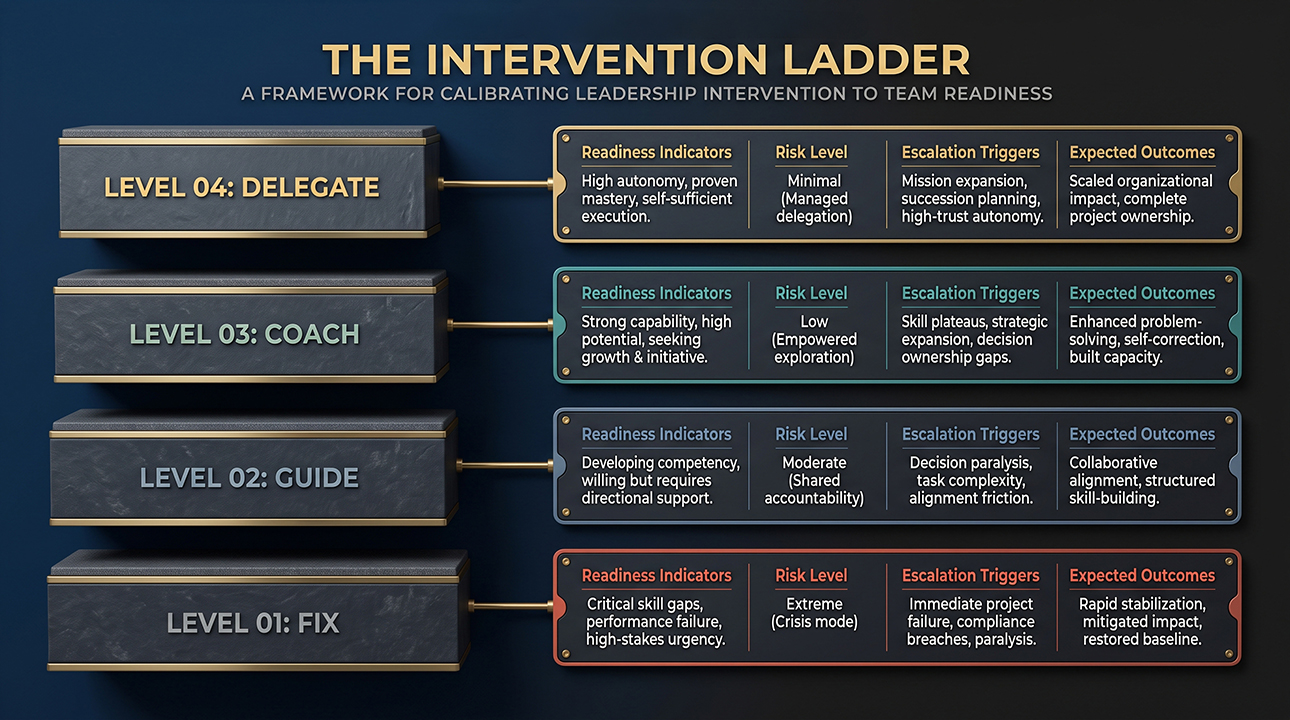 Figure 1. The Intervention Ladder: Adaptive leaders do not rely on a single management style. They dynamically calibrate their level of intervention, from hands-on fixing during a crisis to high-trust delegation for mature experts, based on the employee's task readiness and the operational risk.
The Full Range Leadership Model (FRLM): Reminds us that a firm Transactional Floor (clear role scope, decision guardrails, performance metrics) must precede a Transformational Ceiling (coaching, intellectual stimulation, and long-term career mentoring).
Leader-Member Exchange (LMX) & Psychological Safety: High-trust interpersonal relationships create the psychological safety (Amy Edmondson) team members need to bring unsolved problems to their leader without fearing the leader will take over the task or penalize them for incomplete answers.
Beyond the Hype: Elevating Human Leadership Above AI Troubleshooting
In today's rapidly evolving corporate environment, organizations are giving direct reports AI coding co-pilots, automated troubleshooting bots, and technical assistants to solve daily operational bottlenecks.
Here is the Agentic Reality Check: Managers whose sole organizational value was acting as a 'technical fixer' or 'answer dispenser' are rapidly becoming obsolete. Generative and Agentic AI systems can troubleshoot code, analyze complex financial models, and debug operational workflows faster than any human manager. If a manager's leadership is limited to technical fixes, their role becomes redundant. Dropping AI onto broken human leadership merely digitizes organizational chaos.
As Agentic AI increasingly handles much of the transactional work associated with technical troubleshooting and routine fixes, human managers must elevate into pure Transformational Coaches. The manager's true value shifts to coaching human behavior, building emotional resilience, developing strategic judgment, and navigating complex organizational dynamics, areas where AI can't replace nuanced human leadership.
The 5-Step Coaching & Delegation Playbook
To translate this philosophy into daily operational practice, implement the following 5-step playbook:
Step 1: Risk-Based Task Segmentation
Segment all incoming operational issues into Category A (existential/high-risk crises where margin for error is zero, requiring S1 Directing) vs. Category B (routine friction, requiring S3/S4 Coaching).
Step 2: Open-Ended Inquiry Protocol
When appropriate, encourage employees to bring one or more proposed solutions before discussing a problem. The goal is not to test them. The goal is to strengthen independent thinking. Squelch the urge to provide immediate answers.
Step 3: Deploy 3-Step Coaching Dialogue
Execute the GROW framework: Phase 1 Reality Check ('What structural gaps caused this?'), Phase 2 Option Generation ('Which solution would you pick?'), Phase 3 Commitment ('What support do you need?').
Step 4: Establish Bounded Autonomy
Set explicit decision guardrails (e.g., 'You have full authority to make decisions up to $10,000 or 2 days of schedule variance without prior approval').
Step 5: Succession & Capacity Reviews
Evaluate managerial performance not by operational fires extinguished, but by team problem-solving velocity, delegation depth, and succession readiness.
A Final Thought for the Adaptive Leader
Leadership is not defined by the problems you solve personally. It is defined by the problem-solving capacity you build in others. The strongest leaders eventually become less necessary because they have spent years making other people more capable.
When you step in to fix every technical glitch, you gain a fleeting moment of control at the expense of your team's long-term growth. When you coach your people to navigate complexity, you liberate your bandwidth and build a resilient, high-performing organization.
This week, establish your own Day-One Coaching Contract with your team. Tell them clearly: 'I am here to coach, support, and protect you—but you own the solutions.' Resist the urge to give immediate answers; ask open-ended questions, and watch your team's autonomy flourish.
References
- Sull, D., Homkes, R., & Sull, C. (2015). Why strategy execution unravels. Harvard Business Review, 93(3), 58–66.
- Leadership IQ. (2024). Why new hires fail: 18-month longitudinal leadership study. Leadership IQ Press.
- Gallup. (2025). State of the global workplace: 2025 report. Gallup Press.
- World Health Organization. (2022). Guidelines on mental health at work. WHO Press.
- Nadella, S. (2017). Hit refresh: The quest to rediscover Microsoft's soul and imagine a better future for everyone. Harper Business.
- Hersey, P., & Blanchard, K. H. (1988). Management of organizational behavior: Utilizing human resources (5th ed.). Prentice Hall.
- Whitmore, J. (2017). Coaching for performance: The principles and practice of coaching and leadership (5th ed.). Nicholas Brealey Publishing.
- Bass, B. M., & Avolio, B. J. (1994). Improving organizational effectiveness through transformational leadership. SAGE Publications.