The Empathy vs. Accountability Paradox: Achieving "Ferocious Warmth"
Nov 08, 2026
Many first-time managers instinctively choose harmony over honesty. When performance issues arise, they soften their feedback, delay difficult conversations, and tolerate underperformance in a well-intentioned attempt to protect interpersonal relationships.
Ironically, this avoidance damages both organizational performance and human trust. High-performing team members carry the extra burden of poor execution, while struggling employees never receive the clear, honest feedback they need to improve.
The empirical consequences of this misalignment are severe. Data from Gallup indicates that organizations fail to select the right managerial talent 82% of the time. According to research from Leadership IQ, 46% of newly hired leaders fail within 18 months—and 89% of those failures stem from behavioral and emotional misalignments rather than technical incompetence.
Gallup's 2025 Global Workplace Report also finds that manager disengagement costs $438 billion annually in lost productivity. On the frontline, disengagement costs organizations roughly 34% of annual salaries, about $1 million a year in wasted capacity for an average 50-person team.
This ongoing leadership vacuum erodes basic trust. A study published by Harvard Business Review and Brigham Young University found that an alarming 58% of employees report trusting strangers more than their own bosses.
When leaders mistake temporary discomfort for lasting harm, they fall directly into the 'Stifling Warmth' trap. They decouple empathy—the genuine care and psychological safety required to thrive—from accountability, which represents the high standards required to survive.
The Three Leadership States: Fear, Complacency, and High Performance
To understand how this paradox unfolds, we must examine how empathy and accountability interact across three distinct corporate environments.
State 1: The Anxiety Zone (Low Safety + High Accountability)
Consider Travis Kalanick’s tenure at Uber. Kalanick operated almost exclusively in Daniel Goleman’s Pacesetting and Commanding leadership styles, demanding extreme velocity and hyper-aggressive execution.
By institutionalizing extreme pressure without psychological safety, Uber created a culture where people learned that surviving mattered far more than learning. The result was toxic internal competition, widespread burnout, harassment scandals, and mass executive turnover, culminating in investor pressure that ultimately led to Kalanick's resignation in 2017. Accountability without empathy breeds fear, and fear gradually destroys trust.
State 2: The Comfort Zone & The Stifling Warmth Trap (High Safety + Low Accountability)
Now imagine a manager shielding a well-liked employee who consistently misses deadlines. Wanting to be supportive, the manager repeatedly delays hard performance conversations and protects the employee from consequences.
Over time, team morale declines. High performers grow resentful, carry the extra workload, and the struggling employee gets no actionable feedback to improve. Most managers fall into this trap because they lack standards; they mistake discomfort for harm. They assume avoiding difficult conversations protects relationships, but it erodes respect and delays development.
State 3: The Learning & Performance Zone (High Safety + High Accountability)
Alan Mulally’s historic turnaround at Ford Motor Company illustrates the optimal state. In 2006, Ford projected over $17 billion in losses and was paralyzed by a toxic culture of fear in which executives routinely concealed operational failures.
Mulally instituted a mandatory weekly Business Plan Review (BPR) requiring leaders to evaluate 320 operational metrics using a strict Red, Yellow, or Green status system. Initially, terrified executives presented 100% Green charts despite impending insolvency. Weeks later, executive Mark Fields took an interpersonal risk and presented a Red slide for a critical vehicle launch failure.
Instead of berating or terminating him, Mulally applauded, declaring: 'The problem is red, but Mark is not red.' By decoupling human dignity from operational failure, Mulally achieved true Ferocious Warmth—building a psychologically safe environment where problems were surfaced early and solved systemically, restoring profitability without a government bailout.
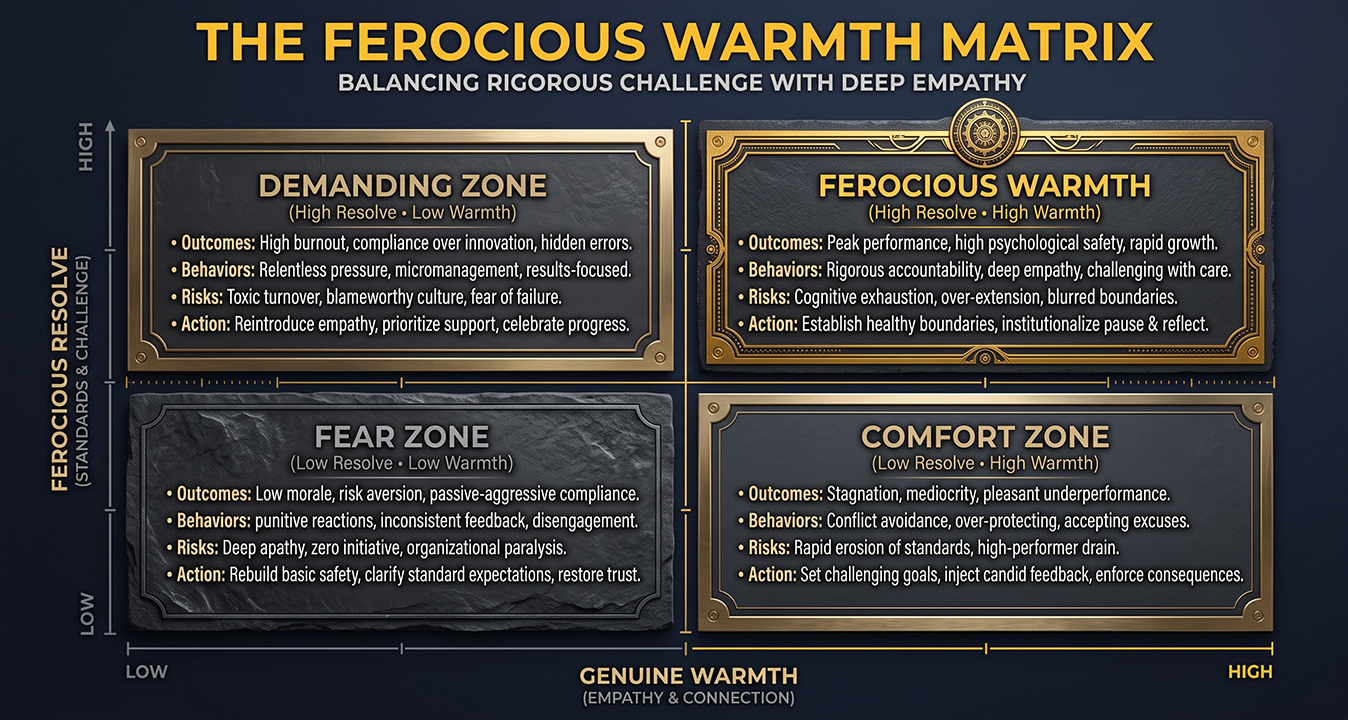 Figure 1. The Ferocious Warmth Matrix: Empathy without accountability eventually creates complacency. Accountability without empathy eventually creates fear. The leaders who earn the greatest trust consistently demonstrate high care and high standards, operating in the upper-right quadrant to build teams capable of peak performance and rapid growth.
Lessons from the Field: Navigating Human Realities
Early in my career, I worked in Egypt and later across Africa and the Middle East, often within joint ventures involving government entities. Many employees had spent years working in legacy systems that didn't consistently reward accountability, competence, or measurable performance.
When we introduced structured delivery metrics, progress was slow and discouraging at first. But as we paired clear performance expectations with continuous coaching and practical support, accountability became the norm. Performance accelerated, and team pride surged. I learned that people rarely resist accountability itself; they resist accountability when they experience it as punishment rather than support.
Conversely, during my tenure with Shell in Gabon, I observed a new CEO arrive with an outstanding operational track record. Nobody questioned his technical competence. However, many local employees felt their cultural realities, workplace concerns, and legitimate needs were completely ignored.
Because the CEO lacked empathy, trust deteriorated rapidly. Union tensions escalated, protests emerged, and production shutdowns followed—ultimately forcing the organization to reassign him. The lesson was unforgettable: being right is not enough. Leaders cannot drive accountability through positional authority alone; people must believe leadership understands their reality before they will commit to the journey.
The Behavioral Scaffolding of Effective Leaders
To resolve this tension, adaptive leaders anchor their daily practice in established organizational psychology:
Amy Edmondson's Psychological Safety Matrix models four operational environments: Apathy (Low/Low), Comfort (High Safety/Low Accountability), Anxiety (Low Safety/High Accountability), and the Learning/Performance Zone (High/High). In the Learning Zone, teams admit errors early, engage in constructive debate, and relentlessly pursue excellence.
Tracey Ezard's 'Ferocious Warmth' Construct demands that leaders balance Warmth (the heart: care, psychological safety, and meaning) with Ferocity (the head: unyielding standards, strategic clarity, and courage). This synthesis embodies 'The Enlightener' archetype.
Hersey-Blanchard Situational Leadership teaches leaders to adjust the direction and support they provide based on the team's capability and confidence. Leaders deploy directive S1 and S2 styles during chaotic shifts, transitioning to S3 Supporting and S4 Delegating as competence solidifies.
Daniel Goleman's Six Leadership Styles require intentional rotation of behaviors. Leaders rotate from the Affiliative style (validating dignity when an error is admitted) into Coaching or Pacesetting to dissect the failure and fix the underlying system.
The Full Range Leadership Model (FRLM) explains how leaders combine management discipline with inspirational vision. Leaders must establish a Transactional Floor (clear roles, measurable KPIs, and Contingent Reward) before building a Transformational Ceiling of shared purpose.
Leader-Member Exchange (LMX) Theory reminds us that leadership happens one relationship at a time. High-trust, individualized exchanges drive employee commitment and discretionary effort.
Beyond the Hype: Automating Accountability, Humanizing Empathy
In today's corporate environment, managers are increasingly turning to Generative AI tools to draft performance reviews, written warnings, and employee coaching feedback.
The true executive risk is not that AI makes mistakes. The danger is that managers use AI to avoid uncomfortable human conversations. Hiding behind AI-generated documents to deliver difficult feedback signals managerial avoidance and quickly erodes psychological safety. AI cannot conduct nuanced human conversations, navigate interpersonal dynamics, or offer genuine empathy.
The tangible future lies in deploying Agentic AI as an objective operational 'Builder.' Agentic systems will autonomously track raw KPIs, project dependencies, execution data, and blocker alerts. By providing unbiased telemetry, AI lets human leaders focus more on empathetic coaching, trust-building, and high-stakes conversations.
The Ferocious Warmth 1-on-1 Execution Playbook
To turn this philosophy into weekly practice, use the following structured workflow for your direct-report meetings.
Before addressing underperformance, apply the Ferocious Warmth Decision Rule: Diagnose whether the root cause is Capability, Clarity, Capacity, or Commitment. Remember: Practical support is entirely flexible; performance standards are entirely fixed.
When performance gaps emerge, execute the Ferocious Warmth Escalation Sequence:
- Step 1: Define the Missed Expectation: Clearly state what specific deliverable or standard fell short.
- Step 2: Diagnose the Root Cause: Determine whether the gap stems from capability, clarity, capacity, or commitment.
- Step 3: Offer Practical Support: Provide targeted coaching, resources, workload adjustments, or obstacle removal.
- Step 4: Reconfirm the Standard: Reinforce that while support is flexible, the performance standard remains non-negotiable.
- Step 5: Agree on Follow-Up Commitments: Document specific DRI ownership, milestones, and a clear follow-up review date.
The 4-Part 1-on-1 Agenda Framework
Structure your weekly 1-on-1 meetings around four distinct phases:
| Agenda Phase | Time Allocation | Core Objective & Mechanics |
|---|---|---|
| Part 1: Psychological Check-In | 15%Warmth Anchor | Assess energy and meaning; identify burnout signals before discussing tasks. |
| Part 2: Ferocious Accountability | 40%Ferocity Anchor | Review objective metrics and KPIs; identify bottlenecks and hold standards without blame. |
| Part 3: Co-Creation & Alignment | 30%Synthesis | Connect daily execution to 2-year career goals; invite frontline process criticism. |
| Part 4: Forward Commitments | 15%Closure | Document mutual deliverables; model vulnerability by requesting upward leadership feedback. |
The 5 'Ferocious Warmth' Interrogation Directives
- The Energy-Meaning Scale: "On a scale from 1 to 10, how much of your current workload is draining your energy versus giving you a sense of meaning, and what specific task is causing the largest deficit?" (Quantifies burnout and triggers workload rebalancing if score < 5).
- The Fixed Standard / Support Offer: "We agreed to deliver by this week, but we fell short. I know you are carrying a heavy load, but our standards remain fixed. What practical support do you need from me to guarantee we hit this target next week?" (Separates person from performance; offers cover fire while holding standards).
- The Frontline Process Critique: "Where do you feel our current team processes are broken, and if you had my authority for a day, what is the first rule or routine you would eliminate?" (Invites co-creation, fights micromanagement, and turns complaints into process optimization).
- The 2-Year Career Connection: "Looking at the tasks you are executing right now, how do these align with where you want your career to be in two years, and where are we failing to provide you with growth opportunities?" (Connects daily grind to long-term personal advancement).
- The Upward Feedback / Hard Truth: "What is one hard truth or piece of critical feedback about my leadership this week that you have been hesitant to share with me?" (Models vulnerability, normalizes upward feedback, and destroys echo chambers).
A Final Thought for the Adaptive Leader
Leadership is not a choice between empathy and accountability.
Empathy without accountability eventually creates complacency. Accountability without empathy eventually creates fear.
The leaders who earn the greatest trust are neither the softest nor the toughest. They consistently demonstrate high care and high standards.
This week, take an honest look at your leadership style. Are you avoiding a difficult conversation in the name of kindness? Or are you enforcing standards without taking time to understand the human being in front of you?
Ferocious Warmth begins when you stop choosing between the person and the performance.
The strongest leaders learn to challenge people because they care, not despite it. The problem may be red. But the person is not.
References
- Sull, D., Homkes, R., & Sull, C. (2015). Why strategy execution unravels. Harvard Business Review, 93(3), 58–66.
- Leadership IQ. (2024). Why new hires fail: 18-month longitudinal leadership study. Leadership IQ Press.
- Gallup. (2025). State of the global workplace: 2025 report. Gallup Press.
- Edmondson, A. C. (1999). Psychological safety and learning behavior in work teams. Administrative Science Quarterly, 44(2), 350–383.
- Ezard, T. (2021). Ferocious Warmth: School leaders who inspire and transform. Ambigene Institute.
- Hersey, P., & Blanchard, K. H. (1988). Management of organizational behavior: Utilizing human resources (5th ed.). Prentice Hall.
- Graen, G. B., & Uhl-Bien, M. (1995). Relationship-based approach to leadership: Development of leader-member exchange (LMX) theory. The Leadership Quarterly, 6(2), 219–247.
- Bass, B. M., & Avolio, B. J. (1994). Improving organizational effectiveness through transformational leadership. SAGE Publications.