
The Command vs. Consensus Paradox: The Spectrum of Decision Making
Nov 08, 2026
The Hidden Cost of Decision Paralysis
Many well-intentioned leaders confuse consultation with leadership. Believing every strategic move requires universal buy-in, they subject routine operational choices to endless committee meetings, Slack polls, and consensus-building workshops.
While seeking alignment appears inclusive, over-indexing on universal agreement creates severe organizational paralysis. It dilutes strategic sharpness into safe, mediocre compromises, exhausts high performers, and destroys execution speed. Organizations rarely fail because they move too quickly; they fail because they cannot decide.
The empirical consequences of decision paralysis are starkly reflected across modern corporate research. Gallup data indicate that organizations fail to select the right managerial talent 82% of the time. A longitudinal study by Leadership IQ finds that 46% of newly hired leaders fail within 18 months, with 89% of those failures driven by behavioral and emotional misalignments, such as an inability to navigate high-stakes decision friction, rather than technical incompetence.
Furthermore, research published in the Harvard Business Review shows that 67% of well-formulated corporate strategies fail entirely because of disconnects between executive intent and operational delivery. Data from the Project Management Institute shows that 50% of strategic transformation projects fail outright or only partially deliver expected performance (13% outright mortality and 37% partial performance delivery), with decision delay cited as a primary barrier.
Globally, Gallup's 2025 Global Workplace Report estimates that manager disengagement and execution bottlenecks cost $438 billion annually in lost productivity. On the frontline, disengagement drains roughly 34% of annual employee salaries—about $1 million in wasted capacity each year for an average 50-person team. This ongoing indecision erodes basic authority: a study published by Harvard Business Review and Brigham Young University found that an alarming 58% of employees trust complete strangers more than their own bosses.
This credibility gap exposes the core paradox: Command (unilateral decision speed) versus Consensus (broad stakeholder buy-in). When leaders hide behind group consensus rather than taking personal accountability for tough calls, they surrender their primary executive duty.
The Two Extremes of Decision Architecture
To navigate this paradox, adaptive leaders must understand the dangers of both structural extremes.
The Command Trap: Speed Without Challenge
Consider an executive who operates purely through autocratic command, issuing unilateral orders without consulting subject-matter experts. While decisions are made instantly, the organization develops severe blind spots. Frontline realities are ignored, undiscovered risks trigger costly rework, and employee commitment dissolves into malicious compliance. The problem is not command itself; it's command executed without challenge.
Steve Jobs & Apple's Decision Architecture
Steve Jobs' leadership at Apple offers a masterclass in synthesizing command and consensus, dismantling the simplistic myth of the 'brilliant autocrat.'
Jobs operated with a legendary, uncompromising disregard for democratic consensus when setting the strategic 'What.' He famously rejected focus groups, ignored committee compromises, and set non-negotiable standards for product design, user experience, and aesthetic quality. He recognized that using democratic consensus to determine overarching strategy inevitably produces diluted, design-by-committee mediocrity.
However, Apple's operational 'How' was intensely collaborative. Apple operated as a functional organization where specialists in hardware engineering, software, industrial design, and marketing led specialized domains across all product lines. Because no single function owned a product end-to-end, experts were required to engage in fierce, peer-level, meritocratic friction known internally as 'collaborative debate.'
When elite teams hit an impasse over technical trade-offs—such as hardware requiring a larger battery versus industrial design demanding a thinner chassis—Jobs or Senior Vice Presidents stepped in as single-point Directly Responsible Individuals (DRIs), asserting autocratic command to break the deadlock. The strategic 'What' was autocratic; the operational 'How' was democratic; and the tiebreaker was single-point command.
My Journey with the Consensus Bias
Over my thirty-year career managing mega-programs at Shell and Rio Tinto, I discovered something fundamental about my own leadership style: I naturally prefer consensus, democracy, and broad collaboration.
My default instinct has always been to listen first, gather diverse opinions, build stakeholder buy-in, and seek alignment before committing to major decisions. I have never been naturally drawn to autocratic command or behaving as though I alone possess all the answers.
Early in my leadership journey, however, this preference created a significant vulnerability. I sometimes waited far longer than I should have to achieve universal agreement. I wanted total comfort, complete consensus, and zero friction before moving forward. In several high-stakes operational situations, I delayed critical decisions while attempting to win over every hesitant stakeholder.
The results were costly. Project schedules slipped, momentum evaporated, and execution teams became frustrated by shifting targets. In some cases, decision delays caused financial losses I could have avoided with a decisive course of action.
This realization forced a fundamental shift in my approach. I learned that collaboration is vital for generating insight, but leadership cannot be held hostage by endless agreement-seeking. I began communicating far more transparently at the launch of major initiatives, telling my teams:
''Collaboration is my preferred operating style. Your input is welcomed, and rigorous debate is encouraged, but only within clearly defined time limits to protect delivery and preserve momentum. Consensus informs decisions; it does not replace decisions. When time expires, my job is to make the call and accept full accountability for the outcome.''
Behavioral Scaffolding for Adaptive Decision-Making
To move smoothly along the decision spectrum, adaptive leaders ground their practice in established behavioral science:
- Situational Leadership (S1–S4): Hersey-Blanchard Situational Leadership teaches that decision authority must modulate based on team task readiness. Leaders deploy high-direction S1 (Telling/Directing) during crises, turnarounds, or with inexperienced teams. As capability grows, they shift to S2 (Coaching), S3 (Participating), and S4 (Delegating), giving mature experts greater decision autonomy.
- Goleman’s Emotional Intelligence Styles: Daniel Goleman’s Six Leadership Styles highlights the trade-offs between decision archetypes. The Democratic style ('What do you think?') builds long-term buy-in but is catastrophic during crises. The Commanding style ('Do what I tell you') breaks bureaucratic stalemates instantly but breeds toxic passivity if used as a permanent default. The Visionary style ('Come with me') sets clear strategic destinations while allowing teams autonomy over tactical execution.
- FRLM & LMX Theory: The Full Range Leadership Model (FRLM) establishes that transformational leadership requires a firm transactional floor. Before attempting transformational collaboration, teams must establish clear decision-making rules, single-point DRIs, and explicit boundaries. Leader-Member Exchange (LMX) Theory shows that high-trust interpersonal relationships create the psychological safety team members need to engage in fierce meritocratic debate without fear of personal retribution.
Beyond the Hype: Telemetry Over Consensus
In today's corporate environment, executives increasingly deploy Generative AI and automated survey tools to run real-time sentiment analysis, Slack polls, and organizational votes before making strategic calls.
Here is the Agentic Reality Check: Seeking universal consensus via AI polling during an operational crisis creates an illusion of modern leadership while functioning as managerial avoidance. Algorithms cannot absorb executive risk, make uncomfortable trade-off choices, or accept personal accountability for outcomes. Dropping automated polling onto broken decision architecture merely digitizes organizational paralysis.
The true future of AI in decision-making lies in deploying Agentic AI as an objective operational 'Builder.' Instead of polling employee opinions on strategic choices, Agentic systems will deliver real-time situational telemetry—autonomously tracking operational velocity, supply chain bottlenecks, project milestone variances, and system performance.
By giving leaders immediate, unvarnished clarity, Agentic AI eliminates subjective guessing. Human executives can make rapid, informed decisions when speed matters, while preserving their energy for high-stakes stakeholder alignment and human leadership.
The Decision-Making Spectrum Playbook
To translate this philosophy into daily operational practice, implement the following 5-step Decision Spectrum Playbook:
| Step | Framework Component | Operational Mechanics |
|---|---|---|
| Step 1 | Decision Categorization (Type 1 vs. Type 2) |
Separate Type 1 (Irreversible, high-stakes → Command) from Type 2 (Reversible, tactical → Democratic Debate). Rule: Minimum command, maximum participation appropriate. |
| Step 2 | Single-Point DRI Ownership | Designate one Directly Responsible Individual (DRI) per initiative. Eliminate shared accountability to prevent bystander apathy. |
| Step 3 | Time-Bounded Debate Windows | Establish strict, non-negotiable debate windows (e.g., 24h, 48h, 1 week) for expert challenge while keeping the delivery deadline fixed. |
| Step 4 | Tiebreaker Protocol & 'Disagree and Commit' |
If consensus is not reached when time expires, the DRI asserts command, makes the final call, and enforces universal alignment. |
| Step 5 | Telemetry-Driven Review | Track post-decision velocity and operational outcomes using objective visual dashboards and Agentic AI metrics. |
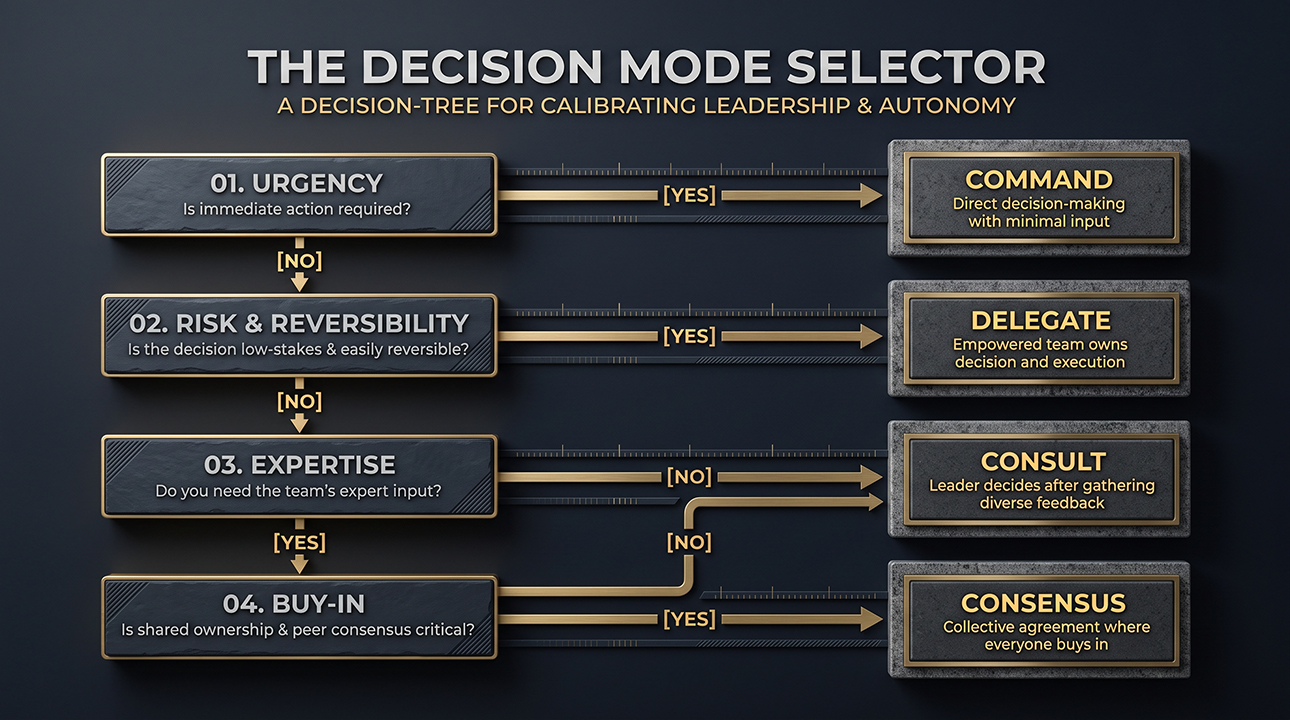 Figure 1. The Decision Mode Selector: Adaptive leaders do not rely on a single decision-making style. By sequentially evaluating urgency, risk, expertise, and the need for buy-in, you can rapidly calibrate your approach—moving fluidly between unilateral command and democratic consensus.
Operational Execution Details
Step 1: Decision Categorization.
Separate decisions into Type 1 (high-stakes, irreversible choices like strategic pivots or capital allocations) and Type 2 (reversible, tactical choices like workflow tools or campaign messaging). Reserve autocratic command for Type 1 decisions to protect strategic intent. Open Type 2 decisions to democratic debate to maximize innovation.
Step 2: Assign Single-Point DRI Ownership.
Assign a single Directly Responsible Individual (DRI) for every initiative. When a committee shares accountability, nobody feels accountable. The DRI owns the process, gathers input, and makes the final determination.
Step 3: Enforce Time-Bounded Collaborative Debate.
Open a strict, time-bounded window (e.g., 48 hours for tactical issues; 2 weeks for major roadmaps) where team members are expected to challenge assumptions, present alternative data, and debate trade-offs. Once the window closes, discussion ends.
Step 4: Execute the Tiebreaker Protocol.
If consensus is not reached when time expires, the DRI or executive executes the Tiebreaker Protocol—asserting single-point authority, making the call, and enforcing the operational rule: 'Disagree and Commit.' Team members may disagree with the choice, but they must commit 100% to its execution.
Step 5: Telemetry-Driven Review.
Utilize objective operational dashboards powered by AI telemetry to track post-decision velocity and delivery metrics. Evaluate decisions on objective performance rather than subjective emotion.
A Final Thought for the Adaptive Leader
Leadership is not a popularity contest; it is the stewardship of collective capability and organizational outcomes.
Command without challenge creates dangerous blind spots in the organization. Consensus without ownership creates chronic execution paralysis.
The most effective leaders are neither autocratic dictators nor passive consensus-seekers. They are adaptive practitioners who master the entire decision spectrum—knowing precisely when to listen, when to debate, and when to command.
This week, audit your active team initiatives. Identify one decision that has been delayed by excessive discussion, assign a single DRI, define a clear debate window, and make the call.
Consensus informs decisions. Leadership makes them and accepts responsibility for the outcome.
References
- Sull, D., Homkes, R., & Sull, C. (2015). Why strategy execution unravels. Harvard Business Review, 93(3), 58–66.
- Leadership IQ. (2024). Why new hires fail: 18-month longitudinal leadership study. Leadership IQ Press.
- Gallup. (2025). State of the global workplace: 2025 report. Gallup Press.
- Project Management Institute. (2025). Step up: Redefining the path to project success with M.O.R.E. PMI Global Research.
- Hersey, P., & Blanchard, K. H. (1988). Management of organizational behavior: Utilizing human resources (5th ed.). Prentice Hall.
- Graen, G. B., & Uhl-Bien, M. (1995). Relationship-based approach to leadership: Development of leader-member exchange (LMX) theory. The Leadership Quarterly, 6(2), 219–247.
- Bass, B. M., & Avolio, B. J. (1994). Improving organizational effectiveness through transformational leadership. SAGE Publications.
- Isaacson, W. (2011). Steve Jobs. Simon & Schuster.