
The Identity Paradox: Mastering "Confident Humility"
Nov 08, 2026
The Myth of Executive Omniscience
A persistent leadership myth suggests promotion should bring instant certainty.
Once managers receive a bigger title, they may believe they must have every answer, resolve every crisis immediately, and never show doubt in front of the people they lead.
The pressure is understandable. A manager who appears uncertain may fear losing credibility. A newly promoted technical expert may continue proving value by personally solving every difficult problem. An executive entering unfamiliar territory may speak with more confidence than the available evidence justifies.
But pretending to know creates its own risk. Important questions remain unasked. Capable people stop contributing. Early warnings are softened because nobody wants to contradict the person who appears certain.
The opposite extreme is equally unhelpful. A leader cannot respond to every difficult question with indecision, delegate every judgment to the team, or use humility to avoid accountability.
Leaders must be secure enough to admit what they do not know and dependable enough to establish what happens next.
That balance is Confident Humility.
Humility acknowledges the limits of personal knowledge. Confidence provides direction, boundaries, and accountability.
The objective is not to become the smartest person in the room. It is to create a room in which the available intelligence can be used responsibly.
What Humble Leadership Actually Means
Leader humility is sometimes confused with modesty, softness, or reduced authority.
Research by Bradley Owens and David Hekman offers a more useful interpretation. Their study, based on 55 in-depth interviews with leaders across varied settings, describes humble leadership as modeling growth and making it legitimate for others to acknowledge uncertainty and development needs at work.
In practice, humble leaders can:
- acknowledge a relevant limitation
- recognize another person’s expertise
- admit and learn from mistakes
- remain open to corrective feedback
- revise a position when stronger evidence emerges
None of these behaviors requires surrendering authority.
Humility becomes credible when accompanied by competence, judgment, and follow-through.
A leader who says, “I do not know,” and then disappears creates anxiety. A leader who admits uncertainty, organizes the inquiry, assigns ownership, and returns with a decision models maturity.
The difference is not certainty. It is responsibility.
Anne Mulcahy and the Value of Honest Learning
Xerox's turnaround under Anne Mulcahy offers a useful illustration.
Mulcahy became CEO in 2001 when Xerox was near bankruptcy, carried more than $17 billion in debt, had recorded years of losses, and faced an SEC investigation into accounting practices in its Mexico operation.
Mulcahy was a long-serving insider, but she did not present herself as a conventionally prepared turnaround specialist. She acknowledged that she lacked a sophisticated financial background and needed to compensate through intensive on-the-job learning.
That admission did not replace action.
Mulcahy and the leadership team addressed liquidity, raised $2.5 billion in cash, reduced capital expenditure and administrative costs, cut debt substantially, and protected research-and-development spending despite wider cost reductions.
The lesson is not that admitting ignorance rescued Xerox. A complex turnaround cannot credibly be attributed to one personality trait.
The lesson is that a leader can acknowledge a material knowledge gap without abandoning authority. Mulcahy paired honest learning with disciplined execution.
“This is not my strongest area yet. I will learn quickly, involve the right expertise, and remain accountable for the decision.”
The admission creates transparency. The plan preserves confidence.
Lessons From the Field: Humility With Boundaries
During my 18 years at Shell, I learned that I could not lead complex programs by pretending to be the most knowledgeable person in every conversation.
I tried to be open about my strengths and areas for development. I accepted responsibility for mistakes, experimented carefully, took calculated risks, and invited respectful feedback from team members and senior leaders.
That openness served a practical purpose. It showed people they didn't need to protect my ego before raising a concern.
With new teams, I also found value in Bruce Tuckman’s Team Development Model.
The original model described four stages: Forming, Storming, Norming, and Performing. Adjourning was added later to address closure when the work ends and the team separates.
In plain English:
- Forming: People are orienting themselves and need clarity.
- Storming: Differences, tensions, and competing expectations become visible.
- Norming: The team agrees on practical ways of working.
- Performing: People collaborate with growing competence and independence.
- Adjourning: The team closes the work, captures lessons, and transitions responsibly.
These stages are a useful map, not a guaranteed linear sequence. Teams may move backward when membership, leadership, priorities, or conditions change.
The model helped me see that disagreement wasn't necessarily proof of team failure. Sometimes it helped develop clearer roles, stronger relationships, and better operating expectations.
I also learned that humility needs boundaries.
Not every doubt belongs in every conversation, and an invitation to challenge does not remove decision authority or professional standards.
The answer is not defensiveness. It is a clear challenge protocol:
“Question the reasoning. Bring evidence. Raise risks early. Once we decide, we will execute unless new material information requires reconsideration.”
Humility opens the discussion. Accountability closes it responsibly.
The Behavioral Frameworks Behind Confident Humility
Psychological Safety
Psychological Safety, associated with Amy Edmondson’s research, means people believe they can raise questions, concerns, ideas, and mistakes without expecting humiliation or punishment.
It does not mean constant agreement or freedom from performance standards.
For the Identity Paradox, the value is straightforward: leaders who acknowledge fallibility make it easier for others to contribute information the leader may not have.
Ambidextrous Leadership
Ambidextrous Leadership describes the ability to use complementary Opening and Closing Behaviors.
Opening Behaviors encourage exploration, experimentation, alternative viewpoints, and learning.
Closing Behaviors create focus through priorities, standards, deadlines, monitoring, and discipline in implementation.
A 2015 study by Hannes Zacher and Kathrin Rosing reported support for the interaction of Opening and Closing Behaviors in predicting team innovation. The authors also noted limitations, including the study’s relatively small sample and cross-sectional design.
The practical lesson is not to remain permanently open or permanently decisive. It is to recognize which behavior the work requires.
During discovery: “What are we missing? Which assumptions should we challenge?”
During execution: “This is the decision, these are the owners, and this is the review date.”
Confident Humility requires both.
The Agentic Reality Check
AI can help leaders challenge their reasoning. It cannot guarantee that the challenge is accurate.
Generative AI may produce incorrect information, overlook context, reinforce assumptions in the prompt, or generate criticism that sounds persuasive without being well supported.
That makes “AI as the ultimate red team” too strong a claim.
A credible role for AI is structured pre-decision challenge.
A leader may ask an approved AI system to:
- list the assumptions behind a proposal
- generate plausible counterarguments
- identify missing stakeholder perspectives
- suggest evidence that would weaken the recommendation
- compare alternative scenarios
- draft questions for a human review panel
But you must also check AI-generated criticism.
Do not provide confidential, personal, legally sensitive, or commercially restricted information without approved safeguards. Do not treat fluent output as verified evidence. Do not use AI to replace qualified financial, legal, technical, safety, or human judgment.
Dropping AI into a leadership culture that discourages challenge will not create intellectual humility. It may simply digitize confirmation bias.
AI can widen the questions. Human leaders remain accountable for the answers and the decision.
The Calibrated Uncertainty Playbook
Use this five-step process when facing a consequential question without a complete answer. 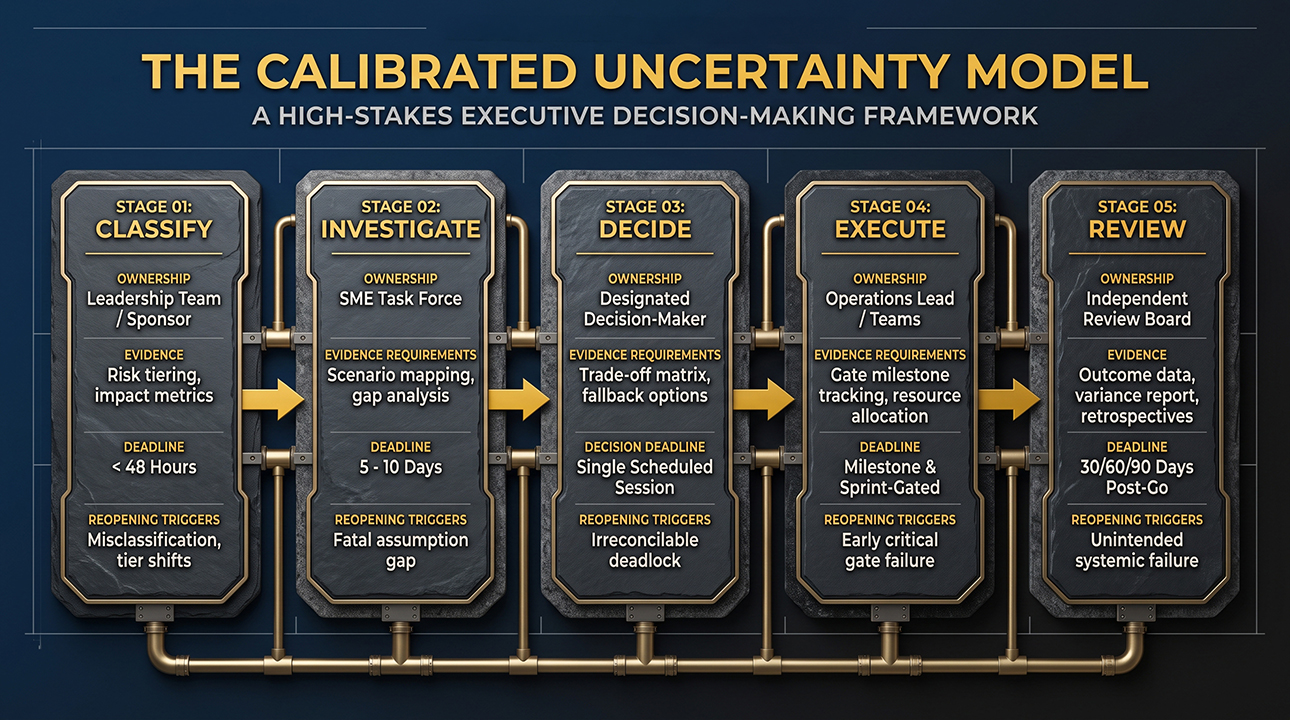
Figure 1. The Calibrated Uncertainty Model: You do not need to manufacture fake certainty to protect your executive authority. By deploying this 5-stage framework, you can pair "I don't know" with absolute process conviction, establishing a clear path from investigation to accountable execution.
Step 1: Classify the Knowledge Gap
Identify precisely what is missing: a fact, an unresolved assumption, a capability, conflicting evidence, or specialist judgment. Being specific prevents vague uncertainty from spreading across the team.
Step 2: Establish the Inquiry
Define the question to answer, the evidence required, the people with relevant expertise, one accountable owner, and the decision deadline. Replace “We will investigate” with a visible discovery plan.
Step 3: Communicate Calibrated Uncertainty
Say: “I do not have the final answer because the evidence is incomplete.” Then add: “Here is what we know, what we need to test, who owns the work, and when we will decide.” Do not manufacture certainty. Do not abandon direction.
Step 4: Open, Then Close
During exploration, invite challenge, alternatives, and evidence. Before execution, summarize the trade-offs, identify the decision authority, make the decision, and clarify what new evidence would justify reopening it. This turns disagreement into disciplined input rather than endless debate.
Step 5: Red-Team Responsibly
Ask human reviewers to challenge the proposal. If appropriate, use AI to generate additional questions or counterarguments, but verify every material claim against reliable evidence. Record the strongest objection, evidence considered, residual risk, final owner, and review trigger. Red-teaming is complete only when relevant criticism has been evaluated.
A Final Thought for the Adaptive Leader
Your title does not require you to possess every answer.
It requires you to create a responsible way to find answers and make decisions.
This week, identify one issue on which you may be projecting more certainty than the evidence supports.
Name the gap. Bring in the right expertise. Set the process and decision date. Invite respectful challenge. Then decide.
Confident Humility is not saying, “I do not know,” and stepping away. It is saying: “I do not know yet. Here is how we will find out, and I remain accountable for what happens next.”
References
- Edmondson, A. C. (1999). Psychological safety and learning behavior in work teams. Administrative Science Quarterly, 44(2), 350–383.
- Owens, B. P., & Hekman, D. R. (2012). Modeling how to grow: An inductive examination of humble leader behaviors, contingencies, and outcomes. Academy of Management Journal, 55(4), 787–818.
- Stanford Graduate School of Business. (2004, December 1). Anne Mulcahy: The keys to turnaround at Xerox.
- Tuckman, B. W. (1965). Developmental sequence in small groups. Psychological Bulletin, 63(6), 384–399.
- Tuckman, B. W., & Jensen, M. A. C. (1977). Stages of small-group development revisited. Group & Organization Studies, 2(4), 419–427.
- Zacher, H., & Rosing, K. (2015). Ambidextrous leadership and team innovation. Leadership & Organization Development Journal, 36(1), 54–68.