
The Time Traveler's Dilemma: Managing Today's Revenue vs. Tomorrow's Innovation
Nov 08, 2026
The ultimate test of executive strategy is allocating scarce organizational resources—capital, top talent, and cognitive bandwidth—across competing time horizons. Shareholders and corporate boards relentlessly demand optimizing and exploiting current cash cows, while industrial history shows that organizations that optimize only the present inevitably fall to disruptive obsolescence.
The empirical consequences of short-term myopia are starkly reflected across modern corporate research. Data from Gallup indicates that organizations fail to select the right managerial talent 82% of the time. According to a longitudinal study by Leadership IQ, 46% of newly hired leaders fail within 18 months—and 89% of those failures stem from behavioral and emotional misalignments, such as an inability to navigate competing priorities and resource trade-offs, rather than technical incompetence.
Furthermore, research published in the Harvard Business Review by Donald Sull and colleagues finds that 67% of well-formulated corporate strategies fail entirely because of execution gaps between executive planning and daily operational delivery. An estimated 90% of strategic transformation plans are never fully realized, illustrating that visionary thinking without operational architecture rarely translates into meaningful results.
Data from the Project Management Institute shows that 50% of strategic transformation initiatives fail outright or only partially deliver expected outcomes (13% outright mortality and 37% partial performance delivery), with short-term resource competition cited as a primary barrier to reinvention.
Globally, Gallup's 2025 Global Workplace Report estimates that manager disengagement and execution disconnects cost $438 billion annually in lost productivity. On the frontline, disengagement drains roughly 34% of annual employee salaries—about $1 million in wasted capacity each year for an average 50-person team. This ongoing short-term focus erodes basic credibility: a joint study by Harvard Business Review and Brigham Young University found that an alarming 58% of corporate employees trust complete strangers more than their own bosses, illustrating the breakdown that occurs when leaders keep pivoting between short-term firefighting and unfulfilled long-term promises.
Corporate Case Studies: Defensive Exploitation vs. Ambidextrous Transformation
To navigate this paradox, adaptive leaders must analyze the divergent paths of Eastman Kodak and Fujifilm.
Eastman Kodak: The Fractured Decision Stack
A common myth is that Kodak failed because it lacked vision. Kodak engineer Steven Sasson invented the world's first digital camera in 1975, and Kodak held the number-one digital camera market share in the United States as late as 2005. Furthermore, a 1981 internal Kodak research report explicitly and accurately predicted the exact timeline of film's demise and the rise of digital imaging.
Kodak's executive failure stemmed from a fractured 'Decision Stack'—a misalignment between long-term strategic vision and daily resource allocation. Kodak's traditional silver-halide film business generated massive gross margins near 70%. Executives were financially and structurally incentivized to protect current cash flows. Instead of pivoting, Kodak used its predictive research defensively to calculate how long it could safely exploit film. When forced into digital markets, they attempted to force digital technology into legacy analog channels—deploying 10,000 physical photo printing kiosks and acquiring the photo-sharing site Ofoto merely to drive physical print sales. By prioritizing short-term margins over brutal operational transformation, Kodak accumulated $349 million in digital division losses by 2011, culminating in a $6.75 billion bankruptcy filing in 2012.
Fujifilm & CEO Shigetaka Komori: The Ambidextrous Masterclass
Facing the identical digital collapse in the early 2000s, Fujifilm CEO Shigetaka Komori launched 'VISION 75', an existential transformation plan that explicitly accepted that photographic film would not remain a viable core business. Komori did not abandon the cash cow immediately; he ruthlessly squeezed every available dollar of profit out of the declining film business through operational restructuring.
However, instead of returning those profits via short-term dividends or propping up film marketing, he funneled the capital into the newly created Fujifilm Advanced Research Laboratories. Fujifilm executed an unglamorous, exhaustive audit of its core capabilities, identifying 70 transferable silver-halide technologies—including precision coating, anti-oxidation, and collagen preservation. They acquired 40 companies and applied these capabilities to build high-growth businesses in healthcare, flat-panel LCD displays, and cosmetics (launching the successful 'Astalift' brand). Komori's ambidexterity preserved the enterprise and drove long-term market dominance.
Lessons from the Field: The Global Governance Trap and the Joint Venture Sandbox
During my career with Shell, I experienced firsthand the structural tension that exists inside massive global enterprises. In large organizations, you frequently feel constrained when trying to innovate or express creativity at work. These companies are structurally vast, spanning multiple continents, hubs, and operating units. Because of the sheer scale, capital stakes, and geographical distribution of resources, leadership tends to over-engineer governance and rationalized frameworks. To a degree, this rigid standardization is justified and necessary to manage enterprise risk.
However, this creates a profound dilemma for managers and teams who do not operate directly within the central decision-making hubs. Outside the core centers of authority, professionals face immense friction when pursuing innovation. They feel bound by global standards and standardized processes that leave very little room for localized problem-solving or creative experimentation. This operational bottleneck suffocates frontline adaptability.
At various points in my career, I was fortunate to work within Joint Ventures (JVs). In a Joint Venture, you cannot simply copy and paste a single parent company's global standards. By definition, a JV involves different partner entities, each bringing its own distinct standards, governance expectations, and strategic mandates. To succeed, you are forced to break out of rigid corporate playbook thinking.
Working in JVs taught me that innovation often thrives in the gaps between rigid structures. We had to find creative ways to align competing partner requirements, bridge disparate operational standards, and build pragmatic compromises that satisfied all parties while delivering outcomes. The JV environment became an ambidextrous sandbox, where structure and flexibility were forced to coexist.
"Global standardization protects today's operational baseline, but over-engineered governance destroys tomorrow's creative capacity. True executive leadership requires creating 'adaptive sandboxes'—much like Joint Ventures demand—where teams have the psychological safety and structural flexibility to innovate without breaking the core system."
Behavioral Scaffolding for Ambidextrous Leadership
Adaptive leaders resolve the Time Traveler's Dilemma by anchoring their practice in established behavioral science:
James March's Organizational Ambidexterity: Teaches that organizations must simultaneously master Exploitation (managing today through variance reduction, efficiency, strict rule adherence, and cash cow optimization) and Exploration (building tomorrow through deliberate variance creation, experimentation, risk-taking, and searching for radical market alternatives).
Zacher & Rosing's Ambidextrous Leadership (Opening vs. Closing Behaviors): Explains that leaders must dynamically modulate between Closing Behaviors (transactional leadership: KPI tracking, milestone discipline, budget control) for exploitation, and Opening Behaviors (transformational leadership: encouraging independent thought, fostering risk-taking, tolerating localized failure) for exploration. This framework identifies 4 executive archetypes: the Ambidextrous Leader (High Opening / High Closing), the Chaotic Explorer (High Opening / Low Closing), the Rigid Exploiter (Low Opening / High Closing), and the Disengaged Manager (Low Opening / Low Closing).
Hersey-Blanchard Situational Leadership (S1–S4): Modulates management style based on maturity—applying directive control (S1/S2) to enforce core operational standards, while granting execution autonomy and privacy (S3/S4) to exploratory innovation teams.
Goleman's Emotional Intelligence Styles: Requires blending the Visionary style (charting the long-term future) with Pacesetting and Commanding styles (demanding operational execution in the present).
FRLM & LMX Theory: The Full Range Leadership Model (FRLM) establishes that a transactional floor of operational discipline must precede a transformational ceiling. Leader-Member Exchange (LMX) Theory proves that high-trust relationships protect exploratory teams from premature financial judgment.
Beyond the Hype: Ambidextrous Agentic AI Over Short-Term Myopia
In today's corporate environment, executives are increasingly deploying AI predictive analytics and financial modeling tools strictly to optimize next quarter's sales funnels, cost structures, and earnings targets.
Here is the Agentic Reality Check: Over-optimizing AI models solely for short-term survival metrics blinds the organization to long-term market disruption. Dropping automated tools onto short-term thinking merely digitizes short-term myopia and accelerates path-dependency. AI cannot set long-term strategic vision or make nuanced trade-off decisions between present survival and future reinvention.
The true future of AI lies in deploying Ambidextrous Agentic AI as an operational 'Builder.' Instead of using AI to police short-term tasks, Agentic systems autonomously handle the heavy transactional lifting of today's business—tracking raw KPIs, automating workflow logistics, and optimizing operational efficiency. By streamlining the core business, Agentic AI frees human managers to dedicate 20% to 30% of their cognitive bandwidth to strategic exploration, long-term vision, and human leadership.
The Ambidextrous Strategic Allocation Playbook
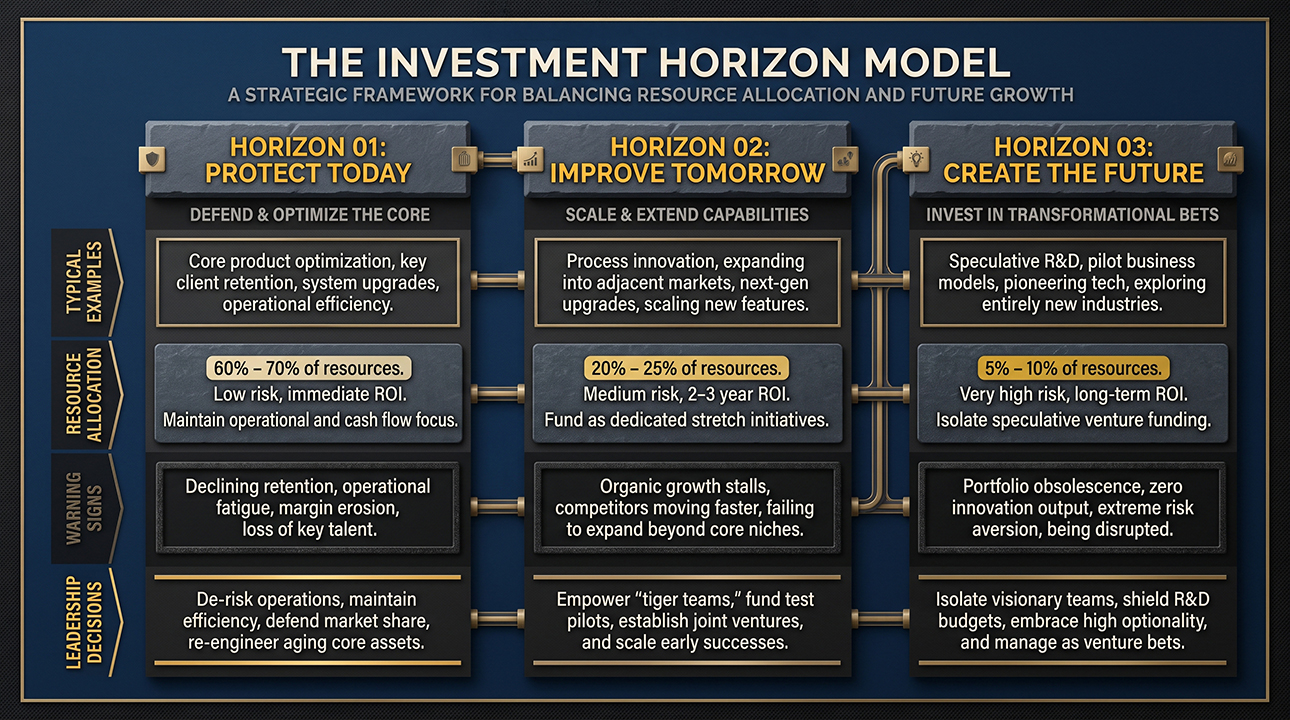
Figure 1. The Investment Horizon Model: Structurally ring-fencing your resources is the only way to survive the Time Traveler's Dilemma. Use this framework to rigorously audit where your team's bandwidth is actually going, ensuring that short-term operational fires do not consume the oxygen required for long-term strategic bets.
To translate this philosophy into daily operational practice, implement the following 5-step playbook:
Step 1: Enforce the 70/20/10 Rule
As a starting point, allocate about 70% of capital and team bandwidth to core revenue streams, 20% to adjacent growth opportunities, and 10% to high-risk, high-reward strategic exploration. Adjust the mix based on industry realities, competitive pressure, and organizational maturity.
Step 2: Establish 'Firewalled' Bandwidth
Ring-fence 20% to 30% of exploratory team capacity from the brutal efficiency and short-term ROI metrics applied to mature products. Protect the 'messy middle' of innovation from premature financial judgment.
Step 3: Deploy Dual Performance Metrics
Apply Closing KPIs (efficiency, margin, variance reduction) to core operations, while applying Opening KPIs (learning velocity, prototype iteration speed, customer discovery milestones) to exploratory bets.
Step 4: Execute the 'Vital Few' Audit
Audit active projects to eliminate low-impact distractions. Focus executive energy strictly on initiatives that protect immediate delivery or build future capacity.
Step 5: Separate Review Cadences
Run separate review cadences for core delivery (weekly operational reviews) and innovation initiatives (monthly strategic sprints) to prevent short-term fire-fighting from crowding out long-term strategic reviews.
A Final Thought for the Adaptive Leader
Leadership is not a choice between today's revenue and tomorrow's growth. Exploitation without exploration leads to irrelevance. Exploration without exploitation leads to insolvency.
The most effective leaders are neither short-term firefighters nor ungrounded visionaries. They are ambidextrous practitioners who protect today's cash cow while building adaptive sandboxes for tomorrow's breakthroughs.
This week, audit your team's calendar and resource allocations. Identify one project that represents tomorrow's growth, firewall 20% of your team's bandwidth, and protect it from short-term noise.
Manage the present to fund the future. Build the future before the present stops funding itself.
References
- Sull, D., Homkes, R., & Sull, C. (2015). Why strategy execution unravels. Harvard Business Review, 93(3), 58–66.
- Leadership IQ. (2024). Why new hires fail: 18-month longitudinal leadership study. Leadership IQ Press.
- Gallup. (2025). State of the global workplace: 2025 report. Gallup Press.
- Project Management Institute. (2025). Step up: Redefining the path to project success with M.O.R.E. PMI Global Research.
- March, J. G. (1991). Exploration and exploitation in organizational learning. Organization Science, 2(1), 71–87.
- Zacher, H., & Rosing, K. (2015). Ambidextrous leadership and team innovation. Leadership & Organization Development Journal, 36(1), 54–68.
- Komori, S. (2015). Innovating out of crisis: How Fujifilm survived (and thrived) as its core business was vanishing. Stone Bridge Press.
- Hersey, P., & Blanchard, K. H. (1988). Management of organizational behavior: Utilizing human resources (5th ed.). Prentice Hall.