
The Servant Leadership Paradox: Why Serving Requires Strength
Nov 08, 2026
Servant leadership is frequently misunderstood as passive, conflict-averse, or overly permissive. In many executive suites, the phrase 'serving your team' is mistakenly equated with weak oversight or an inability to enforce tough performance standards.
This misinterpretation leads to a dangerous management trap. Leaders either default to heavy-handed command-and-control tactics out of fear of losing authority, or they fall into permissive management, abandoning operational discipline in a misguided attempt to be liked.
In reality, servant leadership requires emotional resilience, executive judgment, and the discipline to place the team’s legitimate needs ahead of personal status.
It may require accepting accountability for the leadership system, sharing credit with the team, translating pressure from above into clear priorities, and removing unnecessary organizational friction.
Treat servant leadership as a serious leadership philosophy rather than a collection of dramatic performance promises.
Research generally associates servant leadership with outcomes such as job satisfaction, organizational commitment, trust, citizenship behavior, and performance. However, those relationships depend on context, implementation, and the quality of the leader’s behavior.
Its value lies in how it changes how leaders use authority. The servant leader asks:
What does the team need to succeed?
Which obstacles require leadership intervention?
Where do people need greater autonomy?
Which standards remain non-negotiable?
Am I helping people grow, or merely making myself indispensable?
These questions turn service from a personality trait into an operating discipline.
The Architecture of Care: The Southwest Airlines Approach
To understand how service and operational strength can coexist, consider two moments in Southwest Airlines' history.
After the September 11 attacks, the airline’s leaders made avoiding layoffs an immediate priority. The company’s account of that period describes leadership working from a crisis command center and committing to endure the disruption together.
This was not merely an expression of kindness. It reflected a belief that preserving workforce capability, trust, and commitment could be strategically important during a crisis.
An earlier chapter in the airline’s history illustrates the performance side of the equation.
In 1972, Southwest sold one of its four aircraft as it faced serious financial pressure. To maintain the existing schedule with only three planes, the operating team developed the ten-minute turnaround.
That result required close coordination, disciplined execution, and people working across traditional role boundaries.
These examples should not be romanticized into a promise that difficult workforce decisions will never occur. In February 2025, Southwest announced approximately 1,750 reductions concentrated in corporate and leadership roles, calling the decision unprecedented in its 53-year history.
The deeper lesson is that servant leadership does not eliminate difficult decisions. It asks leaders to treat people as stakeholders rather than disposable inputs while remaining responsible for performance, customers, resources, and organizational survival.
Lessons from the Field: Protecting Productive Focus Under Pressure
Early in my executive career, while managing complex capital projects, our team faced a severe, high-stakes delay caused by an unexpected, critical vendor failure.
During an emergency review meeting with senior executives and board members, the discussion became highly pressured. Attention began shifting toward identifying individual fault within the frontline engineering team.
Sitting in that board meeting, I realized I faced a defining leadership choice. I could pass the pressure down, blame my team, and demand endless daily status reports to protect my own standing.
But I knew that allowing unfocused executive pressure to cascade down to the engineers could damage morale and encourage defensive behavior. The team might spend more energy documenting self-protection than resolving the technical problem.
I accepted accountability for coordinating the recovery and acknowledged that our risk management and escalation approach required improvement. My responsibility was to keep senior stakeholders informed while preventing unfocused pressure from distracting the technical team.
Immediately after the review, I returned to my engineering team and cleared away all non-essential administrative reporting and status meetings.
“I will manage the senior-stakeholder communication and remove the nonessential reporting,” I told them. “Your priority is to diagnose the technical problem, develop the recovery plan, and escalate any material risk immediately.”
With fewer distractions and clearer priorities, the engineers could focus on diagnosis and recovery. The team developed a workable response and improved the project’s position against the revised schedule.
Protection did not remove accountability. The team still owned the technical diagnosis, recovery plan, material-risk escalation, and delivery commitments. My role was to protect productive focus, not to shield poor performance or conceal reality.
Behavioral Scaffolding for Servant Leaders
To operationalize servant leadership without falling into permissiveness, adaptive leaders anchor their practice in established organizational psychology:
Full Range Leadership Model (FRLM): Explains how a stable Transactional Floor—clear roles, agreed expectations, appropriate recognition or reward, objective performance standards, and necessary resources—supports the Transformational Ceiling. Above that foundation, Individualized Consideration means understanding each person’s development needs and providing appropriate support, while Idealized Influence means earning credibility by modeling the standards and values expected from others.
Hersey-Blanchard Situational Leadership: Teaches leaders to modulate their posture based on team task readiness. During acute operational crises or with inexperienced staff, the leader provides directive S1 (Telling) and S2 (Selling) support to establish safety. For mature, highly capable experts, the leader shifts to S3 (Participating) and S4 (Delegating) behaviors, granting execution autonomy while remaining available to clear systemic roadblocks.
Amy Edmondson’s Psychological Safety: Psychological Safety means people can raise concerns, ask questions, acknowledge mistakes, and challenge assumptions without unnecessary fear of humiliation or punishment. It does not remove accountability. It makes honest performance conversations possible.
I use the separate metaphor of an executive “snowplow” to describe a leader who removes unnecessary bureaucracy, resolves conflicting priorities, and secures resources so the team can focus on meaningful execution. The metaphor should not imply that leaders clear every difficulty from the team’s path. Some challenges are essential for learning and growth.
Leader-Member Exchange (LMX) Theory: Focuses on the quality of the relationship between a leader and each team member. In practical terms, people are more likely to communicate honestly and accept demanding feedback when they trust that leadership will use its authority fairly and responsibly. Leaders must apply expectations consistently and avoid creating privileged insiders and neglected outsiders.
Beyond the Hype: AI as Governed Administrative Support
AI can help leaders serve teams more effectively, but it can also digitize broken support systems.
Organizations increasingly use employee assistants, workflow tools, automated service portals, survey platforms, and generative AI. These systems may improve access to information and reduce routine administrative work.
They cannot substitute for leadership courage.
An automated assistant cannot determine which stakeholder demand to challenge. It cannot decide when governance has become counterproductive. It cannot accept accountability for protecting a team while maintaining transparency with senior stakeholders.
A credible role for Agentic AI is governed administrative support.
Well-designed systems can help teams consolidate status information, identify overdue approvals, prepare routine reports, route service requests, detect recurring bottlenecks, and summarize evidence for human review.
Leaders must still validate outputs, protect confidential information, maintain human oversight, and question whether the automated work should exist at all.
If a report adds no decision value, automating it does not make it valuable. It simply produces low-value work faster. AI should help remove legitimate administrative friction. It should not strengthen the bureaucracy creating that friction.
The Obstacle-Removal Playbook
To translate servant leadership into daily operational mechanics, implement the following playbook:
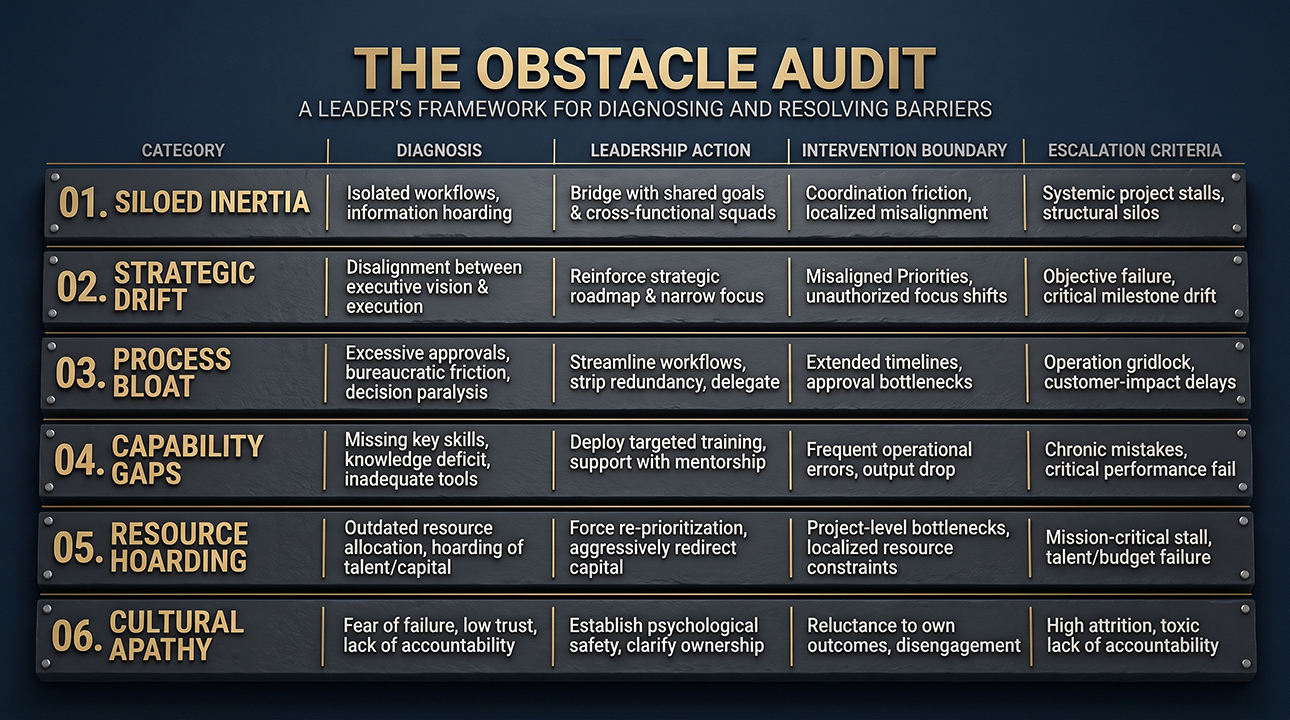 Figure 1. The Obstacle Audit: Servant leadership is not a vague promise to "help". It is the disciplined identification and removal of specific organizational friction. Use this diagnostic matrix to determine exactly which obstacles require your executive intervention, and which ones the team must learn to navigate independently.
Step 1: Identify the Real Obstacle
Ask: “What is blocking meaningful progress, and what evidence shows that it requires leadership intervention?” Distinguish genuine organizational barriers from problems the team can solve independently.
Step 2: Classify the Intervention
Decide whether the obstacle requires coaching, a decision, resources, cross-functional coordination, escalation, or protection from unnecessary work. Name the intervention rather than promising vaguely to help.
Step 3: Establish Mutual Commitments
Clarify what you will do and what the team continues to own. For example: “I will resolve the approval conflict by Friday. You will complete the revised technical plan and identify any remaining delivery risks.” Service should clarify accountability, not transfer all accountability upward.
Step 4: Remove Friction Without Hiding Reality
Challenge unnecessary meetings, duplicate reports, conflicting priorities, and slow approvals. Do not conceal material risks, withhold legitimate information, or prevent stakeholders from understanding reality. Protection should improve execution, not manufacture comfort.
Step 5: Review Growth and System Learning
After the issue is resolved, ask: Did my intervention build capability or dependency? Which obstacle should be permanently removed? What should the team handle independently next time? Were standards maintained? What learning should be built into the system?
The best servant-leadership intervention makes the next intervention less necessary.
A Final Thought for the Adaptive Leader
Servant leadership is not about abdicating authority or seeking your team's approval. It is about deploying your executive power where it matters most: absorbing organizational friction, clearing operational roadblocks, and creating an environment where talented professionals can execute without unnecessary fear.
When you use authority to remove legitimate barriers, clarify expectations, and support people’s growth, you create the conditions for trust and strong performance. High support should be matched by clear accountability. Service is not surrendering executive authority. It is the disciplined use of that authority to grow people and advance the mission.
This week, ask your team: “What is one obstacle preventing meaningful progress, and which part genuinely requires my intervention?”
Remove what only you can remove. Coach people through what they can learn to overcome. Protect their ability to perform, but never protect them from the accountability required to grow.
References
- Bass, B. M., & Avolio, B. J. (1994). Improving organizational effectiveness through transformational leadership. SAGE Publications.
- Canavesi, A., & Minelli, E. (2022). Servant leadership: A systematic literature review and network analysis. Employee Responsibilities and Rights Journal, 34, 267–289.
- Edmondson, A. C. (1999). Psychological safety and learning behavior in work teams. Administrative Science Quarterly, 44(2), 350–383.
- Graen, G. B., & Uhl-Bien, M. (1995). Relationship-based approach to leadership: Development of leader-member exchange (LMX) theory. The Leadership Quarterly, 6(2), 219–247.
- Greenleaf, R. K. (1970). The servant as leader. Center for Applied Research.
- Hersey, P., & Blanchard, K. H. (1988). Management of organizational behavior: Utilizing human resources (5th ed.). Prentice Hall.
- Lu, J., Falahat, M., & Cheah, P. K. (2024). A systematic literature review on the relationship between servant leadership and its team- and organizational-level outcomes. Journal of Organizational Change Management, 37(2), 255–282.
- Southwest Airlines. (2021). A shining light in the darkest of hours: Southwest and 9/11.
- Southwest Airlines. (2025). Southwest Airlines announces reduction in corporate overhead workforce.