
The Transparency Paradox: Enforcing Candor Without Eroding Morale
Nov 08, 2026
Many well-intentioned managers confuse visibility with trust. Believing that more monitoring, continuous dashboards, and radical openness automatically drive better performance, they subject their teams to relentless scrutiny.
Ironically, excessive oversight produces the exact opposite of its intended effect. When executives judge every minor mistake or raw idea too early, employees stop experimenting, withhold critical bad news, and manage appearances rather than operational reality.
The empirical consequences of surveillance-driven management are starkly reflected across modern corporate research. Gallup data indicate that organizations fail to select the right managerial talent 82% of the time. According to a longitudinal study by Leadership IQ, 46% of newly hired leaders fail within 18 months—and 89% of those failures stem from behavioral and emotional misalignments, such as handling mistakes with punitive judgment instead of fostering psychological safety, rather than technical incompetence.
Furthermore, a joint study by the Harvard Business Review and Brigham Young University finds that an alarming 58% of corporate employees trust complete strangers more than their own bosses. Research published in the MIT Sloan Management Review shows that a toxic corporate culture—driven by continuous scrutiny, fear of exposure, and public blame—is 10.4 times more likely to drive employee attrition than compensation, making it the primary catalyst for modern turnover.
Additional data from the Project Management Institute shows that 50% of strategic transformation projects fail outright or deliver only partial results, while Gallup's 2025 Global Workplace Report estimates that manager disengagement and execution disconnects cost $438 billion annually in lost productivity. On the frontline, disengagement drains roughly 34% of annual employee salaries—about $1 million in wasted capacity each year for an average 50-person team.
Conversely, research from Gallup and Harvard Business School shows that genuine psychological safety reduces turnover by 27%, safety incidents by 40%, and preventable operational errors by 15%, while increasing baseline productivity by 12% because team members surface mistakes early and solve them systemically.
Observability vs. Psychological Safety: Two Corporate Realities
To understand how visibility can destroy performance, consider a landmark field study Harvard Business School professor Ethan Bernstein conducted at one of the world's largest mobile phone manufacturing plants in China.
The plant was meticulously engineered around transparency: floor managers could always see assembly line workers to enforce strict compliance with Standard Operating Procedures (SOPs). Counterintuitively, Bernstein discovered that intense, continuous observability reduced worker productivity. Because workers were constantly watched, they altered their behavior defensively—strictly following official, highly inefficient corporate manuals whenever management was looking to avoid reprimand.
When management was out of sight, workers utilized highly innovative, unauthorized workarounds, what Bernstein termed 'productive deviance', that significantly boosted manufacturing efficiency. Total transparency kept management from learning about these localized frontline innovations because workers feared being penalized for deviating from official protocols. Bernstein solved this by creating 'Zones of Privacy', structural boundaries where teams could experiment and work without constant executive scrutiny, which significantly and sustainably improved line performance.
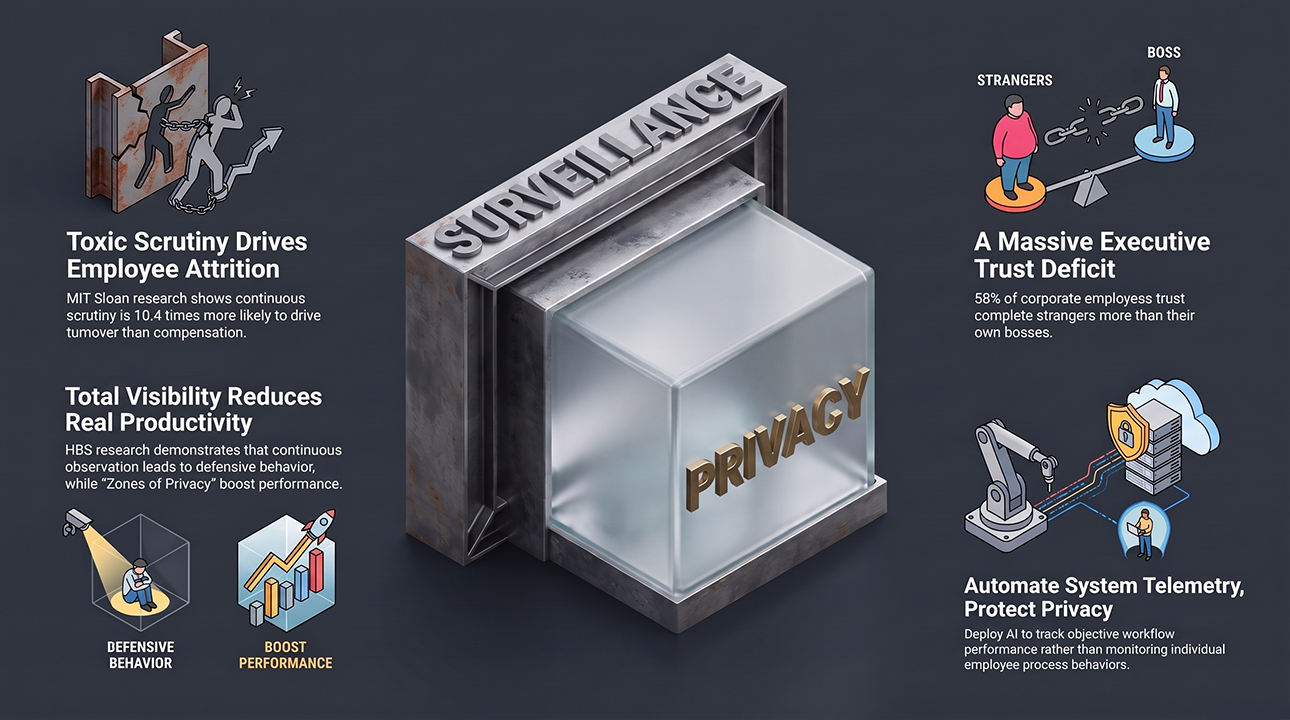 Figure 1. The Cost of Surveillance: Total visibility does not create total accountability. Research from Harvard Business School and MIT Sloan shows that removing zones of privacy forces employees into defensive posturing, metric gaming, and performative compliance, ultimately destroying the very performance transparency it was meant to enhance.
This dynamic is further illustrated by contrasting Netflix's culture of Radical Candor with Alan Mulally's turnaround at Ford Motor Company. While Netflix enforces continuous 360-degree feedback loops that can induce evaluation anxiety under a 'pro sports team' philosophy, Mulally built true transparency at Ford by making it safe to tell the truth.
In 2006, facing over $17 billion in losses, Mulally instituted a weekly Business Plan Review (BPR) using Red, Yellow, and Green status reporting. When executive Mark Fields presented a Red slide for a critical vehicle launch failure, Mulally applauded, declaring: 'The problem is red, but Mark is not red.' By decoupling human dignity from operational failure, Mulally established true transparency, encouraging leaders to surface problems early and restore profitability without a government bailout.
Lessons from the Field: When Transparency Became Bureaucracy
During a major greenfield capital project, upper management faced enormous pressure to deliver. For many of the leaders involved, it was their first experience working on a project of that scale and complexity. Their concern was genuine. They wanted the project to succeed and wanted to avoid failure. But their anxiety gradually manifested itself in a very specific way.
Leadership responded by demanding increasingly elaborate governance controls: more meetings, more dashboards, more reporting, more reviews, and more visibility. The underlying belief was simple: 'If we can see everything, we can control everything.'
The outcome was exactly the opposite. Project managers became overwhelmed by administrative overhead. Decision-making slowed, execution suffered, and morale deteriorated significantly. Many members of the project management team regularly expressed exhaustion and frustration.
I have always preferred environments built on trust, healthy transparency, and open communication. Throughout my career, nobody on my team has ever hidden a major issue, risk, or problem from me. Because of that belief, I repeatedly pushed back against what I viewed as excessive governance and unnecessary transparency requirements. I refused to force my teams to do reporting that added little value, absorbed the pressure myself, and shielded the team wherever possible.
Eventually, I left the project. Leadership concluded that my resistance to the additional reporting and governance requirements was part of the problem. They brought in a replacement who accepted those demands without challenge.
Nothing improved. The excessive governance remained. The pressure remained. The morale problems remained. The project continued experiencing delays. Removing the person who challenged the system did not fix the system.
The problem was never a lack of visibility; the problem was leadership anxiety. More transparency did not create more control; it created more fear, more bureaucracy, more reporting, and less execution. I learned that transparency is valuable only when it helps people solve problems. When transparency becomes surveillance or performance theater, people stop focusing on the work and start focusing on managing appearances. Real transparency requires trust. Without trust, visibility becomes noise.
Behavioral Scaffolding for Genuine Candor
To resolve the Transparency Paradox, adaptive leaders ground their practice in established organizational psychology:
Amy Edmondson's Psychological Safety Model:
Distinguishes between the Anxiety Zone (Low Safety / High Accountability), where surveillance drives fear and metric gaming, and the Learning Zone (High Safety / High Accountability), where teams surface risks early and engage in blame-free problem solving.
Ethan Bernstein's Zones of Privacy & Productive Deviance:
Teaches leaders to protect the drafting and testing phases from premature scrutiny, while actively surfacing and codifying frontline operational workarounds.
Hersey-Blanchard Situational Leadership:
Modulates supervision based on task maturity—applying directive control (S1/S2) during acute operational crises, while granting execution privacy and autonomy (S3/S4) to mature experts.
Daniel Goleman's Emotional Intelligence Styles:
Requires rotating from Affiliative and Coaching styles during post-mortems—validating human dignity—to Pacesetting styles when fixing broken processes.
FRLM & LMX Theory:
The Full Range Leadership Model (FRLM) establishes that a stable Transactional Floor of clear rules and blame-free protocols must precede a Transformational Ceiling. Leader-Member Exchange (LMX) Theory suggests that high-trust relationships make it safer to communicate hard truths.
Beyond the Hype: Objective Telemetry Over Process Policing
In today's corporate environment, organizations are increasingly deploying code scanners, process-monitoring bots, and AI 'process police' that flag and log every employee mistake or delay in real time.
Here is the Agentic Reality Check: Using AI as a digital surveillance tool creates a culture of fear, where employees spend energy hiding critical failures, gaming the algorithm, or engaging in performative compliance. AI cannot distinguish between careless negligence, genuine experimentation, and productive deviance. Dropping automated surveillance onto broken processes merely digitizes organizational fear.
The true future of AI lies in deploying Agentic AI to support blame-free post-mortems. Agentic systems can collect objective workflow data, trace system timelines, and help identify root-cause process breakdowns. By removing human finger-pointing, AI transforms execution failures into structural process improvements, freeing human managers to focus on psychological safety, coaching, and trust-building.
The Blame-Free Post-Mortem & Privacy Playbook
To translate this philosophy into daily operational practice, implement the following 5-step playbook:
Step 1: Engineer 'Zones of Privacy'
Ring-fence drafting, ideation, and initial testing from premature executive scrutiny. Let teams iterate in protected environments to avoid performative compliance.
Step 2: Trigger Blame-Free Post-Mortems
When an operational failure occurs, immediately reframe the discussion: 'The process failed, not the person.' Decouple human dignity from operational breakdowns.
Step 3: Execute Telemetry 5-Why Analysis
Use objective system logs and project telemetry to trace root causes back to broken handoffs, ambiguous criteria, or resource gaps rather than personal fault.
Step 4: Codify Productive Deviance
Actively ask frontline staff: 'What unofficial workarounds did you create to get this job done?' Convert the best unauthorized shortcuts into official company SOPs.
Step 5: Enforce Blame-Free Reporting
Institute a weekly review where you publicly recognize and reward early flagging of operational 'Red' risks, turning transparency into a sustainable competitive advantage.
Always guide your decision-making with the Golden Rule of Transparency: Maximize transparency for systems, decisions, risks, data, and outcomes; protect privacy for experimentation, learning, mistakes, and personal growth.
A Final Thought for the Adaptive Leader
Transparency is not a tool for control; it is a mechanism for alignment and learning.
Visibility without trust creates fear and performance theater. Privacy without accountability creates complacency.
The most effective leaders do not monitor every move. They build protected zones for experimentation, establish psychological safety for early risk escalation, and focus more on fixing broken systems than on blaming people.
This week, audit your team's reporting tools. Identify one area where excessive monitoring is driving defensive behavior, create a Zone of Privacy, and let your team build.
The problem may be red. But the person is not.
References
- Sull, D., Homkes, R., & Sull, C. (2015). Why strategy execution unravels. Harvard Business Review, 93(3), 58–66.
- Leadership IQ. (2024). Why new hires fail: 18-month longitudinal leadership study. Leadership IQ Press.
- Gallup. (2025). State of the global workplace: 2025 report. Gallup Press.
- Bernstein, E. S. (2012). The transparency paradox: The hidden costs of the open workplace. Administrative Science Quarterly, 57(2), 181–216.
- Edmondson, A. C. (1999). Psychological safety and learning behavior in work teams. Administrative Science Quarterly, 44(2), 350–383.
- Hersey, P., & Blanchard, K. H. (1988). Management of organizational behavior: Utilizing human resources (5th ed.). Prentice Hall.
- Graen, G. B., & Uhl-Bien, M. (1995). Relationship-based approach to leadership: Development of leader-member exchange (LMX) theory. The Leadership Quarterly, 6(2), 219–247.
- Bass, B. M., & Avolio, B. J. (1994). Improving organizational effectiveness through transformational leadership. SAGE Publications.