
The Vision vs. Execution Paradox: The Architect and the Builder
Nov 08, 2026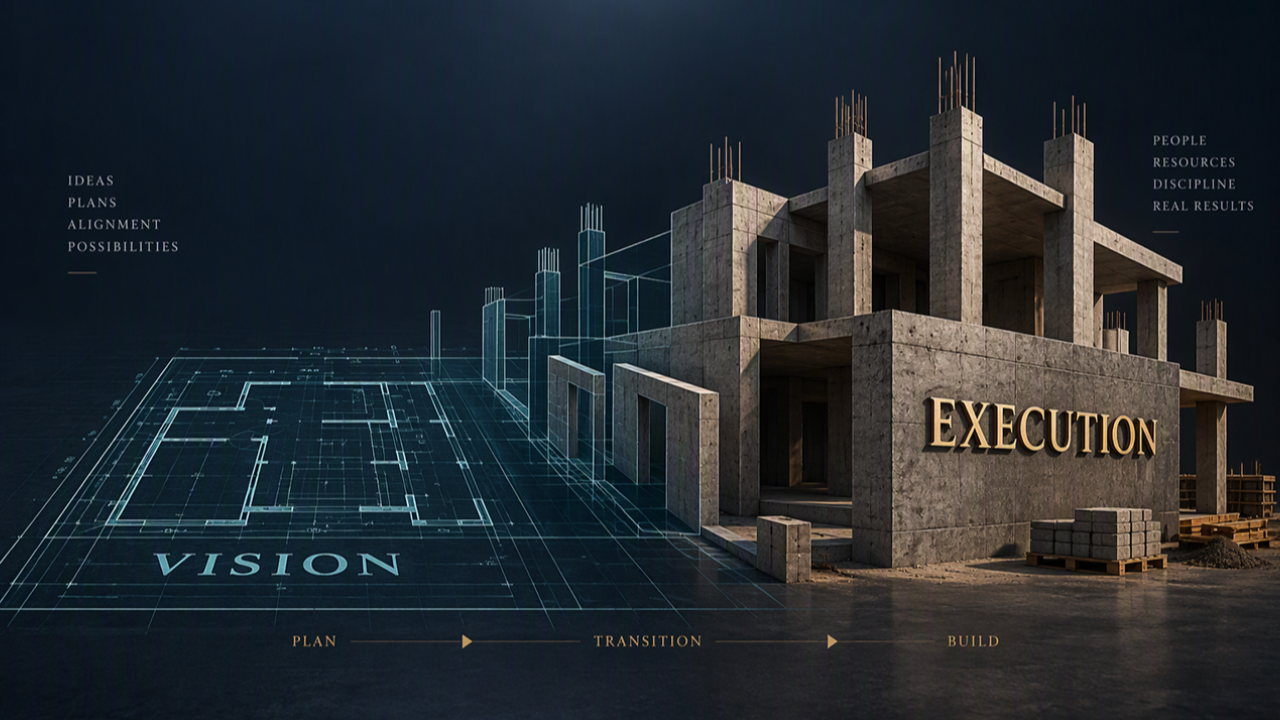
The transition from a high-performing technical contributor to a strategic leader is one of the most demanding shifts in a manager’s career. Early in our careers, we often celebrate the visionary executive who can stand before a board and paint a compelling picture of the future.
Yet, as mid-level managers, we soon face a harder reality: organizations are full of promising ideas that never progress beyond the planning stage. The problem is rarely ambition alone. More often, organizations struggle to translate that ambition into coordinated, sustained execution.
This persistent gap points to a foundational tension in modern organizational life: leadership creates the future, while management operationalizes it.
I describe this dynamic as the tension between the Architect and the Builder.
A common career trap emerges when ambitious mid-level managers begin to undervalue the unglamorous mechanics of daily management, while senior executives become increasingly removed from the practical friction of execution. Great organizations cannot survive on vision alone, nor can they endure on pure operational routine. Sustainable success requires balancing both.
When Brilliant Roadmaps Meet Operational Friction
To understand how this paradox can play out at the mid-level, consider a representative scenario I call “The Cloud Migration Trap.” A newly promoted IT manager receives executive praise for proposing an ambitious cloud-transformation roadmap. The strategy is persuasive, the projected return is attractive, and senior leadership approves the initiative.
Six months later, the initiative has stalled. Why? Because the architectural vision never matched an effective execution system. The team did not map cross-functional dependencies, frontline support teams lacked practical training, security and compliance requirements were not integrated into the delivery plan, and operational ownership remained unclear. The manager had acted purely as an Architect, assuming the building would construct itself.
At the corporate level, Eastman Kodak and Fujifilm's contrasting experiences illustrate the same paradox.
Eastman Kodak: The Fractured Decision Stack
Kodak did not fail because it lacked foresight. In fact, Kodak invented the first digital camera in 1975 and held the number-one digital camera market share in the United States as late as 2005.
However, Kodak’s executive leadership suffered from a fractured “Decision Stack.” Their overarching vision remained defensively anchored to preserving high-margin analog film operations (which historically yielded gross margins near 70%). Instead of executing a true digital operating model, they forced new technology into legacy channels—deploying 10,000 physical photo kiosks to mimic film printing. Kodak compromised its execution to protect short-term quarterly earnings, eventually accumulating $349 million in digital division losses and filing for a $6.75 billion bankruptcy in 2012.
Fujifilm: The Disciplined Builder
Conversely, under CEO Shigetaka Komori, Fujifilm navigated the vision-versus-execution paradox.
When Komori took the helm in the early 2000s, he launched “VISION 75,” an existential transformation plan that explicitly accepted the obsolescence of traditional film.
Komori did not stop at declaring a bold vision; he also took on the less celebrated role of a disciplined operational Builder. Fujifilm conducted an exhaustive internal audit of its core scientific capabilities, isolating 70 transferable silver-halide technologies—such as precision coating, anti-oxidation, and collagen preservation. Komori then confronted the difficult execution work of restructuring legacy operations, retraining employees, and redeploying technical capabilities into new sectors, including healthcare, cosmetics, and flat-panel displays.
Vision pointed to the destination. Execution built the road.
Discovering My Own Default Settings
I joined Shell relatively young in a mid-level management role supporting a joint venture. In an organization that invested heavily in leadership development and succession planning, I learned early that great leadership requires both vision and execution.
Over the next eighteen years, I had the privilege of working directly with exceptional leaders. Some were highly charismatic visionaries who could paint a compelling picture of the future and inspire people to follow them. Others were outstanding executors who could translate strategy into action, navigate complexity, and consistently deliver results.
What I discovered, however, was that leaders who excelled equally on both sides of the equation were surprisingly rare. Even among very successful leaders, there was almost always a natural preference.
Some were energized by strategy, transformation, and long-term thinking. Others were most comfortable in the mechanics of execution, governance, delivery, and operational discipline.
The Core Realization: This observation led me to an important realization: The Vision vs. Execution Paradox is not only an organizational challenge; it is deeply personal. Most of us have a natural comfort zone. Some naturally lean toward the Architect. Others naturally lean toward the Builder. Few begin their careers equally comfortable in both roles.
The danger is that we tend to overinvest in the activities we enjoy and underinvest in those that require more effort. Visionaries can become detached from operational reality, while executors can become trapped in present demands and neglect the future.
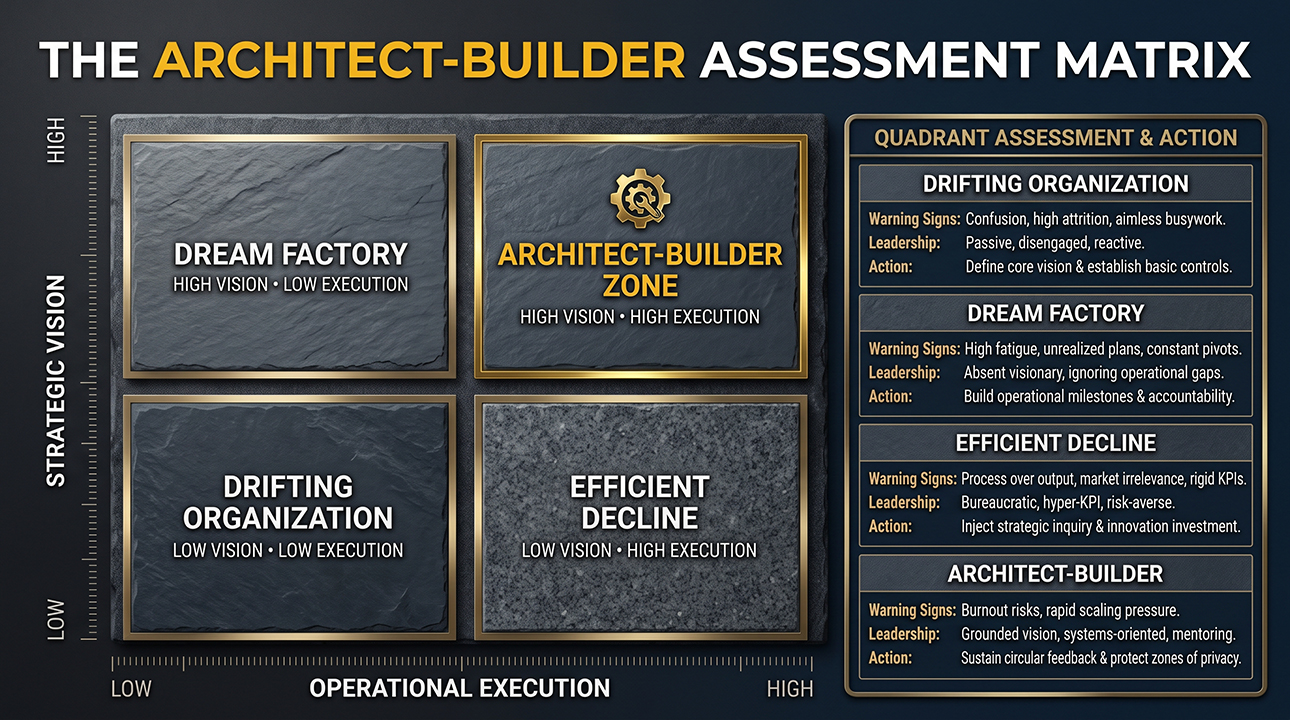 Figure 1. The Architect-Builder Matrix: Sustainable success requires balancing strategic design with operational delivery. Over-indexing on the Architect creates a 'Dream Factory' of unrealized plans, while over-indexing on the Builder leads to an 'Efficient Decline.' The adaptive leader must actively develop both capabilities to reach the optimal performance zone.
That is why self-awareness matters far more than most management books suggest. The goal is not to change your fundamental personality, but to identify your default settings. Once you understand those defaults, the real work begins. Leadership growth comes from deliberately strengthening capabilities that do not come naturally. The Architect must learn how to build, and the Builder must learn how to design.
Grounding the Paradox in Organizational Psychology
To resolve this tension, adaptive leaders must move beyond simplistic management advice and anchor their practice in established behavioral frameworks.
1. Hersey-Blanchard Situational Leadership
This framework argues that no single “best” leadership style exists. Effective management requires adjusting your behavior based on your team's task maturity and readiness. When leading a team through a high-risk operational shift, S1 (Directing) and S2 (Coaching) may be more appropriate when people need greater clarity, instruction, or support. As team competence, confidence, and autonomy grow, the leader can gradually shift toward S3 (Supporting) and S4 (Delegating).
2. Leader-Member Exchange (LMX) Theory
LMX Theory highlights the quality of the interpersonal relationship between a manager and each team member. Architects often rely on high-level positional authority, assuming an overarching vision will automatically motivate everyone. LMX Theory suggests that the quality of a leader's relationship with each team member can influence trust, commitment, and access to support. In practice, this means understanding what each person needs to contribute effectively while maintaining fair expectations and consistent standards across the team.
3. Full Range Leadership Model (FRLM) & Organizational Ambidexterity
The Full Range Leadership Model (FRLM) helps explain how effective leaders combine transactional discipline with transformational leadership:
The Transactional Floor: Built on clear roles, measurable Key Performance Indicators (KPIs), standard operating procedures, and Contingent Reward, which means clarifying expectations and linking agreed performance to appropriate recognition or reward. Without this foundation, inspirational vision can lose credibility because people cannot see how it will translate into action.
The Transformational Ceiling: Built on Inspirational Motivation and Intellectual Stimulation, which encourage innovation and discretionary effort.
This dual structure reflects Organizational Ambidexterity—the capacity to balance two distinct operational behaviors simultaneously:
Organizational Ambidexterity = Opening Behaviors + Closing Behaviors
Opening Behaviors: Experimentation, challenging status quo assumptions, and exploring unproven opportunities.
Closing Behaviors: Governance, strict milestone tracking, budget discipline, and variance reduction.
The Guiding Maxim: Innovation without control creates chaos. Control without innovation creates irrelevance.
Beyond the Hype: Automating the Builder
In today's corporate landscape, managers are increasingly turning to Generative AI tools to draft transformation proposals, strategic roadmaps, and executive presentations.
The Agentic Reality Check: Generative AI can produce a polished strategic outline remarkably quickly, but generating a document is not the same as executing a strategy. AI can support analysis and communication, but it cannot assume a leader’s accountability for navigating organizational politics, building trust, resolving cross-functional friction, or conducting difficult performance conversations. Dropping AI onto broken human processes merely digitizes existing chaos. If operational ownership is unclear, AI may simply automate confusion and amplify its cost.
A more credible opportunity lies in using Agentic AI as an operational support layer for the Builder. Properly governed agentic systems may increasingly help teams track project dependencies, monitor performance data, propose risk-register updates, and flag potential delivery bottlenecks for human review.
By delegating appropriate administrative tracking and data collection to AI agents, leaders may recover time for higher-value work. This gives managers more capacity to act as strategic Architects while staying accountable for execution, human alignment, psychological safety, and the judgment required when circumstances change.
The Compromise Playbook: The Architect-Builder Audit
To turn this philosophy into daily practice, implement a structured, repeatable operational cadence. The following 5-step audit is designed to help you balance your leadership portfolio:
Step 1: Run the 70/30 Calendar Audit
Audit your calendar over the previous four weeks. Categorize each meaningful block of time as either Current Delivery, covering execution and immediate commitments, or Future Capacity, covering strategy, experimentation, capability building, and stakeholder alignment.
Use the 70/30 split as a diagnostic starting point rather than a universal rule. If current delivery consistently consumes almost all available leadership attention, identify meetings you can shorten, delegate, combine, or remove. Then protect a realistic, recurring block of time for future-focused work.
Step 2: Map and Eliminate Orphaned Activities
Review your active project roadmaps and flag any task that lacks a clear operational home. “Orphaned activities” (such as post-implementation documentation or cross-departmental handoffs) are where strategic vision quietly breaks down.
Step 3: Assign One Accountable Owner
For every critical milestone or orphaned activity, assign one Directly Responsible Individual (DRI), meaning the person accountable for coordinating the work and driving it to completion. Multiple people may contribute, but the accountable owner should never be ambiguous. Record the owner, expected outcome, target date, and escalation route in the project plan.
Step 4: Create a Visible Execution Dashboard
Create one concise dashboard showing the next major milestones, accountable owners, target dates, current status, material risks, blocked decisions, and required support. Use the simplest available project tool. The purpose is not to create more reporting; it is to make the few issues requiring leadership attention unmistakably visible.
Step 5: Establish a Weekly Execution Review
Establish a short weekly execution review with the people responsible for the priority initiatives. Keep it focused on five questions:
- What was completed since the previous review?
- What is behind schedule or at risk?
- Which decisions remain unresolved?
- Who owns each next action, and by when?
- What support or escalation is required?
End the review by recording each decision, action owner, and target date. At the next review, begin with those commitments before discussing new issues. This simple discipline closes the loop between conversation and execution.
A Final Thought for the Adaptive Leader
Leadership is not about choosing between vision and execution. It is about maintaining a healthy, intentional tension between them.
The Architect imagines what could be. The Builder turns that possibility into coordinated action. Most leadership failures occur when an organization over-indexes on one at the expense of the other.
This week, take a thoughtful look at your calendar, active projects, and leadership habits. You do not need to become equally comfortable in every leadership mode overnight. You do need to recognize your default, build complementary habits, and invite people around you who strengthen the side that comes less naturally. Then ask yourself one honest question:
The Reflection: Where does your leadership need greater attention today: designing a clearer future or building the execution system required to reach it?
References
- Sull, D., Homkes, R., & Sull, C. (2015). Why strategy execution unravels. Harvard Business Review, 93(3), 58–66.
- Project Management Institute. (2025). Step Up: Redefining the Path to Project Success with M.O.R.E.
- Gallup. (2025). State of the Global Workplace: 2025 Report.
- Hersey, P., & Blanchard, K. H. (1988). Management of Organizational Behavior: Utilizing Human Resources (5th ed.). Prentice Hall.
- Graen, G. B., & Uhl-Bien, M. (1995). Relationship-based approach to leadership: Development of leader-member exchange (LMX) theory. The Leadership Quarterly, 6(2), 219–247.
- Bass, B. M., & Avolio, B. J. (1994). Improving organizational effectiveness through transformational leadership. SAGE Publications.
- Rosing, K., Frese, M., & Bausch, A. (2011). Explaining the twin dilemma: Ambidextrous leadership and innovation. The Leadership Quarterly, 22(4), 656–674.
- Komori, S. (2015). Innovating out of crisis: How Fujifilm survived (and thrived) as its core business was vanishing. Stone Bridge Press.