
The Vulnerability Paradox: Sharing Weakness While Projecting Strength
Nov 08, 2026
The Peril of Performative Vulnerability
Many managers believe leadership requires complete certainty. They hide doubts, avoid admitting mistakes, and resist acknowledging limitations for fear of losing authority.
Others move in the opposite direction. They share anxiety before they have processed it, disclose personal struggles without considering the audience, and unintentionally ask their teams to carry emotional burdens that belong elsewhere.
Both approaches can weaken trust. One feels artificial. The other can feel destabilizing.
This is the Vulnerability Paradox: People do not need a leader who pretends to be invincible. They also shouldn't have to emotionally support the person responsible for supporting them.
The leadership challenge is not choosing between strength and vulnerability. It is learning to practice both responsibly.
Effective vulnerability acknowledges mistakes, uncertainty, and human limitations while preserving the clarity, judgment, and support the team needs to move forward.
Inverting the Support Matrix: The Crying CEO Incident
In August 2022, Braden Wallake, CEO of HyperSocial, posted a tearful photograph on LinkedIn after laying off several employees.
In the post, he accepted responsibility for a decision that contributed to the layoffs and said he wanted people to understand that not every CEO was cold-hearted. The public response was divided.
Critics described the post as self-focused and argued that attention should have remained on the people who lost their jobs. Others defended Braden Wallake’s humanity, including a former employee who spoke positively about working for him. Braden Wallake later apologized for making the situation appear centered on himself and attempted to use the attention to connect job seekers with employers.
The useful lesson is not that leaders should never cry. Nor should the episode be used to diagnose Braden Wallake’s character or intentions. The leadership lesson concerns where attention moves after a disclosure.
A layoff creates an unequal burden. The departing employee loses income, security, routine, and a sense of belonging. The leader may feel guilt and grief, but still retains greater control over the situation.
When the leader’s feelings become the public focus, affected employees may be pushed into the background.
That is the boundary vulnerability must respect: A leader may acknowledge a decision's emotional weight without asking the people most affected to validate the leader.
The disclosure should direct attention toward responsibility, support, and what happens next.
Lessons from the Field: Navigating Constant Turbulence and the Dual Duty of Care
Over my 18 years at Shell, I learned firsthand that true leadership is never about pretending to have all the answers. From my early career through leading major programs, I stayed open about my strengths, limitations, and areas for development. I never shied away from taking full accountability, experimenting, or taking calculated risks—and I communicated this openly with both my teams and my superiors from day one in any new role.
I share my strengths and areas for development transparently, and I explicitly ask my team and leaders to remind me, hold me accountable, and challenge me openly and respectfully when necessary. In turn, I encourage every team member to do the same, sharing their own strengths and growth areas within a secure, psychologically safe environment.
In a global enterprise, organizational turbulence is a recurring reality. Oil-price changes, strategic shifts, restructurings, and leadership transitions can create uncertainty even for experienced managers. These cycles taught me profound lessons about vulnerability. At times, I was the individual directly impacted, needing support and reassurance myself. At other times, I was the executive accountable for holding my team's hands and guiding them through the storm.
More often than not, as a senior leader, you experience both at the same time: feeling the pressure and uncertainty yourself while also serving as the steady anchor for your people. That is one of the hardest realities of senior leadership: you may be experiencing the storm personally while being responsible for helping others navigate it professionally. You learn that taking care of your team requires you to first take care of yourself, balancing authentic human vulnerability with the executive strength needed to lead through uncertainty.
Behavioral Scaffolding for Bounded Vulnerability
To practice authentic vulnerability without undermining team confidence, adaptive leaders anchor their practice in established organizational psychology:
Amy Edmondson’s Psychological Safety Model: Psychological Safety is a shared belief that the team is safe for interpersonal risk-taking. In practice, people can ask questions, raise concerns, acknowledge mistakes, and challenge assumptions without fear of humiliation or punishment. Leaders contribute by admitting fallibility and creating space for others to speak. However, Psychological Safety does not mean lowering standards, abandoning accountability, or sharing every private emotion. The leader’s vulnerability should make honesty safer for the team. It should not make employees responsible for regulating the leader’s emotions.
Bounded Vulnerability: Honest disclosure with a clear leadership purpose. It means acknowledging a relevant limitation, mistake, or uncertainty while keeping private emotional processing within appropriate boundaries. Before sharing, leaders should ask:
- Is this information relevant to the team?
- Will sharing it help people understand, decide, or act?
- Am I asking employees to support the work, or to support me emotionally?
- Bounded Vulnerability is not robotic composure. It is selective honesty in service of the team.
The Full Range Leadership Model, or FRLM: Its transactional dimension provides clear roles, expectations, responsibilities, and decision boundaries. Its transformational dimension adds purpose, intellectual stimulation, development, and credible role modeling. In plain English, people can tolerate uncertainty more easily when they understand the process and know what happens next.
Leader-Member Exchange, or LMX, Theory: Focuses on the quality of the relationship between a leader and each team member. Strong relationships may make it easier for leaders to acknowledge limitations without losing credibility. Leaders must still apply standards consistently and avoid disclosing sensitive information only to a favored inner circle. Trust should improve communication, not create unequal access or emotional dependency.
Beyond the Hype: AI Can Rehearse the Conversation, Not Lead It
AI can help leaders prepare for difficult conversations. It cannot make the conversation authentic.
Tone-checkers may identify wording that sounds defensive, vague, or unnecessarily harsh. AI roleplay tools may also help leaders rehearse feedback, conflict, strategy changes, budget reductions, or other demanding workplace conversations.
But these systems have meaningful limitations.
They may not understand the team's full history, the power imbalance in the conversation, cultural differences, or the consequences of a particular disclosure.
A responsible use of AI is narrow:
- Rehearse possible wording
- Test whether the message is clear
- Identify defensive language
- Generate questions employees may ask
- Compare more and less direct versions
AI should not determine whether a disclosure is emotionally appropriate. It should not receive confidential employee, legal, medical, or restructuring information without approved safeguards. It should not deliver the message.
AI can help rehearse the conversation. The leader must still have it.
The Bounded Vulnerability Playbook
To translate bounded vulnerability into daily leadership mechanics, implement the following 5-step playbook:
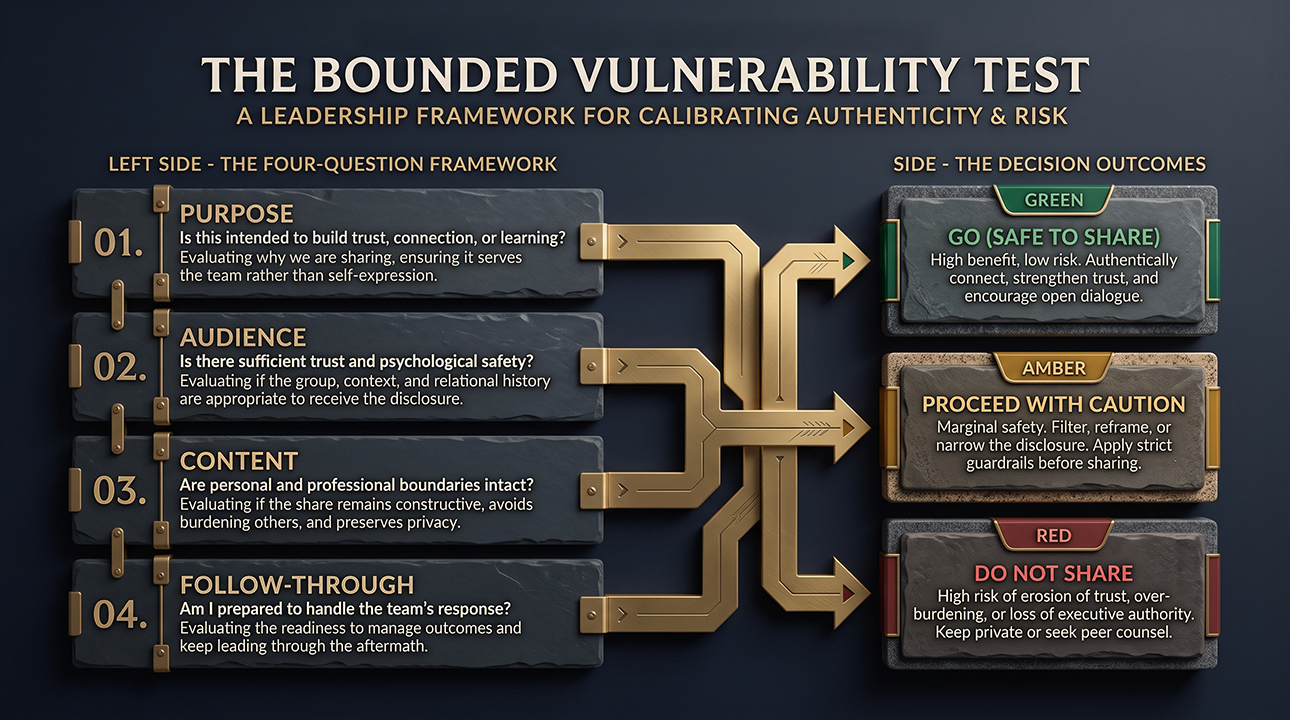 Figure 1. The Bounded Vulnerability Test: Executive vulnerability is a tactical tool, not a therapeutic release. Before disclosing uncertainty or personal challenges, leaders must run their intent through a rigorous filter to ensure the disclosure serves the team's operational capability rather than offloading the leader's own anxiety.
Step 1: Identify the Purpose
Ask:
- What does the team need to know?
- Why do people need to know it?
- What decision or action should this disclosure support?
- What belongs in a private support conversation instead?
If the disclosure serves no team purpose, pause.
Step 2: Choose the Right Processing Channel
Process unresolved distress with an appropriate peer, mentor, coach, counselor, trusted personal contact, or other suitable support resource. Do not use direct reports as your primary source of reassurance. This is a directional principle, not a prohibition on being human with your team.
Step 3: Pair Uncertainty With Process
Say: “I do not have the final answer because some information is still incomplete.”
Then add: “Here is what we know, what we are investigating, who owns the next step, and when I will update you.”
Do not manufacture certainty. Provide process clarity.
Step 4: Establish a Feedback Contract
Tell the team what respectful challenge looks like. For example: “I want you to tell me when I am overlooking a risk, contradicting a commitment, or closing down discussion too quickly.” Then demonstrate that disagreement does not trigger retaliation.
Step 5: Check the Impact
After the conversation, ask:
- Did the team receive the clarity it needed?
- Did my disclosure increase understanding or anxiety?
- Are responsibilities and next steps clear?
- Did I preserve everyone else’s privacy?
- Do I need additional personal support before the next conversation?
If using AI for rehearsal, remove confidential details and treat the output as practice input, not leadership judgment.
A Final Thought for the Adaptive Leader
Your team does not need a flawless leader. It needs a leader who can acknowledge reality without surrendering responsibility.
This week, identify one uncertainty you may be hiding behind an artificial display of confidence. Ask whether sharing it would help your team understand, decide, or act.
If it would, share what is relevant. Explain what remains unknown. Clarify how the answer will be found.
Then process your personal anxiety through an appropriate support channel.
Vulnerability should make truth easier to discuss. Strength should make the next step easier to trust.
The adaptive leader provides both.
References
- Bass, B. M., & Avolio, B. J. (1994). Improving organizational effectiveness through transformational leadership. SAGE Publications.
- Brito, C. (2022, August 11). U.S. CEO who posted crying selfie while announcing layoffs responds to backlash. CBS News.
- Edmondson, A. C. (1999). Psychological safety and learning behavior in work teams. Administrative Science Quarterly, 44(2), 350–383.
- Graen, G. B., & Uhl-Bien, M. (1995). Relationship-based approach to leadership: Development of leader-member exchange (LMX) theory. The Leadership Quarterly, 6(2), 219–247.
- Kiderlin, S. (2022, August 11). CEO posts crying selfie on LinkedIn after laying off employees, and it goes viral. CNBC.